DICOM PS3.3 2020a - Information Object Definitions |
Page 1221 |
C.8.30.3.1.3 Source Image Corneal Processed Data Sequence
The Source Image Corneal Processed Data Sequence (0046,0244) provides power, elevation and wavefront measurements taken at specific points of the Source Image. These Attributes were used to generate the corneal topography map and indices of this SOP Instance. This processed data can also be used to generate other corneal topography maps and indices.
C.8.30.3.1.4 Corneal Vertex Location
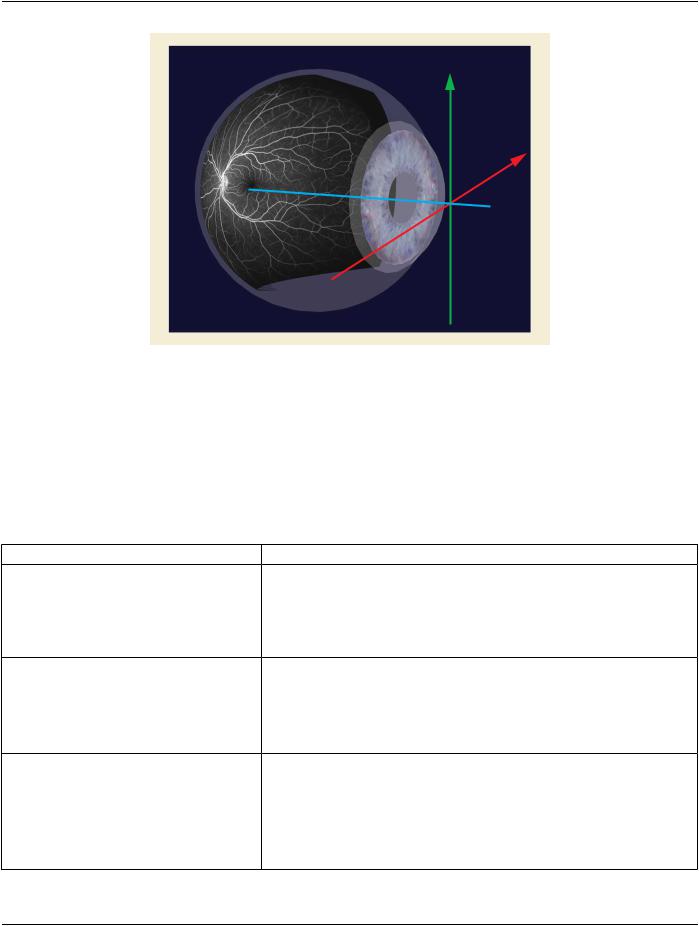
TheCornealVertexLocation(0046,0202)establishesthereferencepointforthecornealvertex,theoriginoftheOphthalmicCoordinate System.TheOphthalmicCoordinateSystemisusedastheFrameofReferencethatestablishesthespatialrelationshipforthecorneal vertex (i.e., used within corneal topography maps) for a set of Images within a Series. It also allows Images across multiple Series to share the same Frame Of Reference. The corneal vertex is the point located at the intersection of the patient's line of sight (visual axis) and the corneal surface. It is represented by the corneal light reflex when the cornea is illuminated coaxially with fixation.
Note
Since the criteria used to group images into a Series is application specific, it is possible for imaging applications to define multiple Series within a Study that share the same imaging space. Therefore the images with the same Frame of Reference UID (0020,0052) Attribute value share the same corneal vertex location within the patient's eye.
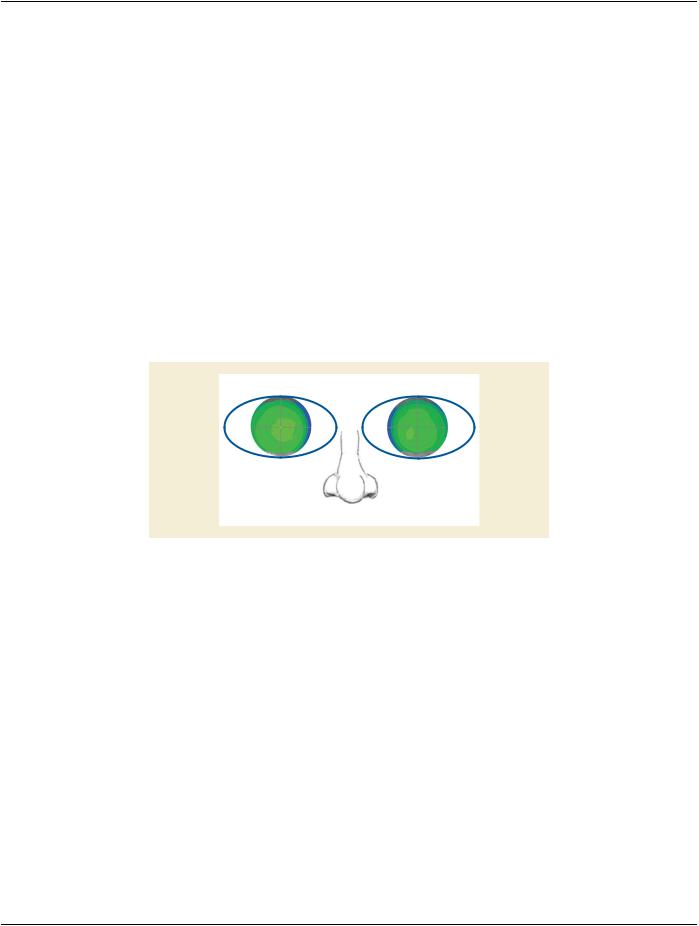
Figure C.8.30.3.1-3 illustrates the representation of corneal topography. The corneal vertex lies at the center of the rulers. Typical circular grids are 3, 5, 7, and 9 mm diameters centered on the vertex. The annotations in Figure C.8.30.3.1-3 are R, right; L, left; H = Head; F = Foot.
H H
R L R L
F F
R L
Figure C.8.30.3.1-3. Representation of Corneal Topography
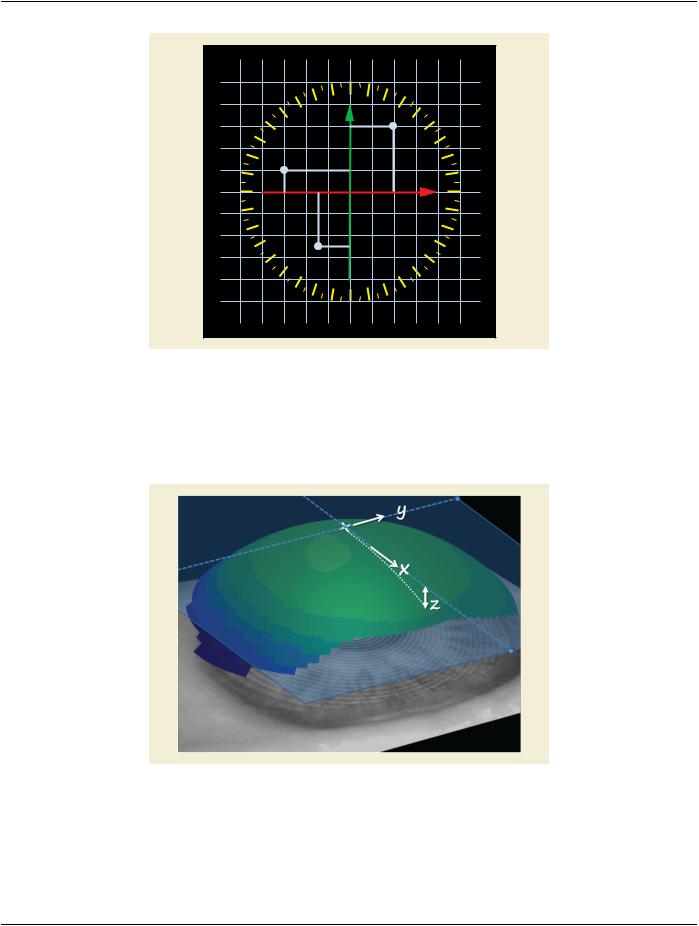
Numerical position data shall use the Cartesian (i.e., two dimensional rectangular) coordinate system. The direction of the axes are determined by Patient Orientation (0020,0020), see Section C.7.6.1.1.1 for further explanation.
Devices that internally capture data in polar coordinates will need to convert to Cartesian coordinates, see Figure C.8.30.3.1-4.
 Z
Z