Материал: part03

Внимание! Если размещение файла нарушает Ваши авторские права, то обязательно сообщите нам

Page 1216​

DICOM PS3.3 2020a - Information Object Definitions​

Attribute Name​

Tag​

Type​

Attribute Description​

Equivalent Pupil Radius​

(0046,0205)​

1C​

The average physical distance in mm from the pupil centroid specified in​


the Attributes Pupil Centroid X-Coordinate (0046,0203) and Pupil Centroid​


Y-Coordinate (0046,0204) to the measured perimeter of the pupil.​


Required if Attribute Corneal Topography Surface (0046,0201) is A​


(Anterior).​


Note​


When the pupil is not able to be determined the typical estimate​


is 4mm.​

Vertices of the Outline of​

(0046,0208)​

1C​

A set of row/column vertices that outline the perimeter of the pupil.​

Pupil​


Twoormorepairsofvaluesfollowandaretherowandcolumncoordinates​


of the other vertices that outline the perimeter of the pupil. For a two​


dimensionalcurve:X1,Y1,X2,Y2,etc.Thefirst(X)dimensioncorresponds​


to the image column (horizontal offset), and the second (Y) dimension​


corresponds to the image row (vertical offset). This is a Polyline and the​


points are to be interpreted as an n-tuple list of end points between which​


straight lines are to be drawn.​


Required if Attribute Corneal Topography Surface (0046,0201) is A​


(Anterior).​

Include Table C.8.25.10-2 “Keratometric Measurements​

Macro Attributes”​


Minimum Keratometric​

(0046,0215)​

1​

A Sequence that specifies the lowest power obtained when averaging​

Sequence​


individual meridian.​


Only one Item shall be permitted.​


Note​


The measurement is typically taken at 3-4 mm from the corneal​


vertex.​

>Radius of Curvature​

(0046,0075)​

1​

The radius of curvature of the principal meridian of the cornea, measured​


in mm.​

>Keratometric Power​

(0046,0076)​

1​

The refractive power of the cornea at the principal meridian, measured in​


diopters.​

>Keratometric Axis​

(0046,0077)​

1​

The meridian where the keratometric radius of curvature or power is​


measured, measured in degrees.​

Simulated Keratometric​

(0046,0218)​

1​

A Sequence that specifies simulated keratometric cylinder power of the​

Cylinder Sequence​


corneal surface, measured in diopters.​


Only one Item shall be permitted.​


Note​


This information is obtained from the Steep and Flat Keratometric​


Axis readings.​

>Keratometric Power​

(0046,0076)​

1​

The refractive power of the cornea at the principal meridian, measured in​


diopters.​

>Keratometric Axis​

(0046,0077)​

1​

The meridian where the keratometric cylinder or power is measured,​


measured in degrees.​

- Standard -​


DICOM PS3.3 2020a - Information Object Definitions​

Page 1217​

Attribute Name​

Tag​

Type​

Attribute Description​


Average Corneal Power​

(0046,0220)​

1​ The area-corrected average of the corneal power ahead of the entrance​


pupil, measured in diopters.​


Note​


Itisgenerallyequaltothekeratometricsphericalequivalentexcept​


for decentered refractive surgical procedures. It is used in​


intraocular lens calculations.​


Corneal I-S Value​

(0046,0224)​

1​ Quantifiestheinferior-superiordioptricasymmetryalongtheverticalmeridian​


to discriminate Keratoconus, measured in diopters.​


Note​


1.​See Rabinowitz YS and McDonnell PJ. "Computer-assisted​


corneal topography in keratoconus. Refract Corneal Surg.​


1989 Nov-Dec;5(6):400-8".​


2.​If I-S > 1.4 D, the cornea may be classified as Keratoconus​


Suspect. If I-S > 1.9, enough asymmetry is present in the​


topography to classify the cornea as clinical Keratoconus.​

Analyzed Area​

(0046,0227)​

1​ The corneal surface area that can be analyzed, measured in mm squared.​

Maximum Corneal​

(0046,0211)​

3​ ASequencetoconveythemaximumcurvatureandlocationofthemeasured​

Curvature Sequence​


corneal topography. Only a single Item is permitted in this Sequence.​

>Maximum Corneal​

(0046,0212)​

1​ Maximum curvature in diopters of the measured corneal topography.​

Curvature​


>Maximum Corneal​

(0046,0213)​

1​ Location of the corneal maximum curvature.​


Curvature Location​


Givenascolumn\row.Columnisthehorizontaloffsetandrowisthevertical​


offset.​


Image relative position specified with sub-pixel resolution such that the​


origin at the Top Left Hand Corner (TLHC) of the TLHC pixel is 0.0\0.0, the​


Bottom Right Hand Corner (BRHC) of the TLHC pixel is 1.0\1.0, and the​


BRHC of the BRHC pixel is Columns\Rows (see Figure C.10.5-1). The​


values must be within the range 0\0 to Columns\Rows.​


Surface Regularity Index​

(0046,0230)​

3​ Measures local fluctuations in corneal power (i.e., irregular astigmatism)​


over the pupil (no units).​


Note​


This value would be about 0.4 for a cornea with good optical​


quality; at 1.5 and higher, vision falls below normal calculations.​

SurfaceAsymmetryIndex​

(0046,0232)​

3​ Thisindexsumsthemeridionalmire-to-mirepowerchangesovertheentire​


cornealsurface,increasingastopographicirregularitiesincrease(nounits).​

CornealEccentricityIndex​

(0046,0234)​

3​ Index used to measure the eccentricity of the cornea (no units).​

Keratoconus Prediction​

(0046,0236)​

3​ Index used to indicate the presence of Keratoconus (no units)​

Index​


Note​


It is obtained by discrete analysis of the corneal topographic data.​

(e.g., Invest Ophthalmol Vis Sci 35:2749-2757, 1994).​

- Standard -​

Page 1218​

DICOM PS3.3 2020a - Information Object Definitions​

Attribute Name​

Tag​

Type​

Attribute Description​

Decimal Potential Visual​

(0046,0238)​

3​

The range of best spectacle-corrected distance that might be expected​

Acuity​


from a functionally normal eye with the topographical characteristics of the​


analyzed cornea, measured in decimal.​


Note​


1.​Typicalexamples:referencestandardis1,severevisionloss​


is 0.1.​


2.​See Annex RR “Ophthalmic Refractive Reports Use Cases​


(Informative)” in PS3.17 for guidance in converting Decimal​


Potential Visual Acuity to other customarily used display​


notation such as 20/20 in the US and 6/6 in Britain.​

Corneal Topography Map​

(0046,0242)​

1C​

Identifies the quality of the topography examination.​

Quality Evaluation​


Enumerated Values:​


ACCEPTABLE​


MARGINAL​


NOT_ACCEPTABLE​


Required if a quality rating value exists for the corneal topography map​

Corneal Topography Map​

(0046,0207)​

1​

The type of corneal topography map encoded in this SOP Instance. It​

Type Code Sequence​


specifies the meaning of the pixel values.​


Only a single Item shall be included in this Sequence.​

>Include Table 8.8-1 “Code Sequence Macro Attributes”​DCID 4268 “Corneal Topography Map Value Type”​

Corneal Topography​

(0046,0210)​

1C​

Identifies the Externally Sourced Data Set used for corneal topography​

Mapping Normals​


mapping values from a normative data base. Required if a normative data​

Sequence​


base was used.​


Only a single Item shall be included in this Sequence.​

>Include Table 10-22 “Externally-Sourced Data Set​


Identification Macro Attributes”​


Source Image Sequence​

(0008,2112)​

1​

TheImageSOPClass/InstancepairoftheImagethatwasusedtogenerate​


this corneal topography map.​


Note​


Attribute Corneal Vertex Location (0046,0202) in this corneal​


topography map has been generated by the source image and​


provides the registration of the Corneal Topography Map to the​


Source Image.​


See Section C.8.30.3.1.2 for further explanation.​


Only a single Item shall be included in this Sequence.​

>Include Table 10-3 “Image SOP Instance Reference​


Macro Attributes”​


>Purpose of Reference​

(0040,A170)​

1​

Describes the purpose for which the reference is made, (i.e., the role the​

Code Sequence​


source image or frame(s) played in the generation of this image). Only a​


single Item shall be included in this Sequence.​

>>IncludeTable8.8-1“CodeSequenceMacroAttributes”​Thecodeusedshallbe(121322,DCM,"Sourceimageforimageprocessing​ operation").​

- Standard -​


DICOM PS3.3 2020a - Information Object Definitions​

Page 1219​

Attribute Name​

Tag​

Type​

Attribute Description​


Source Image Corneal​

(0046,0244)​

1​ Attributes that contain various power, elevation and wavefront​

Processed Data​


measurements at specific points on the cornea of the SOP Instance​

Sequence​


referencedinAttributeSourceImageSequence(0008,2112).TheAttributes​


are obtained from measurements of curvature or shape of the cornea. See​


Section C.8.30.3.1.3 for further explanation.​


One or more Items shall be present.​


>Corneal Point Location​

(0046,0247)​

1​ The x, y, and z coordinate of a point in the image within the cornea, in mm.​


Where the origin is conveyed by the Attribute Corneal Vertex Location​


(0046,0202).​


Note​


For two dimensional maps z=0.​


>Corneal Point Estimated​

(0046,0248)​

1​ The point defined in Attribute Corneal Point Location (0046,0247) is an​


estimated point (i.e., interpolated or extrapolated; not an actual measured​


point).​


Enumerated Values:​


Y​Yes​


N​No​


>Axial Power​

(0046,0249)​

1​ Conveys corneal shape characteristics, in diopters. It is determined from​


the curvature, r in mm, of the equivalent sphere with the same slope at a​


given point on the surface. Axial power = Km/r, where Km is the​


Keratometric Index.​


>Tangential Power​

(0046,0250)​

1​ Determined from the curvature (2nd derivative = d2y/dx2) of a point on the​


cornea,indiopters;alsocalledInstantaneousPower.Emphasizesirregular​


astigmatism (large variations in higher order aberrations).​


>Refractive Power​

(0046,0251)​

1​ Conveys the optical refraction properties of the cornea, in diopters. It is​


determinedfromraytracingusingSnell'sLawtocalculatethetruerefractive​


power.​


Note​


It is used to evaluate ocular optics.​


>Relative Elevation​

(0046,0252)​

1​ Relative elevation, in micrometers, is calculated from the corneal surface​


distancefromareferencesurface(i.e.,asphereorellipsoid)thatintersects​


the corneal vertex. This value is determined from z - zref. Where z is​


conveyed in Attribute Corneal Point Location (0046,0247) and zref is the​


elevation of the reference surface.​


>Corneal Wavefront​

(0046,0253)​

1​ Corneal wavefront, in micrometers, is calculated from the elevation data​

by fitting with the Zernike Series expansion.​ Note​

Thispermitsmeasurementofbothlowandhigherorderaberrations​ and provides the total amount of distortion of the Corneal​ Wavefront with a Root Mean Square (RMS) value.​

C.8.30.3.1 Corneal Topography Map Analysis Module Attribute Descriptions​

C.8.30.3.1.1 Ophthalmic Mapping Device Type​

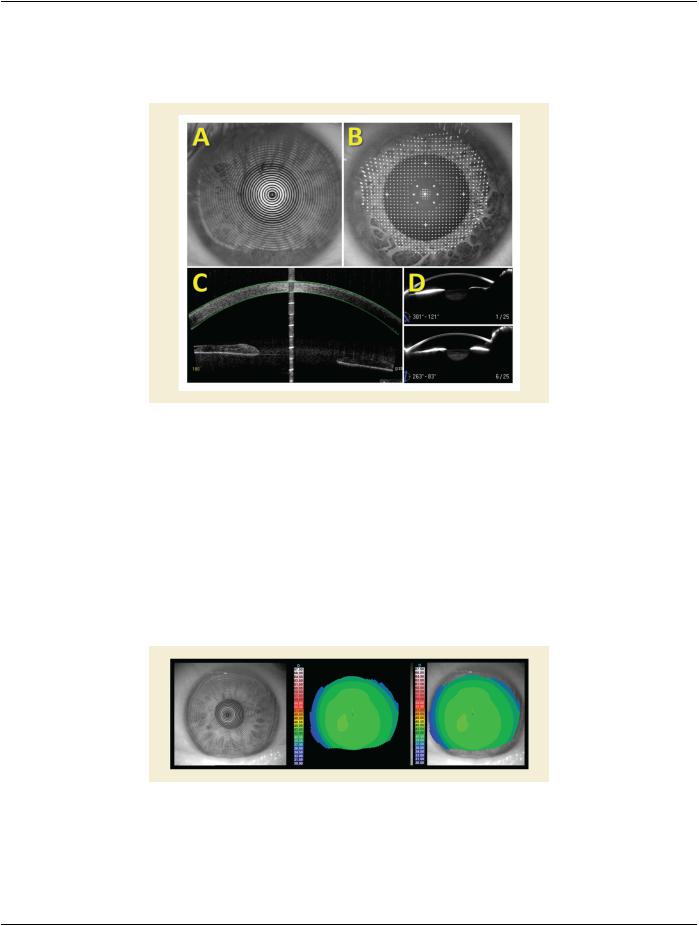
For Ophthalmic Mapping Device Type (0022,1415), Reflection corneal topography, which measures corneal curvature directly, is​ based on the reflection of a specific pattern from the corneal surface. Placido-based topographers use variations of circular mires,​ while grid-based topographers use a rectangular array of point reflections. Slit-based corneal tomography, which measures elevation​

- Standard -​

Page 1220​

DICOM PS3.3 2020a - Information Object Definitions​

directly, is based on the projection of multiple slit beams in succession through the cornea (and anterior segment). Some use the​ Schiempflug optical principle to achieve high resolution over a broad depth of field. Swept source OCT uses high speed scanning to​ produce its optical sections. Source images for these devices are shown in Figure C.8.30.3.1-1. Example A and B are for reflection​ types, C is an interferometry type, and D is a slit based type.​

Figure C.8.30.3.1-1. Device types: A. Placido; B. Grid; C. OCT; D. Slit Based​

C.8.30.3.1.2 Source Image Sequence​

Equipment generating a corneal topography map image first obtains a source image. This image may be single-frame or multi-frame​ such as when the Attribute Ophthalmic Mapping Device Type (0022,1415) is SLIT_BASED or INTERFEROMETRY. From this source​ image, the necessary measurement data is obtained to build the corneal topography map.​

AtypicalsourceimagemaybegeneratedbytheOphthalmicPhotography8bitor16bitSOPClassesfordevicetypesofREFLECTION​ and SLIT_BASED. A typical source image for device type of INTERFEROMETRY would be Ophthalmic Tomography Image SOP​ Class.​

Figure C.8.30.3.1-2 illustrates an example where the source image (left) is generated using a device type of REFLECTION. The​ cornealtopographymapandcolorscaleisshowninthecenter(thisistheoutputofthisSOPClass).Therightfigureshowsanexample​ of the corneal topography map and color scale superimposed on the source image.​

Figure C.8.30.3.1-2. Source Image (left), Corneal Topography Map Image (Center), Corneal Topography​ Map Presented as an Overlay on the Source Image (right)​

- Standard -​