Материал: part03

Внимание! Если размещение файла нарушает Ваши авторские права, то обязательно сообщите нам

Page 1206​

DICOM PS3.3 2020a - Information Object Definitions​

Attribute Name​

Tag​

Type​

Attribute Description​

Include Table 10-5 “General Anatomy Mandatory Macro​

The concept code for Anatomic Region Sequence (0008,2218) shall​

Attributes”​


be (81745001, SCT, "Eye"), and Defined CID 244 “Laterality” shall​


be used for Anatomic Region Modifier Sequence (0008,2220).​


DCID 4266 “Ophthalmic Anatomic Structure Reference Point” shall​


beusedforPrimaryAnatomicStructureSequence(0008,2228).Only​


a single Item shall be included in this Sequence.​


Note​


AlthoughPrimaryAnatomicStructureSequence(0008,2228)​


is Type 3, it is important to convey this information if able to​


be determined.​

Relative Image Position​

(0022,001D)​

3​

The position of this image on the retina (as defined by a specified​

Code Sequence​


nomenclature; the nomenclature is implicit in the code used). Only a​


single Item is permitted in this Sequence.​

>Include Table 8.8-1 “Code Sequence Macro Attributes”.​

BCID 4207 “Ophthalmic Image Position”.​

Anatomic Structure​

(0022,1463)​

1C​

Location of a point in the image identified by an anatomic structure.​

Reference Point​


This is used in ophthalmology for a landmark within a patient's eye.​


Given as column\row. Column is the horizontal offset and row is the​


vertical offset.​


Image relative position specified with sub-pixel resolution such that​


the origin at the Top Left Hand Corner (TLHC) of the TLHC pixel is​


0.0\0.0, the Bottom Right Hand Corner (BRHC) of the TLHC pixel is​


1.0\1.0, and the BRHC of the BRHC pixel is Columns\Rows (see​


Figure C.10.5-1). The values must be within the range 0\0 to​


Columns\Rows.​


Required if Primary Anatomic Structure Sequence (0008,2228)​


contains an Item with the value (67046006, SCT, "Fovea centralis")​


or(81016008,SCT,"Opticnervehead")or(49755003,SCT,"Lesion")​


or (111934, DCM, "Disc-Fovea").​


May be present otherwise.​

RetinalThicknessDefinition​

(0022,1445)​

1C​

The definition of the retinal thickness for this image.​

Code Sequence​


Required if Attribute Image Type (0008,0008) value 3 is​


RETINAL_THICK.​


Only a single Item shall be included in this Sequence.​

>Include Table 8.8-1 “Code Sequence Macro Attributes”​

DCID 4262 “Retinal Thickness Definition”​

C.8.28.2.1 Ophthalmic Thickness Map Module Attribute Descriptions​

C.8.28.2.1.1 Image Type​

For Ophthalmic Thickness Maps, Image Type (0008,0008) is specified to be Type 1 and uses one of the following Defined Terms for​ Value 3:​

Defined Terms:​


ONH​

identifies a topographic map of an optic nerve head​

RETINAL_THICK​identifies a Thickness Map for retinal layers or combination of several sub-layers​

Note​

1.​The images created based upon the source data of the patient examination would be ORIGINAL\PRIMARY.​

- Standard -​

DICOM PS3.3 2020a - Information Object Definitions​

Page 1207​

2.​If the value is specified as "RETINAL_THICK", the definition of the retinal thickness is in Retinal Thickness Definition​ Code Sequence (0022,1445).​

C.8.28.2.1.2 Referenced Instance Sequence​

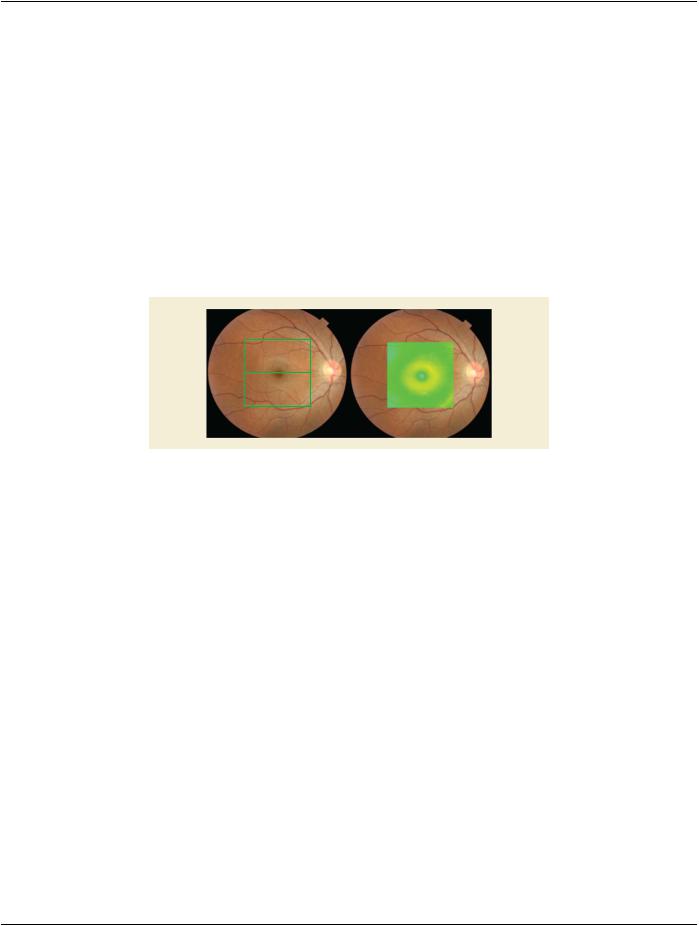
Equipment generating an ophthalmic map (OPM) image, may also obtain an accompanying "reference/localizer" image. This "refer-​ ence/localizer" image serves the purpose of orienting and registering the OPM image to the actual retinal location. For example, a​ fundus photo may be obtained with ophthalmic tomography (OPT). When the retinal thickness map is generated based on OPT data,​ theOPMisregisteredwithpixelprecisiontothefundusphoto.This"reference/localizer"imageisreferencedintheOPMSOPInstance​ using the Attribute Referenced Instance Sequence (0008,114A).​

An example of a "reference/localizer" image and its relationship to an OPM image is shown in Figure C.8.28.2.1-1. Legend: ( A) a​ fundus photo is taken as the "reference/localizer" image. The green box indicates the area the OPT scans are obtained. ( B) The​ retinalthicknessmap(OPMobject)isoverlaidonthe"reference/localizer"fundusphototoshowthecorrespondence.Theseexamples​ could be referenced from different types of SOP Classes, such as Color Softcopy Presentation State Storage (referencing the OP​ SOP Instance of a fundus photo), True Color Secondary Capture Image Storage, Encapsulated PDF, etc. The Purpose of Reference​ CodeSequence(0040,A170)codeissetto(121311,DCM,"Localizer")forexampleA.RegistrationtoLocalizerSequence(0022,1465)​ would be used for example B.​

Figure C.8.28.2.1-1. Reference/Localizer Image Related to OPM Image​

C.8.28.2.1.3 Ophthalmic Mapping Device Type​

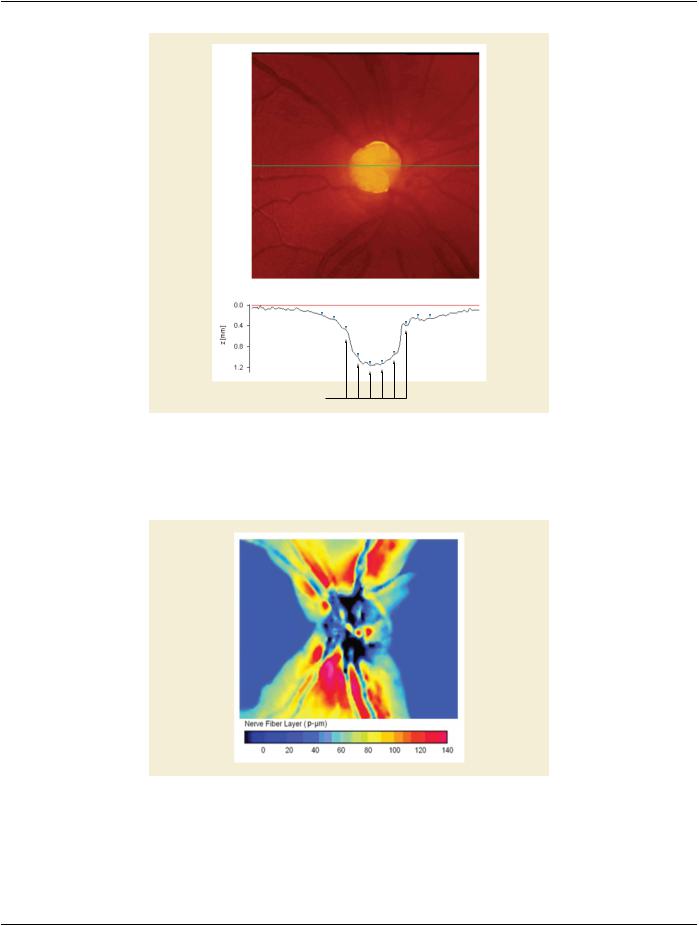
For Ophthalmic Mapping Device Type (0022,1415), Scanning Laser Ophthalmoscopy Tomography (SLO_TOMO) produces a topo-​ graphical representation of the optic nerve head (ONH) rather than a thickness depiction. However, the topographical depiction can​ be considered as "thickness" measurements of multiple points of the ONH surface relative to an assigned datum plane. For this​ reason, the topographical image is included in the ophthalmic thickness map Module.​

- Standard -​

Page 1208​

DICOM PS3.3 2020a - Information Object Definitions​


Thickness Measurements

Figure C.8.28.2.1-2. Optic Nerve Head Thickness Example​

ForOphthalmicMappingDeviceType(0022,1415),PolarimetricTomography(POLARIMETRY)producesathicknessdepictionbased​ on birefringent phase shifts. This is a thickness measure but does not use typical international system of units such as micrometer,​ etc. Due to this, the unit of measurement is defined by the implementation, such as 'p-um'.​

Figure C.8.28.2.1-3. Polarimetry Optic Nerve Head Thickness Example​

C.8.28.3 Ophthalmic Thickness Map Quality Rating Module​

Table C.8.28.3-1 specifies the Attributes that describe the quality rating for the ophthalmic mapping.​

- Standard -​

DICOM PS3.3 2020a - Information Object Definitions​ Page 1209​

Table C.8.28.3-1. Ophthalmic Thickness Map Quality Rating Module Attributes​

Attribute Name​

Tag​

Type​

Attribute Description​

Ophthalmic Thickness Map​

(0022,1470)​

1​

Type of metric and metric value used to evaluate the quality of the​

Quality Rating Sequence​


ophthalmic mapping for grading and diagnostic purposes for this​


SOP Instance.​


Only a single Item shall be included in this Sequence.​

>Include Table 10-26 “Numeric Value Macro Attributes”​

DCID 4243 “Ophthalmic Quality Metric Type” shall be used for​


Concept Name Code Sequence (0040,A043).​

>Ophthalmic Thickness Map​

(0022,1458)​

1​

Quality threshold value and software algorithm used to provide​

Quality Threshold Sequence​


theophthalmicthicknessmapqualityratingforthisSOPInstance.​


Only a single Item shall be included in this Sequence.​

>>Ophthalmic Thickness Map​

(0022,1460)​

1​

Quality rating threshold value for acceptable ophthalmic map.​

Threshold Quality Rating​


Note​


The units of this Attribute is the same as defined in​ Measurement Unit Code Sequence (0040,08EA) of the​ Ophthalmic Thickness Map Quality Rating Sequence​ (0022,1470). The threshold value is not the same as the​ Attribute Numeric Value (0049,A30A) of the Ophthalmic​ Thickness Map Quality Rating Sequence (0022,1470).​ Therefore, it conveys the least stringent value that is​ acceptable, not the actual rating for this SOP Instance.​

>>Include Table 10-19 “Algorithm Identification Macro Attributes”​

C.8.29 Optical Surface Scanner Modules​

This Section describes Optical Surface Scanner Modules. These Modules contain Attributes that are specific to Optical Surface​ Scanner scans.​

C.8.29.1 Optical Surface Scanner Series Module​

Table C.8.29-1 contains IOD Attributes that describe an optical surface scan Series performed on the patient.​

Table C.8.29-1. Optical Surface Scanner Series Module Attributes​

Attribute Name​

Tag​

Type​

Attribute Description​

Modality​

(0008,0060)​

1​

Type of equipment that originally acquired the data used​


to create the images in this Series.​


Enumerated Values:​


OSS​


See Section C.7.3.1.1.1 for further explanation.​

Referenced Performed​

(0008,1111)​

1C​

Uniquely identifies the Performed Procedure Step SOP​

Procedure Step Sequence​


Instance to which the Series is related.​

Only a single Item shall be included in this Sequence.​

Required if a Performed Procedure Step SOP Class was​ involved in the creation of this Series.​

>Include Table 10-11 “SOP Instance Reference Macro Attributes”​

- Standard -​

Page 1210​

DICOM PS3.3 2020a - Information Object Definitions​

Attribute Name​

Tag​

Type​

Attribute Description​

Referenced Surface Data​

(0080,0013)​

2​

Lists the predecessor surfaces and/or point clouds​

Sequence​


instances.​


Zero or more Items shall be included in this Sequence.​

>Include Table 10-11 “SOP Instance Reference Macro Attributes”​


C.8.29.2 Scan Procedure Module​


Table C.8.29-2 specifies the Attributes of the Scan Procedure Module.​


Table C.8.29-2. Scan Procedure Module Attributes​

Attribute Name​

Tag​

Type​

Attribute Description​

Surface Scan Acquisition Type​

(0080,0001)​

1​

Specify the type of acquisition method.​

Code Sequence​


For evaluation of the characteristics or quality of the data.​


Only a single Item shall be included in this Sequence.​

>Include Table 8.8-1 “Code Sequence Macro Attributes”​


BCID 8201 “Surface Scan Acquisition Types”.​

Surface Scan Mode Code​

(0080,0002)​

2​

Used scan mode.​

Sequence​


Zero or more Items shall be included in this Sequence.​


>Include Table 8.8-1 “Code Sequence Macro Attributes”​


BCID 8202 “Surface Scan Mode Types”.​

Registration Method Code​

(0080,0003)​

1C​

Method for registering multiple shots.​

Sequence​


RequirediftheIODstoresdatathathasbeenderivedfrom​


multiple shots.​


Only a single Item shall be included in this Sequence.​

>Include Table 8.8-1 “Code Sequence Macro Attributes”​


BCID 8203 “Surface Scan Registration Method Types”.​

Instance Number​

(0020,0013)​

1​

A number that identifies this shot.​


Shall start at 1 and monotonically increase by 1 within a​


single acquisition.​

Acquisition Number​

(0020,0012)​

1​

A number identifying the single continuous gathering of​


data over a period of time that resulted in this instance.​

Acquisition DateTime​

(0008,002A)​

1​

The date and time that the acquisition of data that resulted​


in this instance started.​

Shot Duration Time​

(0080,0004)​

1​

The time in seconds from the start of this shot until the end​


of this shot.​

Shot Offset Time​

(0080,0005)​

3​

The time in seconds from the Acquisition DateTime to the​


start of this shot.​

C.8.29.2.1 Scan Procedure Module Attribute Descriptions​

C.8.29.2.1.1 Shot Duration Time and Shot Offset Time​

Figure C.8.29.2-1 depicts the usages of some of the Attributes of the Scan Procedure Module.​

The Shot Offset Time is the time required for the detection of focus points and exposure time settings.​

The Shot Duration Time is the time required to acquire a surface from the scanned object.​

- Standard -​