Материал: part03

Внимание! Если размещение файла нарушает Ваши авторские права, то обязательно сообщите нам


DICOM PS3.3 2020a - Information Object Definitions​

Page 1031​

Attribute Name​

Tag​

Type​

Attribute Description​


Bits Allocated​

(0028,0100)​

1​

Number of bits allocated for each pixel sample. See​


Section C.8.17.14.1.6 for specialization.​


Bits Stored​

(0028,0101)​

1​

Numberofbitsstoredforeachpixelsample.SeeSectionC.8.17.14.1.6​


for specialization.​


High Bit​

(0028,0102)​

1​

Most significant bit for pixel sample data.Shall be one less than the​


value in Bits Stored (0028,0101). See Section C.8.17.14.1.6 for​


specialization.​


Samples per Pixel​

(0028,0002)​

1​

Number of samples (planes) in this image.​


Enumerated Values:​


1​


Photometric Interpretation​

(0028,0004)​

1​

Specifies the intended interpretation of the pixel data.​


See Section C.8.17.14.1.4 for specialization.​


Pixel Representation​

(0028,0103)​

1​

Data representation of pixel samples.​


Enumerated Values:​


0​


Pixel Spacing​

(0028,0030)​

1​

Nominal physical distance at the focal plane (in the retina) between​


the center of each pixel, specified by a numeric pair - adjacent row​


spacing (delimiter) adjacent column spacing in mm. See Section​


10.7.1.3for further explanation of the value order.​


Note​


Sinceapatient'sretinaiscurvedandtheimagerepresentation​


is planar, there can be an error in using Pixel Spacing​


(0028,0030)formeasurementsintheperipheryoftheimage.​


En face imaging does not support wide field measurements.​

Content Time​

(0008,0033)​

1​

The time the image pixel data creation started.​


Content Date​

(0008,0023)​

1​

The date the image pixel data creation started.​


Source Image Sequence​

(0008,2112)​

1​

A Sequence that identifies the Images that were used to derive this​


Image.​


One or more Items shall be included in this Sequence.​


See Section C.12.4.1.2 and Section C.8.17.14.1.1 for further​


explanation.​


>Include Table 10-3 “Image SOP Instance Reference Macro​


Attributes”​


>Purpose of Reference​

(0040,A170)​

1​

Describes the purpose for which the reference is made, that is what​

Code Sequence​


rolethesourceimageorframe(s)playedinthederivationofthisimage.​


Only a single Item shall be included in this Sequence.​


>>Include Table 8.8-1 “Code Sequence Macro Attributes”​

DCID 7202 “Source Image Purposes of Reference”.​


If the derived en face image is based upon OPT structure information,​


theConceptCodeshallbe(128250,DCM,"Structuralimageforimage​


processing").​


If the derived en face image is based upon OPT flow information, the​ Concept Code shall be (128251, DCM, "Flow image for image​ processing").​

- Standard -​

Page 1032​

DICOM PS3.3 2020a - Information Object Definitions​

Attribute Name​

Tag​

Type​

Attribute Description​

Derivation Algorithm​

(0022,1612)​

1​

Software algorithm that performed the derivation.​

Sequence​


Only a single Item shall be included in this Sequence.​


>Include Table 10-19 “Algorithm Identification Macro​

DCID 4270 “OCT-A Processing Algorithm Families” shall be used for​

Attributes”​


Algorithm Family Code Sequence (0066,002F)​

Ophthalmic Image Type​

(0022,1615)​

1​

En face image type used to identify this SOP Instance​

Code Sequence​


Only a single Item shall be included in this Sequence.​


See Section C.8.17.14.1.3 for further explanation.​

>Include Table 8.8-1 “Code Sequence Macro Attributes”​

DCID 4271 “En Face Image Types”​

Ophthalmic Image Type​

(0022,1616)​

3​

Description of the en face image type.​

Description​


Window Center​

(0028,1050)​

1​

Window Center for display.​


See Section C.11.2.1.2 for further explanation.​


Note​


When Bits Allocated (0028,0100) is 8, the value is typically​


always set to 127 or 128.​

Window Width​

(0028,1051)​

1​

Window Width for display. See Section C.11.2.1.2 for further​


explanation.​


Note​


When Bits Allocated (0028,0100) is 8, the value is typically​


always set to 256.​

Ophthalmic FOV​

(0022,1517)​

3​

The horizontal field of view used to capture the ophthalmic image, in​


degrees. The field of view is the maximum image size displayed on​


the image plane, expressed as the angle subtended at the exit pupil​


of the eye by the maximum dimension 2r (where r equals the radius).​

Referenced Surface Mesh​

(0022,1620)​

1​

Reference to the surface mesh(s) used in the creation of this SOP​

Identification Sequence​


Instance.​


One or more Items shall be included in this Sequence.​


See Section C.8.17.14.1.2 for further explanation.​

>ReferencedSOPInstance​

(0008,1155)​

1​

Referenced SOP Instance that contains the surface segmentation​

UID​


used in the creation of this SOP Instance.​

>Referenced Surface​

(0066,002C)​

1​

Reference to a Surface Number (0066,0003) present in Surface​

Number​


Sequence (0066,0002).​

>SegmentedPropertyType​

(0062,000F)​

1​

Sequence defining the specific property the surface represents.​

Code Sequence​


Only a single Item is permitted in this Sequence​


Note​

"Property" is used in the sense of meaning "what the surface​ represents", whether it be a physical or biological object, be​ real or conceptual, having spatial, temporal or functional​ extent or not. I.e., it is what the segment "is" (as opposed to​ some feature, Attribute, quality, or characteristic of it, like​ color or shape or size).​

>>Include Table 8.8-1 “Code Sequence Macro Attributes”​ BCID 4273 “Retinal Segmentation Surfaces”.​

- Standard -​


DICOM PS3.3 2020a - Information Object Definitions​

Page 1033​

Attribute Name​

Tag​

Type​

Attribute Description​


>Surface Mesh Z-Pixel​

(0022,1658)​

1​

Offset in number of pixels along the z axis by which the mesh data​

Offset​


has been shifted when generating this SOP Instance.​


The mesh data is the Attribute Point Coordinates Data (0066,0016) of​


the surface mesh referenced by Attribute Referenced SOP Instance​


UID (0008,1155).​


Note​


If no offset is used the value is set to 0.​


Ophthalmic Axial Length​

(0022,1019)​

3​

The axial length measurement, in mm.​


Ophthalmic Axial Length​

(0022,1515)​

3​

The method used to obtain the Ophthalmic Axial Length.​

Method​


Enumerated values:​


MEASURED​ Measured axial length.​


ESTIMATED​ An estimated value based upon performing the​


examination (i.e., based upon surrogate markers of​


axial length).​


POPULATION​A length that represents a population norm (i.e., not​


based upon a measured axial length or surrogate​


markers of axial length).​


Lossy Image Compression​

(0028,2110)​

1​

Specifies whether an Image has undergone lossy compression (at a​


point in its lifetime).​


Enumerated Values:​


00​Image has NOT been subjected to lossy compression.​


01​Image has been subjected to lossy compression.​


Once this value has been set to 01 it shall not be reset.​


See Section C.7.6.1.1.5.​


Lossy Image Compression​

(0028,2112)​

1C​

Describes the approximate lossy compression ratio(s) that have been​

Ratio​


applied to this image.​


See Section C.7.6.1.1.5.2.​


Required if Lossy Image Compression (0028,2110) is "01".​

Lossy Image Compression​

(0028,2114)​

1C​

A label for the lossy compression method(s) that have been applied​

Method​


to this image.​


See Section C.7.6.1.1.5.1.​


Required if Lossy Image Compression (0028,2110) is "01".​

Presentation LUT Shape​

(2050,0020)​

1C​

Specifies an identity transformation for the Presentation LUT, such​


that the output of all grayscale transformations defined in the IOD​


containing this Module are defined to be P-Values.​


Enumerated Values:​

IDENTITY​ output is in P-Values​

RequiredifPhotometricInterpretation(0028,0004)isMONOCHROME2​

- Standard -​

Page 1034​

DICOM PS3.3 2020a - Information Object Definitions​

Attribute Name​

Tag​

Type​

Attribute Description​

Calibration Image​

(0050,0004)​

3​

Indicateswhetherareferenceobject(phantom)ofknownsizeispresent​


in the image and was used for calibration.​


Enumerated Values:​


YES​


NO​

Burned In Annotation​

(0028,0301)​

1​

Indicateswhetherornotimagecontainssufficientburnedinannotation​


to identify the patient and date the image was acquired.​


Enumerated Values:​


YES​


NO​

Recognizable Visual​

(0028,0302)​

1​

Indicates whether or not the image contains sufficiently recognizable​

Features​


visual features to allow the image or a reconstruction from a set of​


images to identify the patient.​

Enumerated Values:​

YES​

NO​

C.8.17.14.1 Ophthalmic Optical Coherence Tomography En Face Image Module Attribute Descriptions​

C.8.17.14.1.1 Source Image Sequence​

An OCT en face image is derived from images obtained using OCT technology. The Source Image Sequence (0008,2112) shall​ convey the SOP Instances used to derive this en face SOP Instance.​

If Attribute Purpose of Reference Code Sequence (0040,A170) is set to (128250, DCM, "Structural image for image processing"), the​ Source Image Sequence will reference an Ophthalmic Tomography SOP Instance.​

If Attribute Purpose of Reference Code Sequence (0040,A170) is set to (128251, DCM, "Flow image for image processing"), the​ Source Image Sequence will reference an Ophthalmic Optical Coherence Tomography B-scan Volume Analysis SOP Instance.​

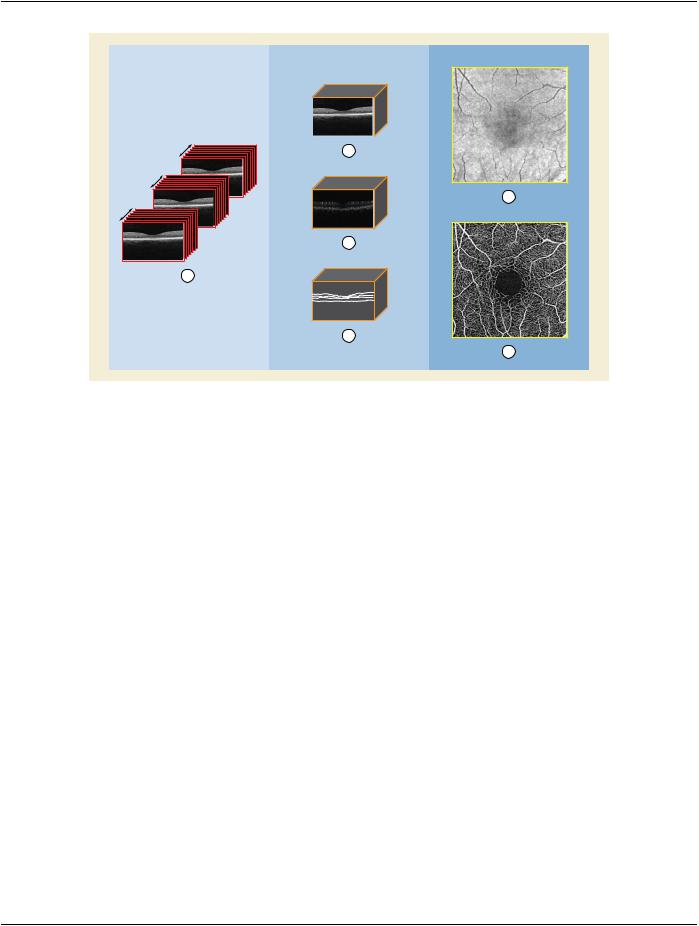
A typical example of the image processing stages performed to generate en face images is shown in Figure C.8.17.14-1.​

- Standard -​

DICOM PS3.3 2020a - Information Object Definitions​

Page 1035​

Stage 1

Stage 2

Stage 3


B

E

C

A

D

F

Figure C.8.17.14-1. Example of the Image Process Performed to Generate En Face Images​

Figure Legend:​

A.​OCT proprietary B-scan data (possibly a DICOM Raw Data Instance)​

B.​Volumetric structural ophthalmic tomography image (Ophthalmic Tomography Image Instance)​

C.​OCT angiographic flow volume information (Ophthalmic Optical Coherence Tomography B-scan Volume Analysis Instance)​

D.​OCT surface mesh (Surface Segmentation Instance)​

E.​Structural en face image (Ophthalmic Optical Coherence Tomography En Face Image Instance)​

F.​En Face angiographic flow image (Ophthalmic Optical Coherence Tomography En Face Image Instance)​

Stage 1:OCT technology is used to acquire a volumetric dataset from a retinal region of interest.This volumetric dataset (A) consists​ of multiple B-scans in a raster pattern, and multiple frames are acquired at each B-scan location. The B-scans are acquired in the​ manufacturer's proprietary format for analysis and storage. If this information is stored in DICOM, it can use the Raw Data Storage​ SOP Class.​

Stage2:TheOCTproprietaryB-scandata(A)(orDICOMRawDataSOPInstance)isthenanalyzedtoderivethevolumetricstructural​ ophthalmic tomography image (B). From (B) one or more OCT surface meshes (D) are generated to delineate the anatomical​ boundaries. The difference in signal between the frames of each individual B-scan is analyzed to produce the OCT angiographic flow​ volume information (C).​

Stage 3:Clinicians typically make their assessment based upon two types of OCT en face images. The structural OCT en face image​

(E) is derived by using pixel information in (B) and two surface meshes (C). The vascular OCT en face image (F) may be derived​ using the volumetric structural ophthalmic tomography image (B) , the OCT surface mesh (D) and the OCT angiographic flow volume​ information (C).​

EnfaceimagesaretypicallyderivedbytheacquisitionmodalitythatgeneratedtheOphthalmicTomographyImage,SurfaceSegment-​ ationandOphthalmicOpticalCoherenceTomographyB-scanVolumeAnalysisSOPInstancesorbyimageworkstationsthatreceived​ therespectiveOphthalmicImage,SurfaceSegmentationandOphthalmicOpticalTomographyB-scanVolumeAnalysisSOPInstances​ via DICOM Storage.​

- Standard -​