Материал: part03

Внимание! Если размещение файла нарушает Ваши авторские права, то обязательно сообщите нам

DICOM PS3.3 2020a - Information Object Definitions​

Page 501​

Note​

InconjunctionwiththePatientPosition(0018,5100)ineachItemoftheGroupofPatientsIdentificationSequence(0010,0027),​ Patient Position (0018,5100) in the General Series Module may be helpful to compute patient-relative spatial information for​ each subject from the Attributes of the Image Plane Module.​

When facing the front of the imaging equipment, Head First is defined as the patient's head being positioned toward the front of the​ imaging equipment (i.e., head entering the front of the equipment). Feet First is defined as the patient's feet being positioned toward​ the front of the imaging equipment (i.e., feet entering the front of the equipment). Left First is defined as the patient's left side being​ positionedtowardsthefrontoftheimagingequipment(i.e.,patient'sleftsideenteringthefrontoftheequipment).RightFirstisdefined​ as the patient's right being positioned towards the front of the imaging equipment (i.e., patient's right side entering the front of the​ equipment).Proneisdefinedasthepatient'sfacebeingpositionedinadownward(gravity)direction.Supineisdefinedasthepatient's​ face being in an upward direction. Decubitus Right is defined as the patient's right side being in a downward direction. Decubitus Left​ is defined as the patient's left side being in a downward direction.​

Defined Terms:​

HFP​ Head First-Prone​

HFS​ Head First-Supine​

HFDR​Head First-Decubitus Right​

HFDL​Head First-Decubitus Left​

FFDR​Feet First-Decubitus Right​

FFDL​Feet First-Decubitus Left​

FFP​ Feet First-Prone​

FFS​ Feet First-Supine​

LFP​ Left First-Prone​

LFS​ Left First-Supine​

RFP​ Right First-Prone​

RFS​ Right First-Supine​

AFDR​Anterior First-Decubitus Right​

AFDL​Anterior First-Decubitus Left​

PFDR​Posterior First-Decubitus Right​

PFDL​Posterior First-Decubitus Left​

Note​

1.​For quadrupeds, separate concepts for ventral and dorsal are not introduced, rather it is expected that anterior and​ posterior will be considered synonymous as they are when applied to the trunk.​

2.​There are no decubitus variants of left or right first, since for imaging equipment that is aligned horizontally with respect​ to gravity the patient cannot be both decubitus and have the left or right side towards the front of the imaging equipment.​

3.​Therearenoproneorsupinevariantsofanteriororposteriorfirst,sinceforimagingequipmentthatisalignedhorizontally​ with respect to gravity the patient cannot be prone or supine and have the anterior or posterior side towards the front​ of the imaging equipment.​

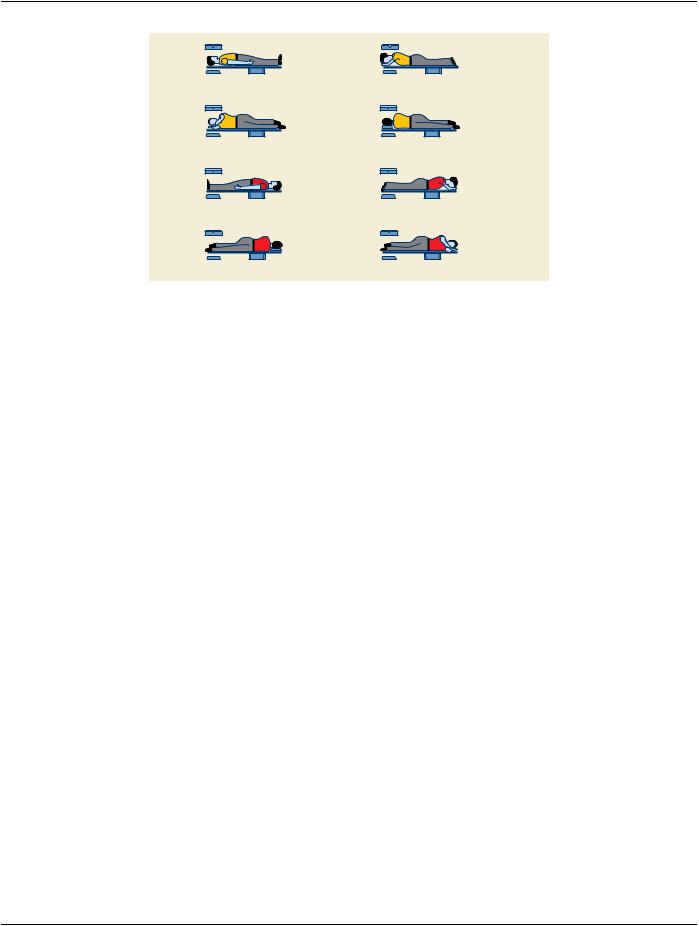
The Figure C.7.3.1.1.2-1 illustrates some of these Defined Terms for imaging equipment with a table, such as in X-Ray Angiography.​ The orientation of the patient related to gravity is always recumbent.​

- Standard -​

Page 502​

DICOM PS3.3 2020a - Information Object Definitions​

Recumbent - Head First - Supine

Recumbent - Head First - Decubitus Right

Recumbent - Feet First - Supine

Recumbent - Feet First - Decubitus Right

Recumbent - Head First - Prone

Recumbent - Head First - Decubitus Left

Recumbent - Feet First - Prone

Recumbent - Feet First - Decubitus Left

Figure C.7.3.1.1.2-1. Representation of the Eight Different Patient Positions on the X-Ray Table​

- Standard -​

DICOM PS3.3 2020a - Information Object Definitions​

Page 503​

View from above gantry/table

Gantry Rear

Gantry

Gantry Front

View from front of gantry

Gantry Left

Gantry Right

Figure C.7.3.1.1.2-2. Example of Right First-Prone (RFP) Patient Position Relative to the Gantry and​ Table for a Small Animal​

C.7.3.2 Clinical Trial Series Module​

Table C.7-5b contains Attributes that identify a Series in the context of a clinical trial or research.​

- Standard -​

Page 504​ DICOM PS3.3 2020a - Information Object Definitions​

Table C.7-5b. Clinical Trial Series Module Attributes​

Attribute Name​

Tag​

Type​

Attribute Description​

Clinical Trial Coordinating Center​

(0012,0060)​

2​ The name of the institution that is responsible for coordinating​

Name​


the medical imaging data for the clinical trial or research. See​


Section C.7.3.2.1.1.​

Clinical Trial Series ID​

(0012,0071)​

3​ An identifier of the Series in the context of a clinical trial or​


research. See Section C.7.3.2.1.2.​

Clinical Trial Series Description​

(0012,0072)​

3​ A description of the Series in the context of a clinical trial or​


research. See Section C.7.3.2.1.2.​

C.7.3.2.1 Clinical Trial Series Attribute Descriptions​

C.7.3.2.1.1 Clinical Trial Coordinating Center Name​

TheClinicalTrialCoordinatingCenterName(0012,0060)identifiestheinstitutionresponsibleforcoordinatingthecollectionofimages​ and associated data for subjects enrolled in the clinical trial or research.​

C.7.3.2.1.2 Clinical Trial Series Identifier and Description​

TheClinicalTrialSeriesID(0012,0071)andClinicalTrialSeriesDescription(0012,0072)Attributescanbeusedtoidentifyanddescribe​ a Series within the context of a clinical trial or research without requiring the replacement of the values in Series Number (0020,0011)​ and Series Description (0008,103E) Attributes in the General Series Module, whose manufacturer or user provided values may be​ relevant and important to retain.​

C.7.3.3 Enhanced Series Module​

Table C.7-5c Table specifies the Attributes that identify and describe general information about the Series within a Study.​

Note​

This table contains a subset of the Attributes of General Series Module (Table C.7-5a) but the Type designation is changed​ into Type 1. Including this Module in an IOD overwrites the Type designation of the General Series Module.​

Table C.7-5c. Enhanced Series Module Attributes​

Attribute Name​

Tag​

Type​

Attribute Description​

Series Number​

(0020,0011)​

1​

A number that identifies this Series.​


Note​


1.​The value of this Attribute should be unique for all​


Series in a Study created on the same equipment.​


2.​Because Series can be created on more than one​


equipment, it can not be guaranteed that the value​


of Series Number (0020,0011) is unique in a Study.​

Referenced Performed​

(0008,1111)​

1C​

Uniquely identifies the Performed Procedure Step SOP Instance​

Procedure Step Sequence​


to which the Series is related.​

Only a single Item shall be included in this Sequence.​

Required if a Performed Procedure Step SOP Class was involved​ in the creation of this Series.​

>Include Table 10-11 “SOP Instance Reference Macro Attributes”​

- Standard -​

DICOM PS3.3 2020a - Information Object Definitions​

Page 505​

C.7.4 Common Frame of Reference Information Entity Modules​

C.7.4.1 Frame of Reference Module​

TableC.7-6specifiestheAttributesnecessarytouniquelyidentifyaFrameofReferencethatensuresthespatialrelationshipofImages​ within a Series. It also allows Images across multiple Series to share the same Frame Of Reference. This Frame Of Reference (or​ coordinate system) shall be constant for all Images related to a specific Frame Of Reference.​

When a Frame of Reference is identified, it is not important how the imaging target (patient, specimen, or phantom) is positioned rel-​ ative to the imaging equipment or where the origin of the Frame Of Reference is located. It is important that the position of the imaging​ target and the origin are constant in relationship to a specific Frame Of Reference.​

Note​

Since the criteria used to group images into a Series is application specific, it is possible for imaging applications to define​ multiple Series within a Study that share the same imaging space. Previous versions of the DICOM Standard specified that​ all images within the Series must be spatially related. However, insufficient information was available to determine if multiple​ Series within a Study were spatially related.​

Table C.7-6. Frame of Reference Module Attributes​

Attribute Name​

Tag​

Type​

Attribute Description​

Frame of Reference UID​

(0020,0052)​

1​

Uniquely identifies the Frame of Reference for a Series. See​


Section C.7.4.1.1.1 for further explanation.​

Position Reference Indicator​

(0020,1040)​

2​

Part of the imaging target used as a reference. See​


Section C.7.4.1.1.2 for further explanation.​

C.7.4.1.1 Frame of Reference Attribute Descriptions​

C.7.4.1.1.1 Frame of Reference UID​

The Frame of Reference UID (0020,0052) shall be used to uniquely identify a Frame of Reference for a Series. Each Series shall​ have a single Frame of Reference UID. However, multiple Series within a Study may share a Frame of Reference UID. All images in​ a Series that share the same Frame of Reference UID shall be spatially related to each other.​

Note​

1.​Previous versions of this Standard defined a Data Element "Location", which has been retired. Frame of Reference UID​ provides a completely unambiguous identification of the image location reference used to indicate position.​

2.​A common Frame of Reference UID may be used to spatially relate localizer images with a set of transverse images.​ However, in some cases (e.g., multiple localizer images being related to a single set of transverse images) a common​ FrameofReferenceUIDmaynotbesufficient.TheReferencedImageSequence(0008,1140)providesanunambiguous​ method for relating localizer images.​

C.7.4.1.1.2 Position Reference Indicator​

The Position Reference Indicator (0020,1040) specifies the part of the imaging target that was used as a reference point associated​ with a specific Frame of Reference UID. The Position Reference Indicator may or may not coincide with the origin of the fixed Frame​ of Reference related to the Frame of Reference UID.​

For a Patient-related Frame of Reference, this is an anatomical reference point such as the iliac crest, orbital-medial, sternal notch,​ symphysis pubis, xiphoid, lower costal margin, or external auditory meatus, or a fiducial marker placed on the patient. The Patient-​ Based Coordinate System is described in Section C.7.6.2.1.1.​

Foraslide-relatedFrameofReference,thisistheslidecornerasspecifiedinSectionC.8.12.2.1andshallbeidentifiedinthisAttribute​ with the value "SLIDE_CORNER". The slide-based coordinate system is described in Section C.8.12.2.1.​

- Standard -​