Материал: part02
Page 46 |
DICOM PS3.2 2020a - Conformance |
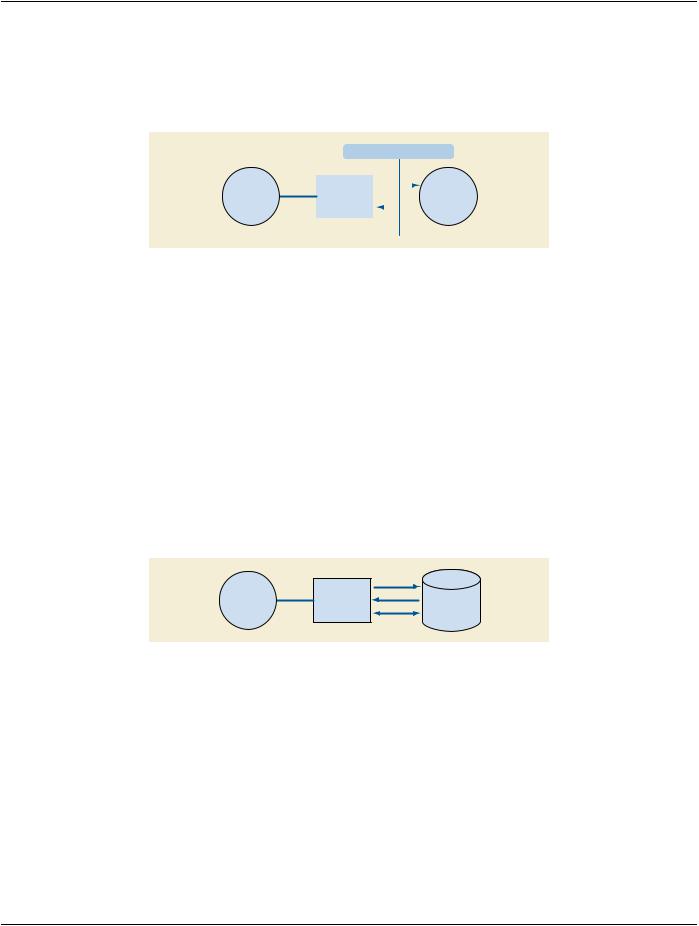
StandardInterfacebetweenthelocalApplicationEntities,andwhateverremoteApplicationEntitiesthathandletheremoteReal-World Activities. An arrow from the local Application Entity to the remote Real-World Activity indicates that an occurrence of the local Real- World Activity will cause the local Application Entity to initiate an association for the purpose of causing the remote Real-World Activity to occur. An arrow from the remote Real-World Activity to the local Application Entity indicates that the local Application Entity expects to receive an association request when the remote Real-World Activity occurs, causing the local Application Entity to perform the local Real-World Activity.
|
DICOM Standard Interface |
||||
|
|
|
|
|
Remote |
Local |
Local |
|
|
|
|
|
|
||||
Real-World |
Application |
|
|
|
Real-World |
Activity |
Entity |
|
|
|
Activity |
|
|
|
|||
|
|
|
|
|
|
Figure 5.1-4. Associations Convention
5.1.5 Media Storage File-Set Access
Application Entities exchanging information on media use the DICOM File Service as specified in PS3.10 for access to, or creation of, File-sets. This File Service provides operations that support three basic roles, which are File-set Creator (FSC), File-set Reader (FSR), and File-set Updater (FSU).
These roles are depicted on an Application Data Flow diagram by directional arrows placed between the local Application Entities and the DICOM Storage Media on which the roles are applied.
•File-set Creator (FSC), denoted by 
•File-set Reader (FSR), denoted by 
•File-set Updater (FSU), denoted by 

•Physical movement of the medium, denoted by  (with or without arrowhead)
Figure 5.1-5 illustrates the three basic roles.
Local |
Local |
DICOM |
Real-World |
Application |
|
Activity |
Entity |
Storage |
|
|
Medium |
Figure 5.1-5. File-Set Access
The local interactions shown on the left between a local Real-World activity and a local Application Entity are depicted by a dashed line. The arrows on the right represent access by the local Application Entity to a File-set on the DICOM Storage Medium. When an Application Entity supports several roles, this combination is depicted with multiple arrows corresponding to each of the roles. The dotted arrow symbolizes the removable nature of media for an interchange application.
Note
The use of two arrows relative to an FSC and an FSR should be distinguished from the case where a double arrow relative to an FSU is used. For example, an FSU may update a File-set without creating a new File-set, whereas a combined FSC and FSR may be used to create and verify a File-set.
- Standard -

DICOM PS3.2 2020a - Conformance |
Page 47 |
6 Purpose of a Conformance Statement
An implementation need not employ all the optional components of the DICOM Standard. After meeting the minimum general require- ments,aconformantDICOMimplementationmayutilizewhateverSOPClasses,communicationsprotocols,MediaStorageApplication Profiles, optional (Type 3) Attributes, codes and controlled terminology, etc., needed to accomplish its designed task.
Note
In fact, it is expected that an implementation might only support the SOP Classes related to its Real World Activities. For example, a simple film digitizer may not support the SOP Classes for other imaging modalities since such support may not berequired.Ontheotherhand,acomplexstorageservermightberequiredtosupportSOPClassesfrommultiplemodalities in order to adequately function as a storage server. The choice of which components of the DICOM Standard are utilized by an implementation depends heavily on the intended application and is beyond the scope of this Standard.
Inaddition,theDICOMStandardallowsanimplementationtoextendorspecializetheDICOMdefinedSOPClasses,aswellasdefine Private SOP classes.
A Conformance Statement allows a user to determine which optional components of the DICOM Standard are supported by a partic- ular implementation, and what additional extensions or specializations an implementation adds. By comparing the Conformance Statements from two different implementations, a knowledgeable user should be able to determine whether and to what extent com- munications might be supported between the two implementations.
DifferentstructuresareusedforthecontentofConformanceStatementsdependingonwhethertheimplementationsupportsaDICOM network interface, a DICOM Media Storage interface, or a combination thereof. In the latter case, a single Conformance Statement shall be provided that consists of the appropriate sections.
The first part of the conformance statement contains a DICOM Conformance Statement Overview, which is typically a one-page de- scriptioninthebeginningofthedocumentprovidingahighleveldescriptionandalsolistingtheNetworkingandMediaServiceClasses, including their roles (SCU/SCP, FSC, FSR, etc.).
6.1 Overview of Networking Section for Conformance Statements
The networking section of a Conformance Statement consists of the following major parts:
•afunctionaloverviewcontainingtheApplicationDataFlowDiagramthatshowsalltheApplicationEntities,includinganysequencing constraints among them. It also shows how they relate to both local and remote Real World Activities;
•a more detailed specification of each Application Entity, listing the SOP Classes supported and outlining the policies with which it initiates or accepts associations;
•foreachApplicationEntityandReal-WorldActivitycombination,adescriptionofproposed(forAssociationInitiation)andacceptable (for Association Acceptance) Presentation Contexts;
Note
A Presentation Context consists of an Abstract Syntax plus a list of acceptable Transfer Syntaxes. The Abstract Syntax identifies one SOP Class or Meta SOP Class (a collection of related SOP Classes identified by a single Abstract Syntax UID).BylistingtheApplicationEntitieswiththeirproposedandacceptedPresentationContexts,theConformanceStatement is identifying the set of Information Objects and Service Classes that are recognized by this implementation;
•for each SOP Class related to an Abstract Syntax, a list of any SOP options supported;
•a set of communications protocols that this implementation supports;
•a description of any extensions, specializations, and publicly disclosed privatizations in this implementation;
•a section describing DICOM related configuration details;
•a description of any implementation details that may be related to DICOM conformance or interoperability;
•a description of what codes and controlled terminology mechanisms are used.
- Standard -

Page 48 |
DICOM PS3.2 2020a - Conformance |
6.2 Overview of Media Storage Section for Conformance Statements
The media storage section of a Conformance Statement consists of the following major parts:
•afunctionaloverviewcontainingtheApplicationDataFlowDiagramthatshowsalltheApplicationEntities,includinganysequencing constraints among them. It also shows how they relate to both local and remote Real-World Activities;
•a more detailed specification of each Application Entity listing the Media Storage Application Profiles supported (this defines SOP Classes supported and media selected), which outlines the policies with which it creates, reads, or updates File-sets on the media;
•a list of optional SOP Classes supported;
•for each Media Storage SOP Class related to a media storage Application Profile, a list of any SOP options supported;
•for each Media Storage SOP Class related to a media storage Application Profile, a list of optional Transfer Syntaxes supported;
•a description of any extensions, specializations, and publicly disclosed privatizations in this implementation such as Augmented or Private Application Profiles;
•a section describing DICOM related configuration details;
•a description of any implementation details that may be related to DICOM conformance or interoperability;
•a description of what codes and controlled terminology mechanisms are used.
- Standard -

DICOM PS3.2 2020a - Conformance |
Page 49 |
7 Conformance Requirements
An implementation claiming DICOM conformance may choose to support one of the following: •network conformance according to Section 7.1 (DICOM Network Conformance Requirements);
•media storage conformance according to Section 7.2 (DICOM Media Storage Conformance Requirements); •both of the above.
7.1 DICOM Networking Conformance Requirements
An implementation claiming DICOM network conformance shall:
•conform to the minimum conformance requirements defined in this section;
•providewiththeimplementationaConformanceStatementstructuredaccordingtotherulesandpoliciesinthisPartincludingAnnex A;
•conform to at least one Standard or Standard Extended SOP class as defined in PS3.4; Note
Conformance to a Standard or Standard Extended SOP class implies conformance to the related IOD outlined in PS3.3, the Data Elements defined in PS3.6, and the operations and notifications defined in PS3.7.
•comply with the rules governing SOP Class types outlined in Section 7.3;
•accept a Presentation Context for the Verification SOP Class as an SCP if the implementation accepts any DICOM association requests;
•produce and/or process Data Sets as defined in PS3.5; Note
Conformance to PS3.5 also implies conformance to PS3.6.
•obtain legitimate right to a registered <org id> for creating UIDs (see PS3.5) if an implementation utilizes Privately Defined UIDs (i.e., UIDs not defined in the DICOM Standard);
•support the following communication mode: •TCP/IP (See PS3.8).
7.2 DICOM Media Interchange Conformance Requirements
An implementation claiming DICOM Media Interchange conformance shall: •conform to the minimum conformance requirements defined in this section;
•providewiththeimplementationaConformanceStatementstructuredaccordingtotherulesandpoliciesinthisPartincludingAnnex C;
•conform to at least one Standard Application Profile as defined in PS3.11;
•support one of the Physical Media and associated Media Format, as specified by PS3.12; •comply with the rules governing SOP Class types outlined in Section 7.3;
•comply with the specific rules governing media storage Application Profile according to their types as specified in Section 7.4. No other types of Application Profiles may be used;
- Standard -

Page 50 |
DICOM PS3.2 2020a - Conformance |
•read as an FSR or FSU all SOP Classes defined as mandatory by each of the supported Application Profiles encoded in any of the mandatory Transfer Syntaxes.
•writeasanFSCorFSUallSOPClassesdefinedasmandatorybyeachofthesupportedApplicationProfilesinoneofthemandatory Transfer Syntaxes;
•be able to gracefully ignore any Standard, Standard Extended, Specialized or Private SOP Classes that may be present on the Storage Medium but are not defined in any of the Application Profiles to which conformance is claimed.
Note
TheremaybemorethanoneApplicationProfileusedtocreateorreadaFile-setonasinglephysicalmedium(e.g.,amedium may have a File-set created with Standard and Augmented Application Profiles).
•be able to gracefully ignore Directory Records in the DICOMDIR file that do not correspond to Directory Records defined in any of the Application Profiles to which conformance is claimed.
•access the File-set(s) on media using the standard roles defined in PS3.10;
•produce and/or process Data Sets as defined in PS3.5 encapsulated in DICOM Files;
Note
Conformance to PS3.5 also implies conformance to PS3.6
•obtain legitimate right to a registered <org id> for creating UIDs (see PS3.5) if an implementation utilizes Privately Defined UIDs (i.e., UIDs not defined in the DICOM Standard).
AnimplementationthatdoesnotmeetalltheaboverequirementsshallnotclaimconformancetoDICOMforMediaStorageInterchange.
7.3 Rules Governing Types of SOP Classes
Each SOP Class published in a Conformance Statement is one of four basic types. Each SOP Class in an implementation claiming conformance to the DICOM Standard shall be handled in accordance with the following rules, as dictated by the type of SOP Class.
Standard SOP Classes conform to all relevant Parts of the DICOM Standard with no additions or changes.
ToclaimconformancetoaStandardSOPClass,animplementationshallmakeadeclarationofthisfactinitsConformanceStatement, and identify its selected options, roles, and behavior.
Standard Extended SOP Classes shall:
a.be a proper super set of one Standard SOP Class;
b.not change the semantics of any Standard Attribute of that Standard SOP Class;
c.not contain any Private Type 1, 1C, 2, or 2C Attributes, nor add additional Standard Type 1, 1C, 2 or 2C Attributes;
d.not change any Standard Type 3 Attributes to Type 1, 1C, 2, or 2C;
e.use the same UID as the Standard SOP Class on which it is based.
A Standard Extended SOP Class may include Standard and/or Private Type 3 Attributes beyond those defined in the IOD on which it is based as long as the Conformance Statement identifies the added Attributes and defines their relationship with the PS3.3 inform- ationmodel.IfadditionalType3AttributesdrawnfromtheDataDictionaryinPS3.6aresentthataffecttheencodingofotherAttributes, or whose encoding depends on the values of other Attributes, their presence and use shall be consistent.
Note
E.g., An Attribute such as Pixel Padding Value (0028,0120) with a dictionary VR of US or SS would not be allowed to be present without Pixel Representation (0028,0103) also being present to resolve the encoding ambiguity. Further, Pixel Padding Value would not be allowed to be present in the absence of the Pixel Data (7FE0,0010) to which it applies.
- Standard -