Материал: m912201e
114• Components of WAGO-I/O-PRO 32
Managing Objects in a Project
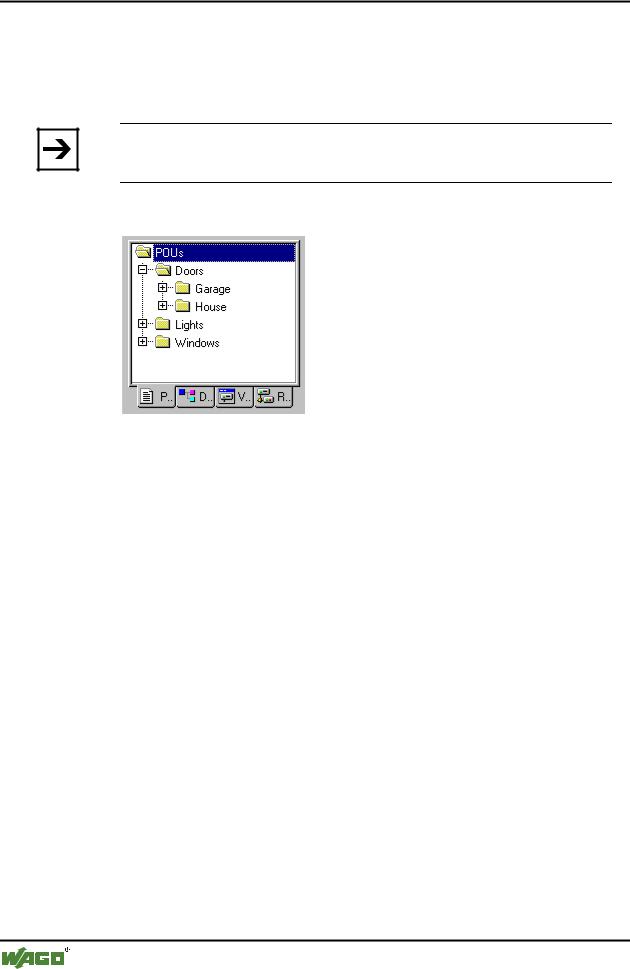
With Drag&Drop you can move the objects as well as the folders within their object type. For this select the object and drag it with pressed left mouse button to the desired position.
You can create more folders with the command 'New folder'.
Note:
Folders have no influence on the program, but rather serve only to structure your project clearly.
x Example of folders in the Object Organizer
4.4.3 'New Folder'
With this command a new folder is inserted as a structural object. If a folder has been selected, then the new one is created underneath it. Otherwise it is created on the same level. If an action is selected, the new folder will be inserted at the level of the POU to which the action belongs.
The context menu of the Object Organizer which contains this command appears when an object or the object type has been selected and you have pressed the right mouse button or <Shift>+<F10>.
The newly inserted folder initially has the designation 'New Folder'. Observe the following naming convention for folders:
Folders at the same level in the hierarchy must have distinct names. Folders on different levels can have the same name.
A folder can not have the same name as an object located on the same level.
If there is already a folder with the name "New Folder" on the same level, each additional one with this name automatically receives an appended, serial number (e.g. "New Folder 1"). Renaming to a name that is already in use is not possible.
4.4.4 'Expand nodes' 'Collapse nodes'
With the command expand the objects are visibly unfolded which are located in the selected object. With Collapse the subordinated objects are no longer shown.
WAGO-I/O-SYSTEM 759 WAGO-I/O-PRO 32

Components of WAGO-I/O-PRO 32 |
• 115 |
Managing Objects in a Project |
|
|
|
With folders you can open or close them with a double mouse click or by pressing <Enter>.
The context menu of the Object Organizer which contains this command appears when an object or the object type has been selected and you have pressed the right mouse button or <Shift>+<F10>.
4.4.5 'Project' 'Object Delete'
Shortcut: <Delete>
With this command the currently selected object (a POU, a data type, a visualization, or global variables), or a folder with the subordinated objects is removed from the Object Organizer and is thus deleted from the project
For safety you are asked once more for confirmation.
If the editor window of the object was open, then it is automatically closed.
If you delete with the command 'Edit' 'Cut', then the object is parked on the clipboard.
4.4.6 'Project' 'Object Add'
Shortcut: <Insert>
With this command you create a new object. The type of the object (POU, data type, visualization, or global variables) depends upon the selected register card in the Object Organizer. Enter the Name of the new POU in the dialog box which appears. Remember that the name of the object may not have already been used.
Take note of the following restrictions:
The name of a POU can not include any spaces
A POU can not have the same name as another POU, or a data type.
A data type can not receive the same name as another data type or a POU.
A global variable list can not have the same name as another global variable list.
An action can not have the same name as another action in the same POU.
A visualization can not have the same name as another visualization.
In all other cases, identical naming is allowed. Thus for example actions belonging to different POUs can have the same name, and a visualization may have the same as a POU.
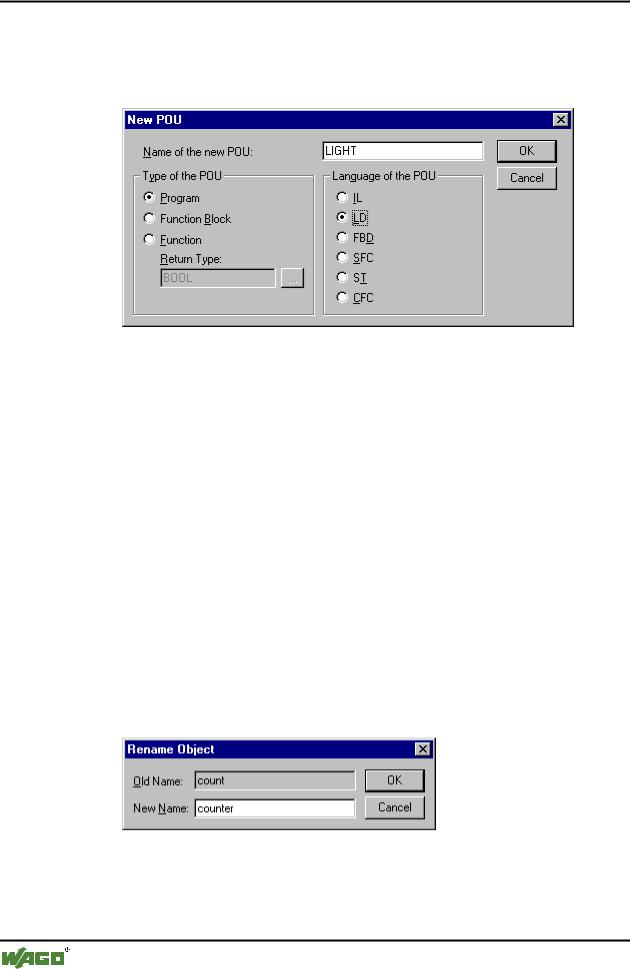
In the case of a POU, the POU type (program, function or function block) and the language in which it is programmed must also be selected. 'Program' is the default value of Type of the POU, while that of Language of the POU is that of most recently created POU. If a POU of the function type is created, the desired data type must be entered in the Return Type text input field. Here all
WAGO-I/O-SYSTEM 759 WAGO-I/O-PRO 32
116• Components of WAGO-I/O-PRO 32
Managing Objects in a Project
elementary and defined data types (arrays, structures, enumerations, aliases) are allowed. Input assistance (e.g. via <F2>) can be used.
x Dialog for creating a new POU
After pressing OK, which is only possible if there is no conflict with the naming conventions described above, the new object is set up in the Object Organizer and the appropriate input window appears.
If the command 'Edit' 'Insert' is used, the object currently in the clipboard is inserted and no dialog appears. If the name of the inserted object conflicts with the naming conventions (see above), it is made unique by the addition of a serial number appended with a leading underline character (e.g. "Rightturnsig_1").
4.4.7 'Project' 'Object Rename'
Shortcut: <Spacebar>
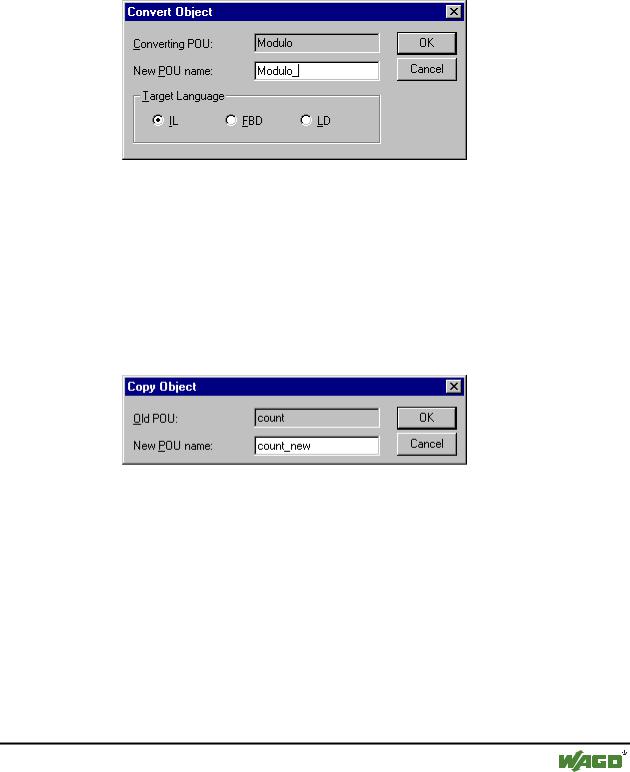
With this command you give a new name to the currently-selected object or folder. Remember that the name of the object may not have already been used.
If the editing window of the object is open, then its title is changed automatically when the name is changed.
x Dialog box for renaming a POU
4.4.8 'Project' 'Object Convert'
This command can only be used with POUs. You can convert POUs from the languages SFC, ST, FBD, LD, and IL into one of the three languages IL, FBD, and LD.
WAGO-I/O-SYSTEM 759 WAGO-I/O-PRO 32
Components of WAGO-I/O-PRO 32 |
• 117 |
Managing Objects in a Project |
|
|
|
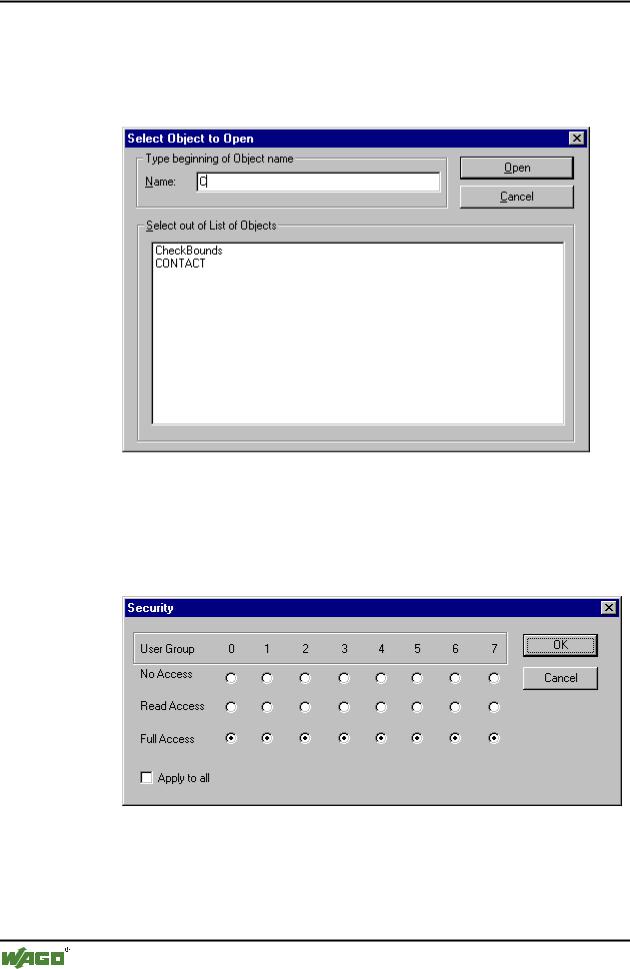
For this the project must be compiled. Choose the language into which you want to convert and give the POU a new name. Remember that the name of the POU may not have already been used. Then press OK, and the new POU is added to your POU list.
The type of processing that occurs during conversion corresponds to that which applies to compilation.
x Dialog box for converting a POU
4.4.9 'Project' 'Object Copy'
With this command a selected object is copied and saved under a new name. Enter the name of the new object in the resulting dialog box. Remember that the name of the object may not have already been used.
If, on the other hand, you used the command 'Edit' 'Copy', then the object is parked on the clipboard, and no dialog box appears.
x Dialog box for copying a POU
4.4.10'Project' 'Object Open'
Shortcut: <Enter>
With the command you load a selected object within the Object Organizer into the respective editor. If a window with this object is already open, then it gets a focus, is moved into the foreground and can now be edited.
There are two other ways of opening an object:
Doubleclick with the mouse on the desired object
type in the Object Organizer the first letter of the object name. Then a dialog box opens in which all objects of the available object types with this initial letter are shown. Select the desired object and click on the button
WAGO-I/O-SYSTEM 759 WAGO-I/O-PRO 32
118• Components of WAGO-I/O-PRO 32
Managing Objects in a Project
Open in order to load the object in its edit window. This option is supported with the object type Resources only for global variables.
This last possibility is especially useful in projects with many objects.
x Dialog box for choosing the object to be opened
4.4.11'Project' 'Object Access rights'
With this command you open the dialog box for assigning access rights to the different user groups. The following dialog box appears:
x Dialog box for assigning access rights
Members of the user group 0 can now assign individual access rights for each user group. There are three possible settings:
No Access: the object may not be opened by a member of the user group.
Read Access: the object can be opened for reading by a member of the user group but not changed.
WAGO-I/O-SYSTEM 759 WAGO-I/O-PRO 32