Материал: m912201e
Components of WAGO-I/O-PRO 32 |
• 119 |
Managing Objects in a Project |
|
|
|
Full Access: the object may be opened and changed by a member of the user group.
The settings refer either to the currently-selected object in the Object Organizer or, if the option Apply to all is chosen, to all POUs, data types, visualizations, and resources of the project.
The assignment to a user group takes place when opening the project through a password request if a password was assigned to the user group 0.
4.4.12'Project' 'Object properties'
This command is only available if a global variable list in the Object Organizer is marked. It opens the dialog 'Global Variable List', in which the parameters for the updating of the list and, if applicable, for data exchange of network global variables, are configured. Entries can be changed here. When a new global variable list is created, this dialog is opened with the command 'Insert Object' if the folder 'Global Variables' or any entry above is marked in the Object Organizer.
4.4.13'Project' 'Add Action'
This command is used to generate an action allocated to a selected block in the Object Organizer. One selects the name of the action in the dialog which appears and also the language in which the action should be implemented.
The new action is placed under your block in the Object Organiser. A plus sign appears in front of the block. A simple mouse click on the plus sign causes the action objects to appear and a minus sign appears in front of the block. Renewed clicking on the minus sign causes the actions to disappear and the plus sign appears again. This can also be achieved over the context menu commands 'Expand Node' and 'Collapse Node'.
4.4.14'Project' 'Open Instance'
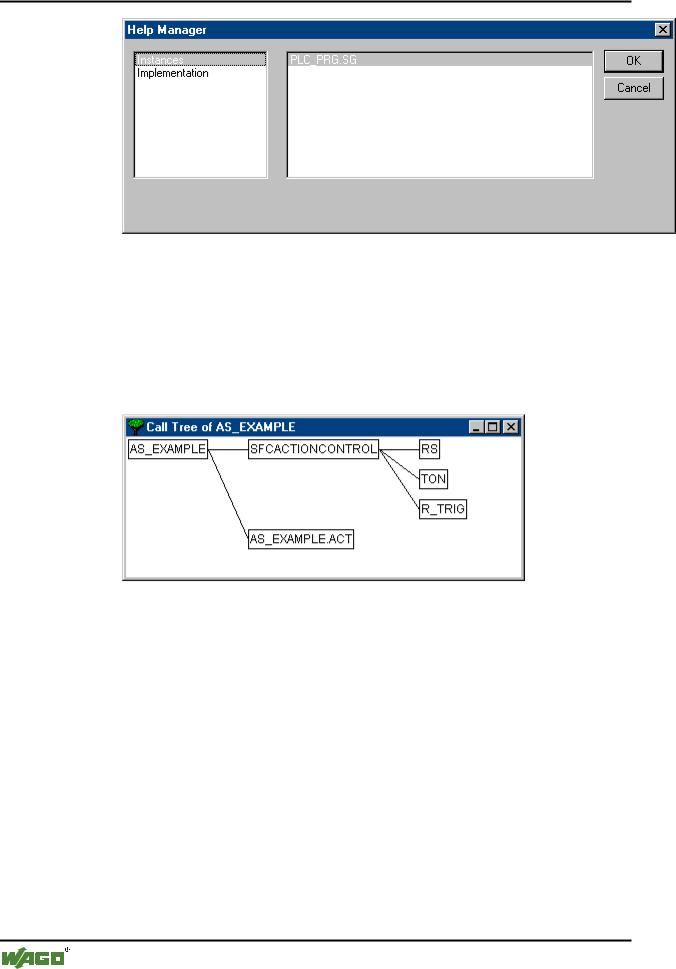
With this command it is possible to open and display the instance of the function block which is selected in the Object Organizer. In the same manner, a double click on the function block in the Object Organizer gives access to a selection dialog in which the instances of the function block as well as the implementation are listed. Select here the desired instance or the implementation and confirm using OK. The desired item is then displayed in a window.
Attention:
If you want to view instances, you first have to log in ! (The project has been compiled with no errors and downloaded to the PLC with 'Online' 'Login').
x Dialog for opening an instance
WAGO-I/O-SYSTEM 759 WAGO-I/O-PRO 32
120• Components of WAGO-I/O-PRO 32
Managing Objects in a Project
4.4.15'Project' 'Show Call Tree'
With this command you open a window which shows the call tree of the object chosen in the Object Organizer. For this the project must be compiled (see 'Rebuild all'). The call tree contains both calls for POUs and references to data types.
x Example of a call tree
4.4.16'Projekt' 'Show cross reference'
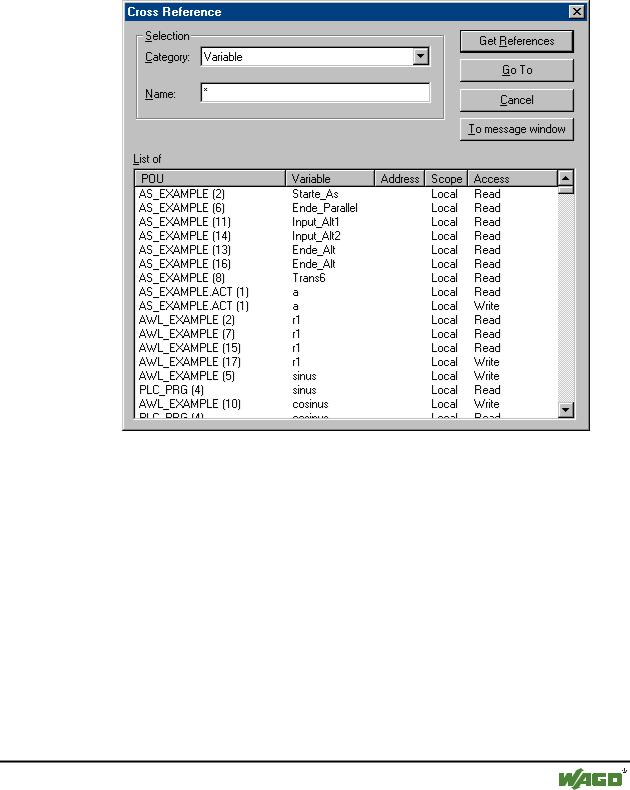
With this command you open a dialog box which makes possible the output of all application points for a variable, address, or a POU. For this the project must be compiled (see 'Project' 'Build').
Choose first the category 'Variable', 'Address', or 'POU' and then enter the name of the desired element. To obtain all elements of the entered category enter a "*" in Name.
By clicking on the button Cross References you get the list of all application points. Along with the POU and the line or network number, the variable name and the address binding, if any, are specified. The Domain space shows whether this is a local or a global variable; the Access column shows whether the variable is to be accessed for ‚reading' or ‚writing' at the current location.
When you select a line of the cross reference list and press the button Go To or doubleclick on the line, then the POU is shown in its editor at the
WAGO-I/O-SYSTEM 759 WAGO-I/O-PRO 32
Components of WAGO-I/O-PRO 32 |
• 121 |
General Editing Functions |
|
|
|
corresponding point. In this way you can jump to all application points without a time-consuming search.
In order to make processing easier, you can use the Send to message window button to bring the current cross reference list into the message window and from there change to the respective POU.
x Dialog box and example of a cross reference list
4.5 General Editing Functions
You can use the following commands in all editors and some of them in the Object Organizer. The commands are located under the menu item 'Edit' and in the context menu that is opened with the right mouse button.
If the IntelliPoint-Software is installed on the computer, WAGO-I/O-PRO 32 supports all functions of the MS IntelliMouse. In all editors with zoom functionality: To magnify press the <Strg> key while rolling the wheel of the mouse, to reduce roll backwards while the <Strg> key is pressed.
4.5.1 'Edit' 'Undo'
Shortcut: <Ctrl>+<Z>
This command undoes the action which was most recently executed in the currently-open editor window or in the Object Organizer; repeated use undoes
WAGO-I/O-SYSTEM 759 WAGO-I/O-PRO 32
122• Components of WAGO-I/O-PRO 32
General Editing Functions
all actions back to the time that the window was opened. This applies to all actions in the editors for POUs, data types, visualizations and global variables and in the Object Organizer.
With 'Edit' 'Redo' you can restore an action which you have undone.
Note:
The commands Undo and Redo apply to the current window. Each window carries its own action list. If you want to undo actions in several windows, then you must activate the corresponding window. When undoing or redoing in the Object Organizer the focus must lie here.
4.5.2 'Edit' 'Redo'
Shortcut: <Ctrl>+<Y>
With the command in the currently-open editor window or in the Object
Organizer you can restore an action you have undone ('Edit' 'Undo').
As often as you have previously executed the command 'Undo' , you can also carry out the command 'Redo'.
Note:
The commands 'Undo' and 'Redo' apply to the current window. Each window carries its own action list. If you want to undo actions in several windows, then you must activate the corresponding window. When undoing or redoing in the Object Manager must lie there.
4.5.3 'Edit' 'Cut'
Symbol: |
Shortcut: <Ctrl>+<X> or <Shift>+<Delete> |
This command transfers the current selection from the editor to the clipboard. The selection is removed from the editor.
In the Object Organizer this similarly applies to the selected object, whereby not all objects can be deleted, e.g. the PLC Configuration.
Remember that not all editors support the cut command, and that its use can be limited in some editors.
The form of the selection depends upon the respective editor:
In the text editors IL, ST, and declarations the selection is a list of characters.
In the FBD and LD editors the choice is a number of networks which are indicated by a dotted rectangle in the network number field or a box with all preceding lines, boxes, and operands.
WAGO-I/O-SYSTEM 759 WAGO-I/O-PRO 32
Components of WAGO-I/O-PRO 32 |
• 123 |
General Editing Functions |
|
|
|
In the SFC editor the selection is a part of a series of steps surrounded by a dotted rectangle.
In order to paste the content of the clipboard you use the command 'Edit' 'Paste'. In the SFC editor you can also use the commands 'Extras' 'Insert parallel branch (right)' or 'Extras' 'Paste after'.
In order to copy a selection onto the clipboard without deleting it, use the command 'Edit' 'Copy'.
In order to remove a selected area without changing the clipboard, use the command 'Edit' 'Delete'.
4.5.4 'Edit' 'Copy'
Symbol: |
Shortcut: <Ctrl>+<C> |
This command copies the current selection from the editor to the clipboard. This does not change the contents of the editor window.
With the Object Organizer this similarly applies to the selected object, whereby not all objects can be copied, e.g. the PLC Configuration.
Remember that not all editors support copying and that it can be limited with some editors.
For the type of selection the same rules apply as with 'Edit' 'Cut'.
The form of the selection depends upon the respective editor:
In the text editors (IL, ST, and declarations) the selection is a list of characters.
In the FBD and LD editors the choice is a number of networks which are indicated by a dotted rectangle in the network number field or a box with all preceding lines, boxes, and operands.
In the SFC editor the selection is a part of a series of steps surrounded by a dotted rectangle.
In order to paste the content of the clipboard you use the command 'Edit' 'Paste'. In the SFC editor you can also use the commands 'Extras' 'Insert parallel branch (right)' or 'Extras' 'Paste after'.
In order to delete a selected area and simultaneously put it on the clipboard, use the command 'Edit' 'Cut'.
4.5.5 'Edit' 'Paste'
Symbol: |
Shortcut: <Ctrl>+<V> |
WAGO-I/O-SYSTEM 759 WAGO-I/O-PRO 32