272 • ETHERNET Network communication
5.2.2.1ETHERNET
ETHERNET address (MAC-ID)
Each WAGO ETHERNET fieldbus coupler is provided from the factory with a unique and internationally unambiguous physical ETHERNET address, also referred to as MAC-ID (Media Access Control Identity). This can be used by the network operating system for addressing on a hardware level.
The address has a fixed length of 6 Bytes (48 Bit) and contains the address type, the manufacturer’s ID, and the serial number.
Examples for the MAC-ID of a WAGO ETHERNET fieldbus coupler (hexadecimal): 00H-30H-DEH-00H-00H-01H.
ETHERNET does not allow addressing of different networks.
If an ETHERNET network is to be connected to other networks, higherranking protocols have to be used.
Note
If you wish to connect one or more data networks, routers have to be used.
ETHERNET Packet
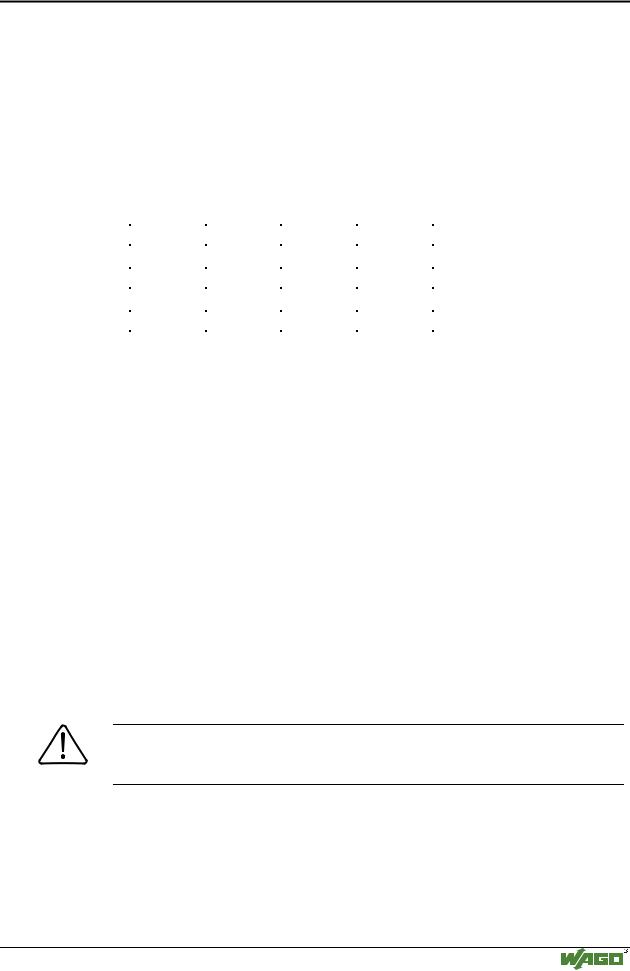
The datagrams exchanged on the transmission medium are called “ETHERNET packets” or just “packets”. Transmission is connectionless; i.e. the sender does not receive any feedback from the receiver. The data used is packed in an address information frame. The following figure shows the structure of such a packet.
|
Preamble |
ETHERNET- |
ETHERNET_Data |
Check sum |
|
Header |
|
|
|
|
|
8 Byte |
14 Byte |
46-1500 Byte |
4 Byte |
|
|
|
|
|
Fig. 5-9: ETHERNET-Packet
The preamble serves as a synchronization between the transmitting station and the receiving station. The ETHERNET header contains the MAC addresses of the transmitter and the receiver, and a type field.
The type field is used to identify the following protocol by way of unambiguous coding (i.e. 0800hex = Internet Protocol).
5.2.2.2IP-Protocol
The Internet protocol divides datagrams into segments and is responsible for their transmission from one network subscriber to another. The stations involved may be connected to the same network or to different physical networks which are linked together by routers.
Routers are able to select various paths (network transmission paths) through connected networks, and bypass congestion and individual network failures. However, as individual paths may be selected which are shorter than other paths, datagrams may overtake each other, causing the sequence of the data packets to be incorrect.
Therefore, it is necessary to use a higher-level protocol, for example, TCP to guarantee correct transmission.