
Материал: m012900e

Внимание! Если размещение файла нарушает Ваши авторские права, то обязательно сообщите нам

ETHERNET • 267

Network architecture

5.1.3Coupler modules

There are a number of coupler modules that allow for flexible arrangement for setting up an ETHERNET network. They also offer important functions, some of which are very similar.

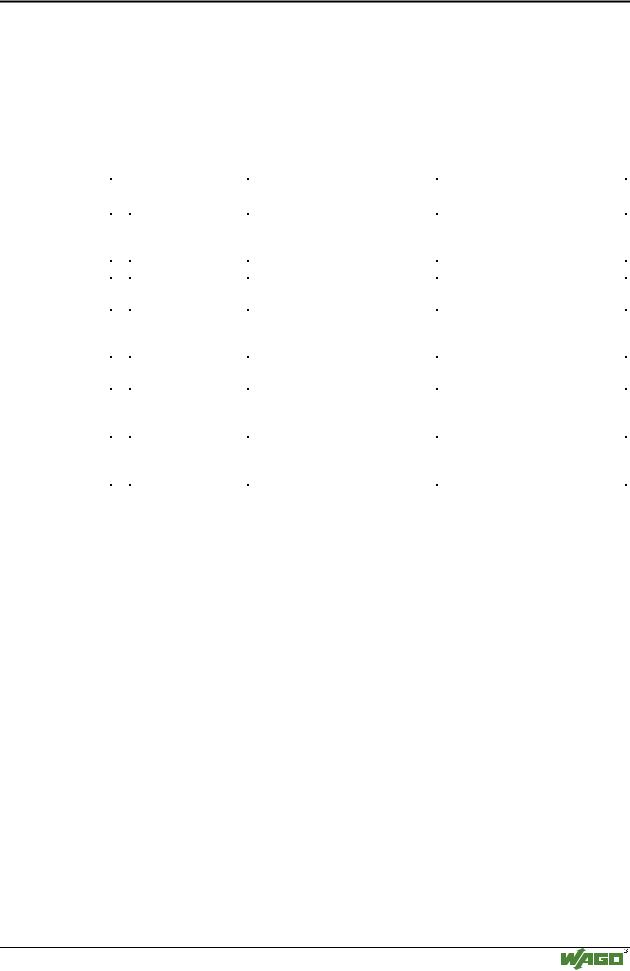
The following table defines and compares these modules and is intended to simplify the correct selection and appropriate application of them.

Module

Repeater

Bridge

Switch

Characteristics/application

ISO/OSI


layer


Amplifier for signal regeneration,

1

connection on a physical level.


Segmentation of networks to increase the length.

2


Multiport bridge, i.e. each port has a separate bridge function.

2 (3)

Logically separates network segments, thereby reducing network


traffic.


Consistent use makes ETHERNET collision-free.


Hub

Used to create star topologies, supports various transmission


media, does not prevent any network collisions.


Router

Links two or more data networks.


Matches topology changes and incompatible packet sizes (i.e.


industrial and office areas).


Gateway

Links two manufacturer-specific networks which use different


software and hardware (i.e. ETHERNET and Interbus-Loop).


Tab. 5-3: Comparison of coupler modules for networks

2

3

4-7

Modular I/O System

ETHERNET TCP/IP

268 • ETHERNET Important terms

5.1.4Important terms

Data security

If an internal network (Intranet) is to be connected to the public network (i.e. Internet) then data security is an extremely important aspect.

Undesired access can be prevented by a Firewall.

Firewalls can be implemented in software or network components. They are interconnected in a similar way to routers as a switching element between Intranets and the public network. Firewalls are able to limit or completely block all access to the other networks, depending on the access direction, the service used and the authenticity of the network user.

Real-time ability

Transmission above the fieldbus system level generally involves relatively large data quantities. The permissible delay times may also be relatively long (0.1...10 seconds).

However, real-time behavior within the fieldbus system level is required for ETHERNET in industry.

In ETHERNET it is possible to meet the real-time requirements by, i.e. restricting the bus traffic (< 10 %), by using a master-slave principle, or also by implementing a switch instead of a hub.

MODBUS/TCP is a master/slave protocol in which the slaves only respond to commands from the master. When only one master is used, data traffic over the network can be controlled and collisions avoided.

TCP/IP

TCP/IP was developed for standardized information exchange between any amount of different networks. TCP/IP is not dependent upon the hardware and software used. Although it is often used as one term, it consists of a suite of superimposed protocols: i.e. IP, TCP, UDP, ARP and ICMP.

> IP:

The Internet Protocol IP specifies the correct addressing and de-


livery of the data packets.

> TCP

The Transmission Control Protocol TCP superimposed on IP is a


connection-orientated transport protocol.

> UDP

UDP is a connectionless transport protocol.

> ICMP

Internet Control Message Protocol

> ARP

Conversion of IP addresses into MAC addresses

Modular I/O System

ETHERNET TCP/IP

ETHERNET 269

Important terms

Shared ETHERNET

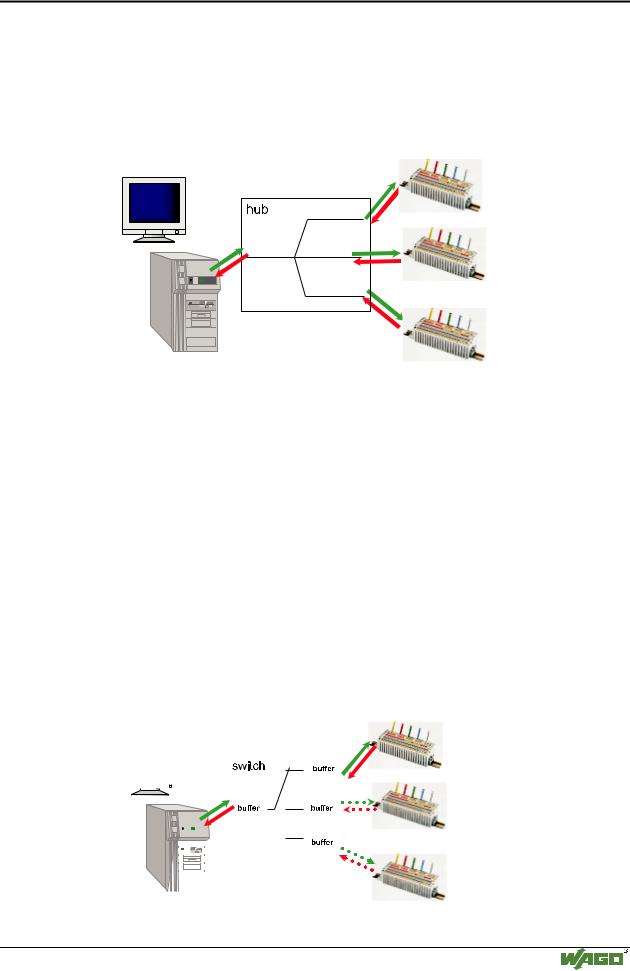
Several nodes linked via a hub share a common medium. When a message is sent from a station, it is broadcast throughout the entire network and is sent to each connected node. Only the node with the correct target address processes the message. Collisions may occur and messages have to be repeatedly transmitted as a result of the large amount of data traffic. The delay time in a Shared ETHERNET cannot be easily calculated or predicted.

Fig. 5-6: Principle of Shared ETHERNET

G012910e

Deterministic ETHERNET

The TCP/IP software or the user program in each subscriber can limit transmittable messages to make it possible to determine real-time requirements. At the same time the maximum medium message rate (datagram per second), the maximum medium duration of a message, and the minimum time interval between the messages (waiting time of the subscriber) is limited.

Therefore, the delay time of a message is predictable.

Switched ETHERNET

In the case of Switched Ethernet, several fieldbus nodes are connected by a switch. When data from a network segment reaches the switch, it saves the data and checks for the segment and the node to which this data is to be sent. The message is then only sent to the node with the correct target address. This reduces the data traffic over the network, extends the bandwidth and prevents collisions. The runtimes can be defined and calculated, making the Switched Ethernet deterministic.


Fig. 5-7: Principle of Switched ETHERNET

G012909e

Modular I/O System

ETHERNET TCP/IP

270 • ETHERNET Network communication

5.2 Network communication

5.2.1Channel access method

In the ETHERNET Standard, the fieldbus node accesses the bus using

CSMA/CD (Carrier Sense Multiple Access/ Collision Detection).

Carrier Sense:

The transmitter senses the bus.

Multiple Access:

Several transmitters can access the bus.

Collision Detection:

A collision is detected.

Each station can send a message once it has established that the transmission medium is free. If collisions of data packets occur due to several stations transmitting simultaneously, CSMA/CD ensures that these are detected and the data transmission is repeated.

However, this does not make data transmission reliable enough for industrial requirements. To ensure that communication and data transmission via ETHERNET is reliable, various communication protocols are required.

5.2.2Communication protocols

In a WAGO ETHERNET fieldbus coupler, several important communication protocols are implemented in addition to the ETHERNET Standard:

>IP, ICMP and ARP on the third ISO/OSI layer (network layer)

>TCP and UDP on the fourth ISO/OSI layer (transport layer).

Moreover, the fieldbus coupler contains several additional user protocols, which use these protocols for transmitting and receiving data.

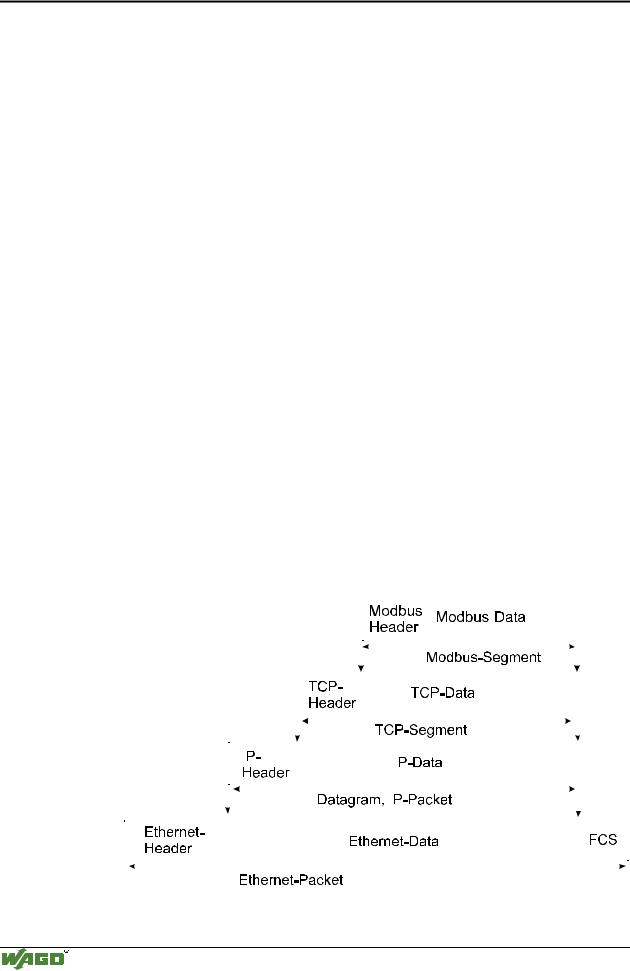
The following diagram is intended to explain how the protocols and their functions are layered and their data packets nested in each other for transmission. A detailed description of the tasks and addressing schemes of these protocols is contained in the following chapter.


Fig. 5-8: Communication protocols


G012907e

Modular I/O System

ETHERNET TCP/IP

ETHERNET 271

Network communication

ETHERNET layers with TCP/IP compared to the ISO-OSI reference model

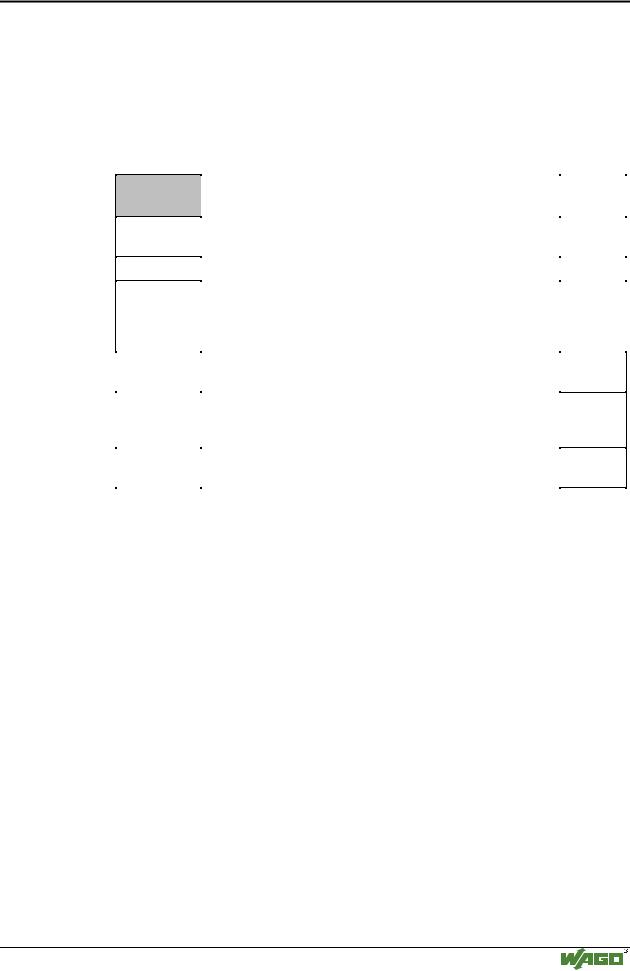
The communication software TCP/IP is superior to ETHERNET. Together with ETHERNET, TCP/IP represents the typical layer structure.

-

-

ETHERNET = layer 1 to 4

TCP/IP = layer 3 and 4


ISO-OSI-layer

in comparison with


Tasks


ETHERNET


Application

-

Ensures the compatibility

7

Application Layer

= Application software, protocols


between applications


and services


6

Presentation Layer


-

Data interpretation

5

Session Layer


- Opening and closing sessions


-

Communication control


Transport

-

Transmission control

4

Transport Layer

= Transport Control Protocol


TCP


3

Network Layer

Internet

-

Addressing and routing

= Internet Protocol IP


Network-Interface

-

Frame format

2

Data Link Layer

= Packet-Driver

-

Medium access control


- Coding and medium access


Hardware

-

Making electrical connection

1

Physical Layer

= ETHERNET –Coupler

-

Laying down all physical


and mechanical parameters

Modular I/O System

ETHERNET TCP/IP