134 C. M. Signorelli and X. D. Arsiwalla
answer can be taken as the direct meaning of each concept and use it to reduce sentences. However, this second option is less simple than the first option.
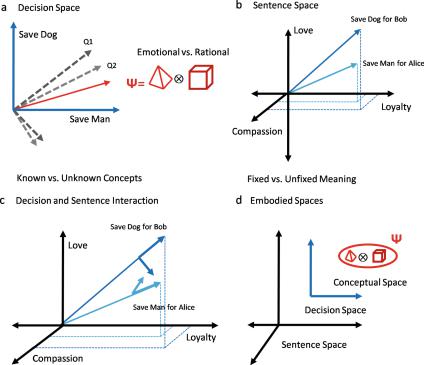
With the semantic space for each subject, the answer to the “why” question can be quantified in terms of the sentence meaning (interaction or projection into word and sentence space) for each sentence. These answers and sentences contain the essential features of a moral thought and the meaning is expected to change from simple meaning to more complexes, depending on how complex is the dilemma (more or less degree of emotional and rational confrontation).
One consequence of this analysis would be the possibility to predict or at least correlate the final decision according to the subjective meaning of individual words, with respect to each dilemma. At the same time, general meanings can be inferred even when decisions can be completely different. For example, if “Bob likes Dogs”, it is possible that Bob would save the dog instead of the man, while if Alice, who hypothetically does not like dogs, would likely do the opposite. However, if a quality dimension is defined with respect to emotions vs. reasons, and sentence meaning with respect to values like love, loyalty among others (Fig. 3), the final meaning for Bob saving the Dog could be similar than the meaning of saving the man for Alice (Fig. 3b). In other words, apparently different decisions would have similar meanings, and the opposite can be also true: same decisions hide completely different ones.
The way how these meanings evolve from context to context is what we refer here as one general property of high-level cognition associated with QC effects and subjectivity, which in the end can be quantified and compared thanks CCMM. In other words, QC and CCMM will be used to compute some kind of subjectivity in a way that is compared across subjects, making this approach a novel tool to complement the phenomenological program suggested by Varela in [35].
5.4Step IV. Application for AI
The last step would be the implementation of moral dilemmas in AI programs using QC to search for non-commutative structures and CCMM to compute their “why” answers. Thanks to some variations in CCMM and QC (step 1), the decisions and meaning of answers would be directly computed and the structure of meaning across human compared with the meaning across different instances of AI programs, developing a way to compare subjective features across humans and machines.
This implementation is not something trivial and will require a big effort in both, previous validation of moral dilemmas in human (preliminary steps) and then adaptations for AI. For example, it is expected to arrange similar experiences than step II, and simulate different instances to compute the same effect (if there is or not) comparing changes in the kind of structure for different versions of our dilemmas. Concretely, AI would be adapted to answer the same experimental set-ups for human, but any modification in order to facilitate or not the answers of the software will be avoided. Then, QC effects will be quantified in the same way than humans and the meaning of their answers will be “computed” using the same strategy than in human experiments, from the semantic space defined by the machine.
Therefore, the first attempt would be searching for a simple “understanding” of context, i.e. if AI programs can distinguish and differentiate versions of the same moral