Moral Dilemmas for Artificial Intelligence |
129 |
4.1Categorical Compositional Model of Meaning
Applications of CCMM basically needs: (1) Define a compositional structure as a grammar category (e.g. pre-groups grammar); (2) Define a meaning space as a semantic category, for example vector space or conceptual space of meaning; and finally,
(3) Connect both categories in some way that it is possible to interpret the grammar category into the semantic category (mathematically, one has to define a functor between categories) [8]. Thus, some useful concepts are:
Compositional Structures. In CCMM, compositional structures are certain rules/definitions about how elements compound each other. In other words, how processes, states, effects, among other possible elements, compound. Grammatical types and their composition are described using a pregroup algebra due to Lambek [31]. However, any kind of grammar definition can, in principle, be implemented. Grammar will be interpreted as the way how word meanings interact, defining first primitive types as nouns n, sentences s, and then other types like adjectives nnl, and verbs, for instance, a transitive verb as nrsnl, among other kinds of words to form complex sentences.
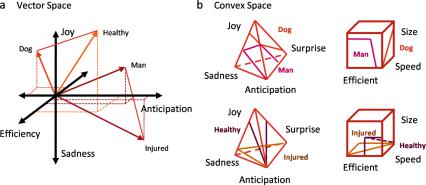
Semantic Spaces. Semantic spaces are spaces where individual words are defined with respect to each other. The simplest way is using distributional approaches to define vectors of meaning for each word (Fig. 2a), or even better, defining density matrices. The choice of a basis vector and how to build other words, adjectives and verbs from the basis, is not trivial and it can be done in many different ways. Of course, it will depend on what the experimenter would like to describe and compare.
Conceptual Spaces. The idea of conceptual spaces, recently suggested in [32], is a more cognitively realistic way to define semantic spaces. This approach is called convex conceptual spaces. In short, concepts can be defined by a combination of others primitive features or quality dimensions, building spaces which can be superposed or not, to define regions of similarity. One perceptual example is to define taste based on some features such as: Saline, Sweet, Sour, and Bitter. Then, different kind of food would be described with a certain level of each taste dimension, and where other features like colour, texture, can also be incorporated [29]. Other complex example is defining elements regarding emotional states and factual features (Fig. 2b). Additionally, conceptual spaces require two semantic/meaning spaces, one for words in a quality dimension space (Fig. 2) and other for sentences in a “sentence meaning space” (Fig. 3a), then, the final sentence meaning is an “interaction” between both spaces.
Computing the Meaning of a Sentence. Diagrammatically, the final meaning of one sentence will be the meaning of individual words interacting according to the grammatical structure, defined as a process [8, 29].
4.2Proof of Concept: Compositional Quantum Cognition
In our framework, meaning is the interaction between external and internal objects, understanding external objects/contents as transductions of external stimuli, while internal objects/contents would correspond to the “space of transduction” that will help