Материал: искусственный интеллект
suai.ru/our-contacts |
quantum machine learning |
52 P. D. Bruza and P. Wittek
random variable, which is the basic building block of probabilistic models. This subtlety hinges on whether random variables can justifiably be considered to be independent of the measurement context in which they are used [7]. Within the quantum cognition community, there has been mounting speculation that human information processing is quantum-like contextual, e.g., in human conceptual processing [3, 9, 18] and perception [4, 5, 23].
Investigations into contextuality in human cognition have thus far relied on translating experimental designs from quantum physics to human experimental settings, with Bell scenario designs being most often employed. This translation involves quite a tricky process of navigation. Bell scenario designs require the no-signalling condition to hold, however, human cognition, however, seems to be replete with signalling. Fortunately, theoretical results allow contextuality to be meaningfully analysed when signalling is present [12] and successfully applied in [10]. Quantifying the amount of signalling is critical in verifying non-locality in quantum physics and an experimentally relevant formalism has been devised [11], and it is related to the proposal in [12].
A measurement context in quantum physics comprises observables that are jointly measurable, so the order in which the observables within a given context are measured will not a ect the associated statistics. This requirement, however, presents an additional challenge for contextuality experiments in human cognition due to the almost ubiquitous presence of order e ects.
In the light of preceding challenges, this article presents a framework for conducting contextuality experiments in human cognition. It has two fundamental components. A probabilistic programming language (PPL) which aims to allow experimenters to easily express contextuality experiments. A key feature in this regard are syntactic scopes which allow random variables to be safely overloaded whilst preserving their functional identity. Secondly, the syntactic components of the program are mapped to theoretical construct known as a contextuality scenario. These can be then composed to form a composite contextuality scenario corresponding to the whole program. If there are no probabilistic models that span this composite contextuality scenario, then the phenomenon modelled by the PPL is deemed contextual.
2A Framework for Determining Contextuality in Human Information Processing
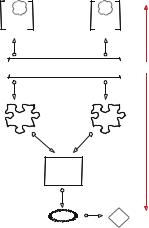
Figure 1 depicts the framework for contextuality analysis. A cognitive phenomenon P is to be studied to determine whether it is contextual. An experimental design is devised in which P is examined in various experimental conditions called “measurement contexts”. A measurement context Mi is designed to study P from a particular experimental perspective. The collective measurement contexts aim to reveal a total picture of P in terms of a global model.
suai.ru/our-contacts |
quantum machine learning |
Probabilistic Programs for Investigating Contextuality |
53 |
The design of the experiment is conceived by the modeller and specified by a PPL. PPLs unify techniques from conventional programming such as modularity, imperative or functional specification, as well as the representation and use of uncertain knowledge. A variety of PPLs have been proposed (see [17] for references), which have attracted interest from artificial intelligence, programming languages, cognitive science, and the natural language processing communities [15]. However, unlike conventional programming languages, which are written with the intention to be executed, a core purpose of a probabilistic program is to specify a model in the form of a probability distribution. In short, PPLs are high-level and universal languages for expressing and computing with probabilistic models in a wide variety of application settings. To the best of our knowledge, PPLs have not yet been applied to investigate contextuality, though some initial ideas in this direction have been put forward [6, 7].
|
|
|
Experiment |
We will now illustrate a probabilis- |
|||
P |
measurement |
P |
|
|
|
tic program (P-program) by means of an |
|
|
|
|
|
|
|||
M1 |
contexts |
Mn |
|
|
|
||
|
|
|
example. Order e ect experiments involve |
||||
|
|
|
|
|
|
|
|
|
|
|
|
|
|
|
two measurement contexts each involving |
|
Experimental Design |
|
|
|
|
two dichotomous variables A and B which |
|
(probabilistic program) |
|
|
|
represent answers to yes/no questions QA |
|||
|
|
|
|
|
|
|
|
|
contextuality |
|
|
|
|
and QB . In one measurement context, the |
|
|
scenarios |
|
Xj |
|
|
|
question QA is served before question QB |
X1 |
|
|
|
|
and in the second measurement context |
||
|
|
|
|
|
|
|
|
|
|
|
|
|
|
|
the reverse order is served, namely QB |
composite |
|
|
|
|
|
then QA. Order e ects occur when the |
|
contextuality X |
|
|
|
|
|
answer to the first question influences the |
|
scenario |
|
|
|
|
|
answer to the second. These two measure- |
|
|
|
|
|
|
|
|
|
|
LP |
|
|
|
|
|
ment contexts are syntactically specified |
|
|
p? |
Theory |
|
by the scopes P1 and P2 shown in Fig. 2. |
||
|
|
|
|
|
|||
Fig. 1. |
Framework for contextuality |
||||||
analysis |
|
|
|
|
|
|
|
|
1 |
var |
P1 = context () { |
||||
|
2 |
|
var |
A |
= |
flip (0.7) |
|
|
3 |
|
var |
B |
= |
A ? flip (0.8): flip (0.1) |
|
|
4 |
|
var p =[A ,B] |
||||
|
5 |
|
return |
|
{ Infer ({ samples :1000} , p} |
||
|
6 |
}; |
|
|
|
|
|
|
7 |
var |
P2 = context () { |
||||
|
8 |
|
var |
B |
= |
flip (0.4) |
|
|
9 |
|
var |
A |
= |
B ? flip (0.4): flip (0.6) |
|
|
10 |
|
var p =[B ,A] |
||||
|
11 |
|
return |
|
{ Infer ({ samples :1000} , p} |
||
12};
13return { model (P1 , P2 )}
Fig. 2. Example order e ects P-program.
suai.ru/our-contacts |
quantum machine learning |
54 P. D. Bruza and P. Wittek
In this P-program, syntax of the form var B = A ? flip(0.8): flip(0.1) models the influence of the answer of QA on QB via a pair of biased coins. In this case, if QA = y, then the response to QB is determined by flipping an 80% biased coin. Conversely, if QA = n, then the response to QB is determined by flipping a 10% biased coin (the choices of such biases are determined by the modeller). It should be noted that the measurement contexts in the order e ects program do not reflect the usual understanding of measurement context employed in experiments analyzing contextuality in quantum physics. In these experiments, a measurement context comprises observables that are jointly measurable, so the order in which the observables within a given context are measured will not a ect the associated statistics. However, in human information processing experiments order e ects are often encountered. Therefore, we take the view that P-progams used to investigate contextuality in human information processing should provide syntactic support for measurement contexts where order e ects between random variables are occurring.
A number of theoretical frameworks have been developed in order to study contextuality: sheaf theory [1], generalized probability theory [13] and hypergraphs [2]. In the following, hypergraphs are used because their modularity allows a straightforward association with syntactic scopes. The basic theoretical construct is a “contextuality scenario”. Definition 2.2.1 [2] states that a contextuality scenario is a hypergraph X = (V, E) such that:
–v V denotes an outcome which can occur in a measurement context
–e E is the set of all possible outcomes given a particular measurement context
The set of hyperedges E are determined by both the measurement contexts as well as the measurement protocol. Each measurement context is represented by an edge in the hypergraph X.
The basic idea is that each syntactic scope in a P-program will lead to a hyperedge, where the events are a complete set of outcomes in the given measurement context specified in the associated scope. Additional hyperedges are a consequence of the constraints inherent in the measurement protocol that is applied. In some cases, hyperedges will have a non-trivial intersection: If v e1 and v e2, then this represents the idea that the two di erent measurement outcomes corresponding to v should be thought of as equivalent as will be detailed below by using an order e ects experiment as an example.
Contextuality scenarios Xi are composed into a composite contextuality scenario X, which aims to be a total theoretical picture of the phenomenon P . The composition must be sensitive to the experimental design, e.g., the no-signalling condition.
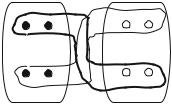
We will now use the order e ects example to illustrate the associated contextuality scenario which is shown in Fig. 3.
suai.ru/our-contacts |
quantum machine learning |
Probabilistic Programs for Investigating Contextuality |
55 |
Firstly, the set of V of events (measurement outcomes) comprises all possible combinations of yes/no answers to the questions QA and QB , namely V = {A = 1 B = 1, A = 1 B = 0, A = 0 B = 1, A = 0 B = 0}, where 1 denotes ‘yes’ and 0 denotes ‘no’.
In this figure, the two rounded rectangles represent the events within the two measurement contexts specified by the
syntactic scopes P1 and P2. For example, in the rectangle labeled P1, “11” is shorthand for the event A = 1 B = 1, “10”
is shorthand for the event A = 1 B = 0, etc. Observe that the corresponding hyperedges (rounded rectangles) contain an exhaustive, mutually exclusive set of events. This is also the case with the two spanning hyperedges going across these rectangles. These spanning edges help illustrate events that are considered to be equivalent.
Firstly, it is reasonable to assume answering yes (or no) to both questions in either measurement context represents equivalent events. Therefore, the events labelled p1 and p4 can respectively be assumed equivalent to q1 and q4. It becomes a little more subtle when the polarity of the answers di er. For example, the event labelled p3 represents the event A = 0 B = 1, remembering that question QA was asked before question QB in this context. The equivalent event in hyperedge P2 is labelled q2, which corresponds the event B = 1 A = 0, where question B is asked before question A. As conjunction is commutative, it is reasonable to view these two converse events as equivalent. In summary, if p3 is equivalent to q2 and p4 is equivalent to q4 then the hyperedge {p1, p2, q2, q4} (the dashed hyperedge in Fig. 3) can be established, in addition to the hyperedge {p1, p2, p3, p4}.
How to determine contextuality
A probabilistic model corresponding to a contextuality scenario X is the mapping of measurement outcomes to a probability p : V → [0, 1] (Definition 2.4.1 in [2]). Ref. [19] points out that
“By defining probabilistic models in this way [rather than by a function pe(V ) depending on the measurement e performed], we are assuming that in the set of experimental protocols that we are interested in, the probability for a given outcome is independent of the measurement that is performed”.
Defining probabilistic models in this way formalizes the assumption mentioned in the introduction, namely that random variables are independent of the measurement context and thus have a single functional identity. Without a single
suai.ru/our-contacts |
quantum machine learning |
56 P. D. Bruza and P. Wittek
functional identity it is impossible to assign a random variable to represent the outcomes of the same measurement protocol in di erent measurement contexts.
It is a requirement that the mapping adheres to the expected normalization condition: e E : v e p(v) = 1. By way of illustration, consider once again Fig. 3. This contextuality scenario has four edges. The normalization condition enforces the following constraints:
p1 + p2 + p3 + p4 |
= 1 |
(1) |
|
q1 + q2 |
+ q3 + q4 |
= 1 |
(2) |
p1 + p2 |
+ q3 + q4 |
= 1 |
(3) |
p3 + p4 |
+ q1 + q2 |
= 1 |
(4) |
where pi, 1 ≤ i ≤ 4 and qj , 1 ≤ j ≤ 4 denote the probabilities of outcomes in the four hyperedges. A definition of contextuality can now be presented.
Definition 1 (Probabilistic contextuality). (General contextuality [2]). Let
X = (V, E) be a contextuality scenario. Let G(X) denote the set of probabilistic models on X. X is deemed “contextual” if G(X) = .
Probabilistic contextuality occurs when there is no probabilistic model p corresponding to composite contextuality scenario X. Determining whether X is contextual is computable by a linear program [2].
3Using Probabilistic Programs to Simulate Bell Scenario Experiments
One of the advantages of using a programming approach to develop probabilistic models is that experimental designs can be syntactically specified in a modular way. In this way, a wide variety of experimental designs across fields can potentially be catered for. For example, consider the situation where an experimenter wishes to determine whether a system S can validly be modelled compositionally in terms of two component subsystems A and B. Two di erent experiments can be carried out upon each of the two presumed components, which will answer a set of ‘questions’ with binary outcomes, leading to four measurement contexts. For example, one experimental context would be to ask A1 of component A and B1 of component B. In Bell scenario experiments, four measurement contexts are typically used: {{A1, B1}, {A1, B2}, {A2, B1}, {A2, B2}}. Bell scenario designs has been widely employed in cognitive psychology to test for contextuality in human cognition [3, 9, 14, 18].
One way to think about system S is that it is equivalent to a set of biased coins A and B, where the bias is local to a given measurement context. Figure 4 depicts a P-program that follows this line of thinking.