Материал: искусственный интеллект
suai.ru/our-contacts |
quantum machine learning |
Are Decisions of Image Trustworthiness Contextual? A Pilot Study |
47 |
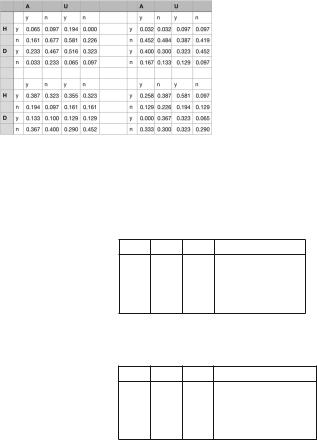
Fig. 3. Pairwise probability distributions corresponding to Eq. (1) for Putin (top left), Shark (top right), Girl (bottom left), antelope (bottom right). Variables H - honest/safe, D - dishonest/unsafe, A -altered, U - unaltered
Table 1. Di erences in marginal probabilities: Putin (L) and Shark (R)
|
|
|di | |
z−score (p−val) |
0.161 |
0.194 |
0.032 |
-0.894 (0.896) |
0.733 |
0.839 |
0.105 |
-0.894 (0.381) |
0.226 |
0.300 |
0.074 |
-0.333 (0.751) |
0.774 |
0.581 |
0.194 |
1.344 (0.192) |
|di | z−score (p−val)
0.065 0.194 0.129 -0.430 (0.742)
0.700 0.774 0.074 -0.566 (0.578)
0.484 0.567 0.083 -0.468 (0.647)
0.484 0.452 0.032 0.174 (0.864)
Table 2. Di erences in marginal probabilities: Girl (L) and Antelope (R)
|
|
|di | |
z−score (p−value) |
0.710 |
0.677 |
0.032 |
0.229 (0.821) |
0.233 |
0.258 |
0.025 |
-0.111 (0.915) |
0.581 |
0.5 |
0.081 |
-0.463 (0.649) |
0.516 |
0.419 |
0.097 |
0.519 (0.611) |
|
|
|
|
|di | z−score (p−value)
0.645 0.677 0.032 -0.218 (0.830)
0.367 0.387 0.020 -0.101 (0.922)
0.387 0.333 0.053 0.261 (0.799)
0.774 0.645 0.129 0.945 (0.355)
4.4Results
Tables 1 and 2 show that di erences in marginal probabilities vary across all four images. Z–scores were computed to determine whether the di erences between marginal probabilities were significant. None of these di erences where found to be significant. Table 3 reveals that 0 < 1 for all images which means that the system of CHSH inequalities (11)–(14) can be meaningfully applied to determine the presence of contextuality. The resulting analyses revealed no violations as none of the maximum CHSH values exceeded the degree of contextuality required.
4.5Discussion
The di erences in marginal probabilities reveal that there is signalling between the content and representation decision systems. This is despite the fact the experimental protocol was designed to isolate these sub-systems.

suai.ru/our-contacts |
quantum machine learning |
48 |
P. D. Bruza and L. Fell |
|
|
|||
|
|
|
Table 3. CHSH values for the four images |
|||
|
|
|
|
|
|
|
|
|
Image |
|
max |CHSH value| |
0 |
Degree of contextuality |
|
|
Putin |
|
0.871 |
0.405 |
2.811 |
|
|
|
|
|
|
|
|
|
Shark |
|
0.293 |
0.318 |
2.637 |
|
|
|
|
|
|
|
|
|
Girl |
|
0.293 |
0.234 |
2.469 |
|
|
|
|
|
|
|
|
|
Antelope |
|
1.013 |
0.235 |
2.471 |
|
|
|
|
|
|
|
Perhaps unsurprisingly, these data reveal that it is challenging to design Bell scenario experiments for cognition where the no signalling condition holds. However, the level of signalling was low enough to meaningfully test for contextuality. In this experiment, no contextuality was found.
The 1 min display time for images employed in the design of the present study was aimed at accessing the Hot system of processing, however, qualitative data revealed evidence that this may have been less a ective than anticipated. Participants appeared to dedicate significant time to their explanation of the reasons behind their decisions to a level of detail that reflects the Cold system of processing. Given that contextuality was assumed to reside in the Hot, more a ective, processing system, a failure to gather answers based purely on this system may have contributed to the small correlations observed.
When conducting Bell scenario designs, the designer must minimize the differences in marginal probabilities in four cases (See Tables 1 and 2). The only way to do this is to choose appropriate stimuli and questions. Despite judicious choices, it often happens that marginal di erences are not minimized in all four cases. The experiment above is yet another example of this. Even when the level of signalling is reduced to meaningfully analyze contextuality ( 0 < 1), the requirement for violating the CHSH inequalities is increased by the condition 2(1 + O ). Moreover, in order to secure violations of the CHSH inequalities, the design must produce strong pair wise (anti-)correlations6 in order to demonstrate the contextuality of the cognitive phenomenon. In previous work [2], we found that the requirement for the experimental design to (1) reduce di erences in marginal probabilities and (2) produce strong correlations can quite easily run counter to each other. These two requirements present a significant challenge for experimenters to uncover contextuality using the Bell scenario design. Perhaps these challenges explain part of the reason why demonstrating contextuality in cognition has thus far been so elusive, notwithstanding [3].
5 Summary and Conclusions
This article documents an empirical pilot study to determine whether decisions of image trustworthiness are contextual. A Bell scenario experimental design was
6Ideally three strong positive correlations and one strong anti-correlation, or the converse.

suai.ru/our-contacts |
quantum machine learning |
Are Decisions of Image Trustworthiness Contextual? A Pilot Study |
49 |
employed which manipulated both content and representational features from a probabilistic information fusion model in order to minimize the di erence in marginal probabilities across experimental conditions. In addition, participants were subjected to time pressure in order to promote judgments emanating from the Hot system of processing. Qualitative data from a previous study suggested evidence that decisions of image trustworthiness were based on both content and representational features of an image. This opened the door for a Bell scenario design based on content and representational decision subsystems. It was hypothesized that there would be little or no signalling the respective subsystems. In addition, two out of the four image stimuli were selected with an expectation of creating large correlations between content and representational features. Two further image stimuli were selected expecting the correlations to be less as a contrast.
Experimental results did confirm our signalling hypothesis to a degree; although signalling was present, it was at statistically insignificant levels. Experiments with larger sample sizes are needed to further confirm this hypothesis.
CHSH analysis, which takes signalling into account, was performed, and no evidence of contextuality was revealed. The expected strong correlations did not eventuate, possibly due to the fact that the Hot processing system, in which contextuality was expected to occur, was not truly accessed. The study revealed a tension between the requirement for minimizing the di erence in marginal probabilities and the need to produce the strong correlations required to empirically ascertain contextuality. This experiment highlights the challenges in applying Bell scenario designs for investigating contextuality in cognition.
Acknowledgements. This research was supported by the Asian O ce of Aerospace Research and Development (AOARD) grant: FA2386-17-1-4016 and the InterPARES Trust (https://interparestrust.org). Thanks to Abdul Obeid for his technical support.
References
1.Barrett, L.F., Tugade, M.M., Engle, R.W.: Individual di erences in working memory capacity and dual-process theories of the mind. Psychol. Bull. 4(130), 553 (2004)
2.Bruza, P., Kitto, K., Ramm, B., Sitbon, L.: A probabilistic framework for analysing the compositionality of conceptual combinations. J. Math. Psychol. 67, 26–38 (2015)
3.Cervantes, V., Dzhafarov, E.: Snow queen is evil and beautiful: experimental evidence for probabilistic contextuality in human choices. arXiv:1711.00418v2
4.Dzhafarov, E., Kujala, J.: Probabilistic contextuality in EPR/Bohm-type systems with signaling allowed. In: Dzhafarov, E. (ed.) Contextuality from Quantum Physics to Psychology, pp. 287–308. World Scientific Press, Singapore (2015)
5.Dzhafarov, E.N., Kujala, J.V.: Random variables recorded under mutually exclusive conditions: contextuality-by-default. In: Liljenstr¨om, H. (ed.) Advances in Cognitive Neurodynamics (IV). ACN, pp. 405–409. Springer, Dordrecht (2015). https://doi.org/10.1007/978-94-017-9548-7 57
suai.ru/our-contacts |
quantum machine learning |
50P. D. Bruza and L. Fell
6.Dzhafarov, E., Zhang, R., Kujala, J.: Is there contextuality in behavioral and social systems? Philos. Trans. R. Soc. A 374(2058), 20150099 (2015)
7.Fell, L., Bruza, P.D., Devitt, K., Oliver, G., Gladwell, M., Partridge, H.: The cognitive decision space of trust: an exploratory study of image trustworthiness and the propensity to deceive. http://eprints.qut.edu.au/102009/ (2016)
8.Jacoby, L., Kelley, C., Dywan, J.: Memory attributions. In: Roediger, H., Craik, F. (eds.) Varieties of Memory and Consciousness: Essays in Honour of Endel Tulving, pp. 391–422. Erlbaum, New York (1989)
9.Kahneman, D.: A perspective on judgment and choice: mapping bounded rationality. Am. Psychol. 9(58), 697 (2003)
10.Kobus, D.A., Proctor, S., Holste, S.: E ects of experience and uncertainty during dynamic decision making. Int. J. Ind. Ergon. 28(5), 275–290 (2001)
11.Lipshitz, R., Klein, G., Orasanu, J., Salas, E.: Taking stock of naturalistic decision making. J. Behav. Decis. Making 14(5), 331–352 (2001)
12.Lum, J.: Getty photographer terminated over altered golf photo. http://petapixel. com/2010/07/19/getty-photographer-terminated-over-altered-golf-photo/
13.Reber, R., Winkielman, P., Schwarz, N.: E ects of perceptual fluency on a ective judgments. Psychol. Sci. 9(1), 45–48 (1998)
14.Rugg, D.: Experiments in wording questions: II. Public Opinion Q. 1(5), 91 (1941)
15. Shane, S., Goel, V.: Fake Russian facebook accounts bought $100,000 in political ads. https://www.nytimes.com/2017/09/06/technology/facebook- russian-political-ads.html
16.Whittlesea, B.W.: Illusions of familiarity. J. Exp. Psychol. Learn. Mem. Cogn. 19(6), 1235 (1993)
17.Whittlesea, B.W., Jacoby, L., Girard, K.: Illusions of immediate memory: evidence of an attributional basis for feelings of familiarity and perceptual quality. J. Mem. Lang. 29(6), 716–732 (1990)

suai.ru/our-contacts |
quantum machine learning |
Probabilistic Programs for Investigating Contextuality in Human Information Processing
Peter D. Bruza1(B) and Peter Wittek2,3,4
1 School of Information Systems, Queensland University of Technology,
Brisbane, Australia p.bruza@qut.edu.au
2 Rotman School of Management, University of Toronto, Toronto, Canada peter@peterwittek.com
3 Creative Destruction Lab, Toronto, Canada
4 Vector Institute for Artificial Intelligence, Toronto, Canada
Abstract. This article presents a framework for analysing contextuality in human information processing. In the quantum cognition community there has been ongoing speculation that quantum-like contextuality may be present in human cognition. The framework aims to provide a convenient means of designing experiments and performing contextuality analysis in order to ascertain whether this speculation holds. Experimental designs are expressed as probabilistic programs. The semantics of a program are composed from hypergraphs called contextuality scenarios, which, in turn, are used to determine whether the cognitive phenomenon being studied is contextual. Examples are provided illustrate the framework as well as some reflection about its broader application to quantum physics.
1 Introduction
Imagine that you were interested in developing a model of how memory a ects the way humans process information. To this end, you design an experiment in which human subjects study a series of words. After the study phase, a cue word is presented. Each subject then recalls the first word that comes to mind from the list just studied. The outcome is recorded as a measurement. How might you go about defining the model? A first step could be to assume that the probability of recall of a word is proportional to its level of activation in memory. So you define a random variable A with this particular function in mind. Furthermore, you adopt a common modelling convention by assuming that the variable A is independent of whether it is measured in a laboratory setting or a night club. Contexuality happens when this independence assumption fails.
Contextuality was originally discovered in quantum physics and is heavily studied in quantum information science, where it is closely related to the study of non-locality. It is a subtle issue which impacts the fundamental concept of a
c Springer Nature Switzerland AG 2019
B. Coecke and A. Lambert-Mogiliansky (Eds.): QI 2018, LNCS 11690, pp. 51–62, 2019. https://doi.org/10.1007/978-3-030-35895-2_4