Материал: filandysheva_lb_red_vozmozhnosti_razvitiia_kraevedeniia_i_tu

Региональные аспекты устойчивого развития туризма: проблемы и тенденции
ASSESSING LANDSCAPES NATURAL SCENICALLY AND AESTHETICALLY
(ON THE EXAMPLE OF UVS PROVINCE)
Narankhuu E., Khovd State University, School of Natural sciences and technology, Geography department, Khovd, Mongolia
A relationship between society and nature has long been considered as a main essence in the development of natural resource usage and recreational industry in recent world. Natural aesthetics is a natural resource which is indispensable for maintaining human mental and physical health. Thus landscape as a main object of natural usage for recreational purpose is in the central attention of aesthetic geography. The current article discusses main aesthetic criteria for assessing landscape types in the case of Uvs province of Mongolia.
Key words: aesthetic appeal of the landscape, aesthetic geography, aesthetic and recreational resources, the method of evaluating the aesthetic appeal, territory of Uvs province of Mongolia
ЭСТЕТИЧЕСКАЯ ОЦЕНКА ПРИРОДНЫХ ЛАНДШАФТОВ (НА ПРИМЕРЕ ПРОФИНЦИИ УВС)
Наранхуу Е., Ховдский Государственный Университет, факультет естественных наук и технологий, г. Ховд, Монголия
Взаимодействие природной среды и общества давно рассматривается как основной элемент развития в использовании природных ресурсов и туризме в современном мире. Красота природных ландшафтов является ресурсом, необходимым для поддержания физического и психологического здоровья людей. Таким образом, природные ландшафты, как объект, который может использоваться в рекреационных целях, является центральным объектом изучения эстетической географии. В статье рассматриваются основные критерии эстетической оценки ландшафтов на примере провинции Увс, Монголия.
Ключевые слова: эстетическая привлекательность ландшафтов, эстетическая география, эстетические и рекреационные ресурсы, методы оценки эстетической привлекательности, провинция Увс, Монголия
Preface. At present, a main essence of the relationship between nature and society is the strengthening development of tourism sector. This tendency is being observed in many countries of the world. Nowadays 7.2 trillions of US dollars are earned from tourism sector (Супруненко 2003). New lands and territories are being attracted to the activities with recreational purposes and many people are being involved in the processes of using nature. Geographical tendencies for solving the issues on developing recreation and health resorts industries are directed at selecting the rational sites of geographical organization of recreational system. On this occasion, territory planning should be based on the estimation that has calculated all aspects of the capacity of natural resources in the territory. A main object for using nature with recreational purposes is geographical landscape. Geographical landscape contains many properties that are directly reflected in recreational environs. One of these properties is an aesthetic attractiveness of landscape (Lowenthal 1964).
Research methodology and criteria
Russian researchers A.R.Budryunas (1971, 1975), N.V.Bukhatskaya (2002), Yu.A.Vyedyenin (1975), A.J.Myelluma (1972), L.I.Mukhina (1973), N.N.Nazarov, D.A.Postnikov (2002), V.A.Nikolayev (1999, 2000, 2003), D.A.Dirin (2007), M.O.Yurgyenye (1973) and other scientists as R.S.Croft (1975), D.L.Linton (1968) and E.S.Penning-Roswell (1974) wrote many research works on assessing landscape aesthetics and natural beauty of mountainous areas. Among them, a Russian researcher D.A.Dirin accurately developed the methodology for assessing landscape aesthetics and natural beauty on the basis of his research done in UstKoksinsk region of the Altai Republic. The following 10 criteria were used in this assessment (Дирин 2003). They are:
1.Density of visually attractive natural sightseeing in landscape sphere (m/km2). Combination of natural sightseeing or scenes visually attractive and distinguishable in the typology of the landscape makes the area more and more scenery and picturesque. The deal or the range of aesthetics can be estimated by the combination of the elements that are creating these natural scenes and charms, the covering area of this combination and its frequencies.
2.Diversity of the constituent elements in the landscape. Geographical landscape consists of a variety of elements. According to the disparities of landscape constituents, they can be classified into 4 groups as
95

Региональные аспекты устойчивого развития туризма: проблемы и тенденции
geology-geomorphologic, hydrological, glacial and biological. The geology-geomorphological group includes rocks, stones, exposure of bedrocks, moraines, talus cones, rock debris and pebbles, the hydrological group includes water objects that spread over the definite area (lakes and pools) and water conduit objects (rivers, brooks, springs and wells), the glacial group includes glaciers, perpetual snow and fluvio-glacial plains, and the biological group includes needle-leaved (or soft-wood) and deciduous forest, shrubs and half-shrubs, herbaceous herbs and lichens.
3.Color spectrum of landscape visibility. An important concrete measurement of landscape aesthetics is color tonality from vegetation cover in the landscape. Human beings sense and receive vigilantly not only the shapes but also the colors. Natural scenes are expressed by color tonality seen with definite ranges and sequences (Барышников 1955).
4.Composition knot in the grandeur of nature. General value and harmony determines the composition of natural beauty on a perceptible level. One of the criteria for landscape aesthetics is a composition knot of the grandeur of nature. Though it is good to have as more composition knots of natural beauty as possible, the reasonable number is 4-5. It creates an effective service of aesthetics.
5.Composition axis in the grandeur of nature. In the aesthetics of natural beauty, the significances of the main contour of human sight shouldn’t be over-estimated. Linear objects that are permeating through natural beauty are considered as the axis of composition. The axis and knot of composition of natural beauty attracts observers’ sight (Дирин 2003).
6.Enigmatic beauty of nature. Enigmatic beauty of nature is explored within the framework of the objects as human-made green infrastructure and plants or the types of relief as mountain’s, steppe’s, basin’s and non-regional valleys. Enigmatic beauty of nature increasingly clarifies the grandeur of nature. When enigmatic beauty circumscribes the grandeur of nature from both sides, the most attractiveness of beauty is created (Бучацкая 2002).
7.Visual space of natural sightseeing. On many aspects, attractiveness of natural beauty depends on the depth of open vista of that specific point, in other words, distant space of things and the broadness of the space that is being looked. Vista is divided into 3 types as close, intermediate and remote and when these three types of vistas are all existed in that point, its natural beauty is the most apparent.
1.Landscape afforestation (Forest’s involvement /role/ in natural beauty). Many researchers emphasized that landscape afforestation has many aesthetic roles. When people travel in beautiful natural scenes, they mostly imagine forest as a healthy pleasant landscape. Therefore, forest factors should inevitably be included in the methodology for assessing the value of natural aesthetics. [Eringis, Budrunas 1975, Mukhina, Danilova 1975, Buchatskaya 2002].
2.Distinctive natural objects in landscape. Presence of extraordinary, rare natural and sociocultural objects is very significant for the attractiveness of landscape aesthetics. Researchers name such objects as “symbolic objects”, because they make the grandeur of nature more specific and distinctive than others (Дирин 2005).
3.Results of human acts in landscape. The most important factor that influences the attractiveness of landscape aesthetics is the level of changes that is caused by human activities. Human acts in natural environs are reflected in the visage of nature.
Every landscape has its own aesthetic and natural beauty and the above mentioned criteria such as landscape diversity, its color spectrum, its distinctiveness or singularity, presence of more symbolic objects and less influence by human activities increase the landscape’s attractiveness. In other words, it considerably depends upon the types of reliefs, a main factor that constitutes landscapes, and Uvs province with the combined territory of mountains and hollows has relatively good landscape attractiveness.
Landscape diversity is influenced by many factors as nature-climatic zone of an area, its distance from seas and oceans, elevation zoning, location of mountains and mountain ranges, adjacent exposure, steepness, sculptural reliefs and intensity of modern physics and geographic processes. Landscape color accord increases the beauty of nature the most and it is understood as an agglomeration of various types of landscape in a relatively little area. Landscape distinctiveness or singularity influences people favorably depending on the presence of aboriginal and rare species areal and confinements from neighboring area. Owing to the abundance of natural, historic and cultural symbolic objects in the landscape, aesthetic value of the landscape ascends and here natural objects include waterfalls, lakes, karst caves, tunnels and other geomorphologic forms.
Using the above criteria for assessing landscape aesthetics and natural beauty, we attempted to assess landscape types of Uvs province of Mongolia. For this purpose, we enriched the point scales for criteria that assess landscape aesthetics and grandeur elaborated by a Russian scientist D.A.Dirin with the methodology processed by other researchers (Будрянас 1971, Бучацкая 2002, Дирин 2003). The principle of this
96

Региональные аспекты устойчивого развития туризма: проблемы и тенденции
methodology assesses every criterion of landscape aesthetics and natural beauty through 4 scales (0-3 points) (Table 1) and their integrated assessment is divided into 5 classes (Table 2).
Table 1 – Criteria for assessing landscape aesthetics and grandeur.
|
Criteria |
Numeric |
meaning |
of |
Points |
|
|
|
criteria |
|
|
|
|
1 |
Density of visually attractive natural |
0 |
|
|
|
0 |
|
sightseeing in landscape sphere (m/km2) |
0.1-1.5 |
|
|
1 |
|
|
|
1.6-3.0 |
|
|
2 |
|
|
|
3.1-4.0 |
|
|
3 |
|
|
|
4.1-5.5 |
|
|
2 |
|
|
|
5.6-7.0 |
|
|
1 |
|
|
|
More than 7 |
|
0 |
||
2 |
Diversity of the constituent elements in |
If visibility consists of 1-2 |
1 |
|||
|
the landscape |
components |
|
|
||
|
|
If 3-4, dominantly 1-2 |
|
2 |
||
|
|
5-7, dominantly 3-4 |
|
3 |
||
|
|
More |
than |
7, dominantly |
2 |
|
|
|
3-4 |
|
|
|
|
|
|
More than 7 alone |
|
1 |
||
3 |
Color spectrum of landscape visibility |
Black, charcoal grey |
|
0 |
||
|
|
Almond, brown |
|
1 |
||
|
|
Dark blue, green |
|
2 |
||
|
|
Yellow-red, white, pink, |
3 |
|||
|
|
light blue |
|
|
|
|
4 |
Composition knot in the grandeur of |
None |
|
|
|
0 |
|
nature |
1 |
|
|
|
1 |
|
|
2 |
|
|
|
2 |
|
|
3 |
|
|
|
3 |
|
|
4 |
|
|
|
2 |
|
|
5 |
|
|
|
1 |
|
|
More than 5 |
|
0 |
||
5 |
Composition axis in the grandeur of |
No axis |
|
|
0 |
|
|
nature |
One axis |
|
|
1 |
|
|
|
Several axes |
|
2 |
||
6 |
Enigmatic beauty of nature |
None |
|
|
|
0 |
|
|
From one side |
|
1 |
||
|
|
From two sides |
|
2 |
||
7 |
Visual space of natural sightseeing |
Close |
|
|
|
0 |
|
|
Close and intermediate |
1 |
|||
|
|
Close, |
intermediate |
and |
2 |
|
|
|
remote |
|
|
|
|
|
|
Close and remote |
|
1 |
||
8 |
Landscape afforestation, % |
0 |
|
|
|
0 |
|
|
1-15 |
|
|
|
1 |
|
|
16-30 |
|
|
|
2 |
|
|
31-60 |
|
|
|
3 |
|
|
61-85 |
|
|
|
2 |
|
|
More than 85 |
|
1 |
||
9 |
Distinctive natural objects in landscape |
Perpetual |
snow, glaciers, |
3/2/1 |
||
|
|
distance, by meters, 20- |
|
|||
|
|
500/500-2000/more |
than |
|
||
|
|
2000 |
|
|
|
|
|
|
Lakes, |
|
distance, |
by |
3/2/1 |
97

Региональные аспекты устойчивого развития туризма: проблемы и тенденции
|
|
meters, 20-500/500-2000/ |
|
||
|
|
more than 2000 |
|
|
|
|
|
Waterfalls, distance, |
by |
3/2/1 |
|
|
|
meters, |
10-100/100- |
|
|
|
|
500/more than 500 |
|
|
|
10 |
Results of human acts in landscape |
If the |
appearance |
of |
3 |
|
|
landscape isn’t changed |
|
|
|
|
|
If it is changed little |
|
2 |
|
|
|
If it is changed in an |
2 |
||
|
|
appropriate level |
|
|
|
|
|
If it is eroded |
|
-3 |
|
Table 2 – Scale of points for evaluating aesthetic beauty.
Assessment |
Categories of aesthetic evaluation |
Total points |
Rates |
and |
scale |
|
|
coefficients |
of |
|
|
|
aesthetic |
|
|
|
|
assessment |
|
I |
Much higher assessment of natural |
>22 |
85-100 |
|
|
beauty |
|
0,78-1,0 |
|
II |
Higher assessment of natural beauty |
18-22 |
67-84 |
|
|
|
|
0,64-0,78 |
|
III |
Medium assessment of natural beauty |
13-17 |
48-66 |
|
|
|
|
0,46-0,64 |
|
IV |
Low assessment of natural beauty |
8-12 |
30-47 |
|
|
|
|
0,28-0,46 |
|
V |
Much lower assessment of natural |
<8 |
30-аас бага |
|
|
beauty |
|
<0,28 |
|
Results of the research
The territory of Uvs province is naturally and geographically specific and because is located in the intersection of 3 major natural provinces /regions/, the areas of these three provinces are quite distinct from each other (Adiya 1999). For instance, the western part of its territory is covered by Kharkhiraa-Turgen Mountains that belong to Great Altai mountainous region, its eastern part is covered by Khan-Khokhii Mountains that belong to Khangai region and its southern and northern parts are occupied by the hollows of Uvs and Khyargal lakes of the Great lakes depression. In connection with these specific characteristics, its landscape division is basically governed by the system of mountains and depressions with high, mediumhigh and low mountains and intermountain and inter-montane depressions (Jigj 1975).
Kharkhiraa-Turgen Mountain located in the western part of the territory is atmospherically continental and has relatively good fluvial nets and continuous and interrupted spread of long lasting cryolitics, besides almost all of its mountains are elevated relatively high compared with other regions. Therefore, its landscape is dominantly spread by not only mountainous meadow landscape with frozen-dry pattern which were formed in the natural conditions similar to the Ice age, but also high-mountainous steppe landscape with cushion forbs-fescue vegetation with steppe coarse humus soil and the landscape of bald and high mountains with perpetual snow and ice. The traces that the mountains in the area iced much during the quaternary period are clearly seen here, especially in the western part. Because of glaciations, corries were formed in the higher layers of the mountains and their downhill became steep and hollow by being eroded by river valleys and glaciers besides there are accumulations of lodge moraines on their bottoms and sides (Tsegmid 1969).
Khan-Khukhii Mountain, the most western branch of Khangai mountain ranges, is deeply ingressive to the central part of the area and is located at the intersection of Uvs and Khyargas lakes of Great Lakes depression. Khan Khokhii Mountain is lower than Khangai mountain ranges and its highest peak is 2928 meter in its eastern section. To the western part, an absolute altitude of surface becomes lower to Togtokh massif, whose peak Khurmen ovoo is 2356 meters. Vertical zonality of landscape is clearly revealed in Khan Khokhii Mountain. The highest peak belongs to the landscape of bare talus, stony slopes and high peaks. Lowering from the peak, it has landscapes of flat surface of mountain heads, mountain meadow and meadow steppe. The landscapes of dry steppe and desert-like steppe dominate on the steep slopes of the front side of
98
Региональные аспекты устойчивого развития туризма: проблемы и тенденции
the mountain, whereas taiga, forestall, forest-steppe, steppe and dry steppe landscapes spread on the inclined slopes of the mountainside.
The depression of Uvs Lake spread on the northern part of the territory of this province is located on the north part of tectonic hollow called Great Lakes depression, which stretches along the longitude by separating Altai and Khangai mountains in the deep basin among Central Asian mountain ranges. The waterlevel of Uvs Lake located in the center of Uvs Lakes depression is 759 meters above sea level and it is the lowest among the other parts of the Great Lakes depression. Therefore, because Uvs Lake depression is located at the lowest northern part of Great Lakes depression, its landscape and geographic location is peculiar. Here Uvs Lake itself covers a relatively large area and the complex of sand accumulations, potash, salt marsh and swamp encircling the lake also covers a large area. From the bed of the hollow to the foot of the mountain there are several types of landscapes with regional peculiarities.
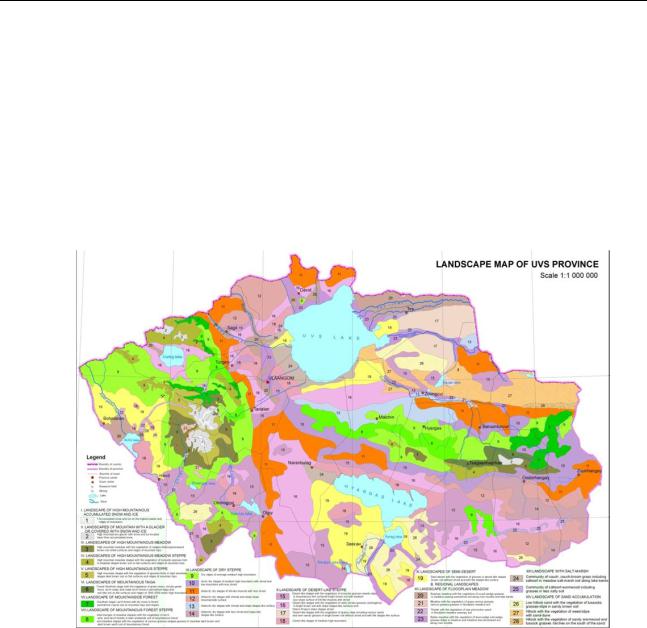
We drew a 1:1000 000-scale landscape map that shows these peculiarities of Uvs province and it sorted 28 types of landscapes in 16 typologies that represent mountains and relief landscapes.
Figure 1
In the map, it is seen that the hollows that encircle Uvs, Khyargas, Achit, Uureg, Namir and Khar Us lakes has desert-like steppe and semi-desert landscapes. There is vertical zonality on Kharkhiraa, Turgen, Tsagaan Shuvuut and Khan khukhii mountains and gradually there are forest and taiga landscapes on the definite areal of mountainsides. The highest peak of Uvs province territory is 4126 meters above sea level on Kharkhiraa, Turgen Mountains and the lowest point is 758 meters above sea level in Uvs Lake depression. It causes the diversity of landscapes in the territory.
According to the amount of covering areas of the landscapes in the territory of the province, 55.7% or 35730.7 km2 of Uvs province territory has 3 types of landscapes as desert-like steppe, southern dry steppe, mountainous dry steppe. The followings are the landscapes of semi-desert and sand accumulation and the least areas are covered by the landscapes of high mountainous accumulated snow and ice and mountainous taiga.
When the territory of Uvs province is assessed through the criteria with point scales made by a Russian scientist D.A.Dirin, its mountainous areas have higher points and lower areas have relatively low points. (Table 3).
99