Материал: Английский язык для управления предприятием. Лавриненко И.Ю., Козлова В.В
Source: Merriam-Webster. [Электронный ресурс]. – Режим доступа: URL: https://www.merriamwebster.com/dictionary/ (время обращения – 15.08.2017).
Task 5. Match the beginning and the ending of the sentences:
1.Crisis management is |
a. such as outside forces or natural disas- |
|
ters |
2.Forecasting potential crises |
b. to respond to a major threat to a per- |
|
son, group or organization |
3.There are events that we have no |
c. a relatively new field of management |
control on, |
|
4.Crisis management responsibilityis |
d. forecast potential crises |
5.Risk management task is to |
e. is the main crisis management activity |
Task 6. Answer the following questions:
1.What events can negatively affect the company?
2.How many categories of crisis are known?
3.Why BP is mentioned?
4.What definition of crisis management is given?
5.What is the difference between risk management and crisis management?
6.What does crisis management include?
7.Whatcanbedonetopreventsomeeventsthatcanleadtocrisisinacompany?
Task 7. Match the sentences below as T (True) or F (False):
1)There are three distinct categories of crisis.
2)Crisis management has been known for a long time.
3)Proactive crisis management is the activities to deal with unpredictable natural disasters.
4)Usually organizations prepare crisis management plan.
5)Crisis management work is closely connected with PR department.
Task 8. a) The text below informs about the steps to deal with the crises. Seven words and word combinations have been removed. Read the text and put the words in the gaps 1-7:
30
Meet the Crisis Head-On
Although every crisis will have unique aspects, there are general principles which apply to most of them. Whatever the crisis, the media, 1) … and, most importantly, your customers and prospects want to know what happened, why, how can it be fixed and howcan customers be compensated.
In most instances where a public relations crisis affects a company, the media will contact either the firm's CEO, the company spokesperson or public relations or 2) … department (if there is one) or some member of senior management. Reporters will ask for explanations and 3) … . Designate a crisis management team or individual, and direct all requests for information to an appropriate member of the group or the appointed spokesperson. Authorize no one else in the company to speak to the media. Internal information about the crisis should only be given to 4) … and or spokesperson to insure that the company speaks with a single, consistent voice.
The public statement should also include how people might be affected by the problem. This would include informing 5) … who might have bought a recalled, flawed or 6) …. In these cases, the company should provide a refund or equal-priced replacement for the product. In some cases, a contaminated product should be disposed of, and customers who have purchased such a product should be properly 7) ….
The CEO, and or technical spokesperson might also offer the media a real time or taped interview in which all questions are answered. A live TV or radio news broadcast with call-in questions is another effective means of handling the crisis.
quotable statements |
media relations |
contaminated product |
informed |
|
management team |
the public |
customers |
members of the crisis |
|
Source: Investopedia. [Электронный ресурс]. – Режим доступа: URL: http://www.investopedia.com/articles/financial-theory/10/crisis-management.asp (время обращения – 15.08.2017).
b)Answer the following questions:
1.What should a head of the company do in the case of public relations crises?
2.What information should a public statement include?
3.Name the positions who usually deal with media in the case of crisis?
Task 9. Usually business faces many pressures from the external environment.
a)Look at the diagram below that shows these types of impact. Match each point with the example given below:
b)Rank the impacts in the rank of importance (0 – the least important, 8 – the most important). Explain your choice.
31
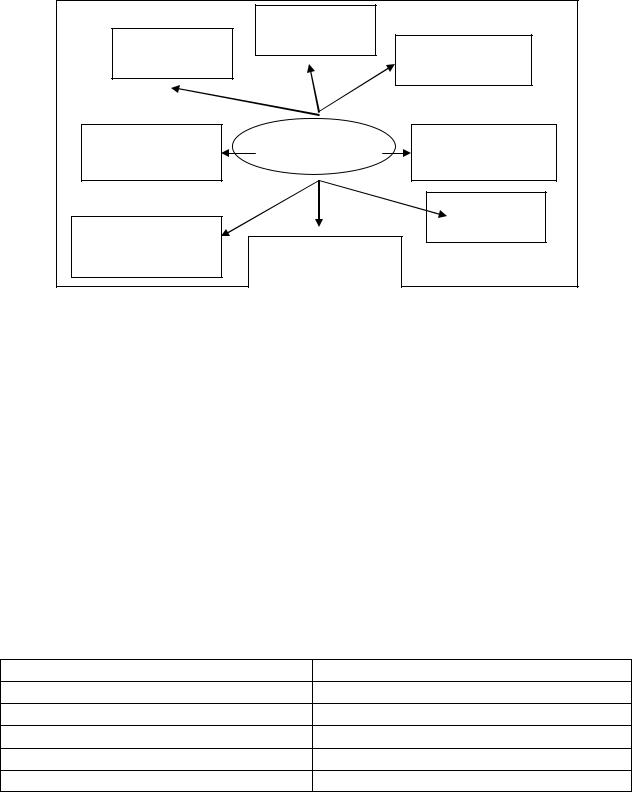
|
international |
|
competition |
environment |
technological |
factors |
|
|
|
environment |
|
|
|
|
environmental |
A company |
consumer |
pressures |
|
needs/wants |
|
|
industry en- |
government/ |
domestic envi- |
vironment |
legal factors |
|
|
|
ronment |
|
1.Other business offer similar or better products of services.
2.Globalization offers opportunities to export more goods or services.
3.The target market changes because of demographic factors.
4.New laws affect product design.
5.Products become out-of-date due to new inventions.
6.Product cost increase because of differences in getting raw materials from the ecologically sensitive areas, e.g. rain forests.
7.Changes in fashion among target markets.
8.The product is new and specialized and the market is growing.
Task 10. Look at some possible bottlenecks that may be produced and their solutions. Fill in the gaps with the correct words below. Match the bottleneck with possible solution:
a group, disagreement, methods, leader evaluate, personality, skills,:
|
Bottlenecks |
|
Solutions |
1) |
… difference within a group. |
a) |
Redefine goals or working … . |
2) |
Conflict between groups. |
b) |
Compare and … options. |
3) |
… on ideas or what to do. |
c) |
Appoint a mediator. |
4) |
Conflict within … . |
d) |
Improve communication … . |
5) |
Failure to act or produce results. |
e) |
A … should intervene. |
Source: Simon Sweeney. Series Eddition: Nick Brieger. Professional English Management, 2-nd imprssion 2002, First Published 2002, Pearson Education Limited, Edinburg Gate, Harlow, Essex CM20 2JE, England. Section 2. Unit 12.
32

Task 11. Below are some hypothetical crises that the company may face. Choose one of them and work out the plan to manage them. Make the presentation of your plan.
a)
c)
b) |
d) |
Crisis Management in Action
Look at the experience of crisis management of some world famous corporations. How effective was their strategy? Present your overview in a form of presentation.
UNIT 6
TIME MANAGEMENT
Task 1. Discuss the following questions:
1.Are you good at time keeping?
2.What do you know about procrastinating?
3.How can time management affect the success of a company?
Task 2. Read and interpret the expressions below. Which of them sound more appealing to you?
1.The early bird catches the worm.
2.There is no time like the present.
3.Better late than never.
33
Task3.Readand memorizethewordsbelow thatwillhelpyouunderstandthetext.
1.notion [ˈnəʊʃən ] - понятие
2.raise [reɪz ] -повысить
3.time tracker - инструмент для отслеживания рабочего времени
4.implementation [ˌɪmplɪmenˈteɪʃən ] - выполнение
5.require [rɪˈkwaɪə] - требовать
6.delegation [dɛlɪˈɡeɪʃən] – передача полномочий
7.authority [ɔːˈθɔrɪtɪ ] – власть, полномочия
8.assets [ˈæsɛts ] – активы компании
9.success [səkˈsɛs] - успех
10.preliminary [prɪˈlɪmɪnərɪ] - предварительный
11.strategy [ˈstrætɪdʒɪ] - стратегия
12.cost-effectiveness [ˌkɒstɪˈfektɪvnɪs ] – экономическая эффективность
13.profitability [ˌprɒfɪtəˈbɪlɪtɪ] – прибыльность, рентабельность
14.personnel [ˌpɜːsəˈnɛl ] - персонал
15.obvious [ˈɒbvɪəs ]- очевидный
Task 4. Read and translate the text.
The Time Management of a Company
The notion of time management includes all the technologies of planning, which are used by an employee by himself to raise the effectiveness of using working time. Time tracker reports sometimes present disappointing results of employers. That is why nowadays there are more and more companies which realize a need in centralized corporateimplementationoftime managementtechnologies.
The necessity of a corporate implementation of time management is conditioned by the following reasons:
1.Growing movement of changes of economic environment require delegation of authorities to employees, their quick decisions and their independent planning of work.
2.Non-material assets of companies are getting more and more valuable. The effectiveness of work of managers and other staff members become the most important factorofsuccessofacompany.
3.Most companies nowadays often change the direction of their development. Employees should be flexible to constant changes and be able to a high level of self control.
Time management training. The first step to have effective and highly organized
employees is to teach them. Your task is to make a preliminary analysis of the effectiveness of each employee. A time tracker will help you to prove that it’s not quite correct. After training your task will be to set a testing period during which employ-
34