Материал: Английский язык для управления предприятием. Лавриненко И.Ю., Козлова В.В
UNIT 1
MANAGEMENT
Task 1. Discuss the following questions:
Can you explain whatmanagementis? What are advantages or disadvantages in being a manager?
What is needed to be a good manager?
Task 2. Work in pairs. Rank the features of a manager below according to their importance for you. Explain your choice.
emotionally strong, good communicator, sensitive to others, flexible, creative, knowledgeable, leadership skills, social skills technically skilled, mental skills.
Source: Яндекс. [Электронный ресурс]. – Режим досту-
па: URL:https://yandex.ru/images ... (время обращения - 24.07.2017).
Example: I believe the most important feature of a manager is to be good communicator, because he works with people, not machines, and it is very important to understand people`s needs and to be able to explain what you want to make the mutual work successful and pleasant.
Task 3. Read and memorize the words below that will help you understand the text.
1.suggest [səˈdʒɛst ] - предлагать
2.setting objectives [əbˈdʒɛktɪv] – ставить цели
3.measuring [ˈmeʒərɪŋ ] - измерение
4.achieve [əˈtʃiːv ] - достигать
5.precise tactics [prɪˈsaɪs] – точные тактики
6.allocating [ˈæləˌkeɪt] - располагать
7.among [əˈmʌŋ] – среди (предлог)
8.manageable [ˈmænɪdʒəbəl] - выполнимые
9.attaining [əˈteɪnŋ] - достижение
10.responsible [rɪˈspɒnsəbəl] - ответственный
11.performance [pəˈfɔːməns] - выполнение
12.measure [ˈmɛʒə ] - оценивать
13.obviously [ˈɒbvɪəslɪ] – разумеется
14.supplier [səˈplaɪəʳ] - поставщик
5
15.neighboring communities – зд. соседние сообщества, организации.
16.authorities [ɔːˈθɒrɪtɪ] - власти
17.appoint [əˈpɔɪnt ] - назначать
18. board of directors [bɔːd ɒv dɪˈrɛktə] – совет директоров
19. skill [skɪl] – искусство, мастерство, навык
Task 4. Read and translate the text.
What is management?
Peter Druker, the well-known American business professor and consultant, suggests that the work of a manager can be divided into planning (setting objectives), organizing,integrating (motivating and communicating), measuring and developing people.
There are several tasks a manager faces. First of all managers set objectives and decide how their organization can achieve them. This involves developing strategies, plans and precise tactics and allocating resources of people and money.
Secondly, managers organize. They analyze and classify the activities of an organization and the relations among them. They divide the work between manageable activities and then into individual jobs. They select people to manage these units and perform the jobs.
Thirdly, managers practice the social skills of motivation and communication. They alsohavetocommunicateobjectivestothepeopleresponsibleforattainingthem.
Fourthly, managers have to measure the performance of their staff to see whether the objectives set for the organization as a whole and for each individual member of it are being achieved.
Lastly, managers develop people – both their subordinates and themselves. Obviously, objectives occasionally have to be modified and changed. It is gen-
erally the job of a manager to consider the needs of the future and to take responsibility for innovation. Top manages also have to manage a business`s relations with customers, suppliers, distributors, bankers, investors, neighboring communities, public authorities and so on. Top managers are appointed, supervised and advised by a company`s board of directors.
Management is not entirely scientific. It is a human skill. Business professors obviously believe that intuition and “instinct” are obviously not enough; there are management skills that have to be learnt.
Source: Ian MacKenzie. English for Business studies. – Cambridge, New York, Melbourne, Madrid, Cape Town, Singapore, Sao Paulo: Cambridge University Press, 1997, 2002. – 207 p. p. 15.
6
Task 5. Match the words with their most likely used collocations (use the text to help you):
1.set |
a. people |
2.precise |
b. resources |
3.manageable |
c. jobs |
4.perform |
d. objectives |
5.social |
e. tactics |
6.allocate |
f. jobs |
7.develop |
g. skills |
8.individual |
h. activities |
Task 6. Find the names of the positions of people mentioned in the text. What position is the most attractive for you and why?
Task 7. Translate the following sentences into English:
1.Работа менеджера может заключаться в организации, оценке деятельности, планировании ресурсов и развитии людей.
2.Постановкацелей включаетразвитиестратегий,планови точныхтактик.
3.Вчера менеджеры поставили цель для организации.
4.Часто цели организации могут быть изменены или модифицированы.
5.Высших менеджеров обычно назначает совет директоров.
6.Менеджмент включает научные знания и знания природы человека.
Task 8. Answer the following questions:
1.What does Peter Druker think about the work of a manager?
2.What does an organization do when it sets all the objectives?
3.How can activities of an organization be divided?
4.What positions does top management also have to manage relations with?
5.Is management entirely scientific?
Task 9. The phrases below present the ideas from the text. Put them in a correct order:
a.Thereareseveralcomponentstodecidehowtheobjectivescanbeachieved.
b.The work of a manager consists of many aspects.
c.Managers deal with people occupying many different positions.
d.Managers select people to do different activities.
e.Managers measure the performance of their organization.
f.Managers should combine human skills and scientific knowledge.
g.Managers are responsible for innovation.
7

Source: Simon Sweeney. Professional English Management. – Essex: Pearson Education Limited, 2002. – 106 p. Section 1, Unit 2.
Management in Action
Make presentation about the function and performance aspects of a manager. Think of the most attractive and the most difficult components of this work.
UNIT 2
THE STRUCTURE OF A COMPANY
Task 1. Discuss the following questions:
What positions in a company do you know?
Which of them are the most important and why?
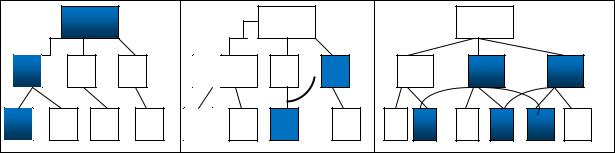
Task 2. Read the descriptions of the company structures below. Match the description with the name of the structure. Find the proper diagram to illustrate it.
a) matrix structure |
b ) line structure |
c)functional structure
1.This type of structure flows vertically from top most executive to the lowest subordinate throughout the organization.
2.This type of structure groups employees by both function and product. The organizational structure is very flat, and the structure is differentiated into whatever functions are needed to accomplish certain goals. Each functional worker usually reports to the functional heads, but do not normally work directly under their supervision.
3.This type of structure is useful for relatively big companies. Employees within this structure are differentiated to perform a specialized set of tasks. For instance, the marketing department would be staffed only with marketers responsible for the marketing of the company's products.
8
A |
B |
C |
Sources: Typocity. [Электронный ресурс]. – Режим доступа: URL: http://notes.tyrocity.com/line- organization-structure/ (время обращения – 22.07.2017).
BusinessMate.org. Great Business Resources. [Электронный ресурс]. – Режим доступа: URL: http://www.businessmate.org/Article.php?ArtikelId=186 (время обращения – 22.07.2017).
Task3.Readand memorizethewordsbelow thatwillhelpyouunderstandthetext.
1.hierarchical [haɪəˈrɑːkɪkəl] – иерархический
2.pyramidal [pɪˈræmɪdl] – пирамидальный
3.increasing number [ɪnˈkriːsɪŋ] – увеличивающееся количество
4.successive level [səkˈsɛsɪv] – последующий уровень
5.superior [suːˈpɪərɪə] – превосходящий
6.decision [dɪˈsɪʒən] – решение
7.immediate subordinate [ɪˈmiːdɪət səˈbɔːdɪnɪt] – человек, находящийся в непосредственном подчинении
8.colleague [ˈkɒliːɡ] – коллега
9.staff position [stɑːf] – штабная должность
10.line authority [ɔːˈθɒrɪtɪ] – линейные полномочия
11.personnel [pɜːsəˈnɛl], human resources department – отдел кадров
12.concerned [kənˈsɜːnd] – быть озадаченным
13.success [səkˈsɛs] – успех
14.encourage [ɪnˈkʌrɪdʒ] innovation – способствовать развитию инноваций
15.inherent [ɪnˈhɪərənt] – обязательный, неотъемлемый
16.responsible [rɪˈspɒnsəbəl] – ответственный
Task 4. Read and translate the text.
Company Structure
Most organizations have a hierarchical or pyramidal structure. It is the structure when there is one person or group of people at the top and an increasing number of people below them at each successive level. There is a clear line or chain of command running down the pyramid. All the people in the organization know what decision they are able to make, who their superior is and who their immediate subordinates are.
9