Материал: Английский язык для управления предприятием. Лавриненко И.Ю., Козлова В.В
McDonald’s or Coca-Cola as examples of tastes, markets and hence cultures becoming similar everywhere. There are, indeed, many products and services becoming common to world markets. What is important to consider, however, is not what they areandwheretheyarefoundphysically,butwhattheymeantothepeopleineachculture.
The essence of culture is not what is visible on the surface. It is the shared ways groups of people understand and interpret the world. So the fact that we can all listen to Walkmans and eat hamburgers tells us that there are some novel products that can be sold on a universal message, but it does not tell us what eating hamburgers or listening to Walkmans means in different cultures. Dining at McDonald’s is a show of status in Moscow whereas it is a fast meal for a fast buck in New York. If business people want to gain understanding of and allegiance to their corporate goals, policies, products or services wherever they are doing business, they must understand what those and other aspects of management mean in different cultures. In addition to exploring why universal applications of western management theory may not work, we will also try to deal with the growing dilemma facing international managers known as “globalization”.
As markets globalize, the need for standardization in organizational design, systems and procedures increases. Yet managers are also under pressure to adapt their organization to the local characteristics of the market, the legislation, the fiscal regime, the socio-political system and the cultural system. This balance between consistency and adaptation is essential for corporate success.
Source: Reading the Waves of Culture. [Электронный ресурс]. – Режим доступа: URL: https://pdfs.semanticscholar.org/baa5/8e86493834d21459cba14437d8900542d666.pdf (время обращения - 23.08.18).
Task 4. Match Russian and English equivalents:
1. |
solutions |
a) |
условия |
2. |
truth |
b) |
продвижение |
3. |
circumstances |
c) |
объекты |
4. |
rule |
d) |
решения |
5. |
promotions |
e) |
отчетность |
6. |
premises |
f) |
правило |
7. |
accountability |
g) |
по всему миру |
8. |
worldwide |
h) |
правда |
Task 5. Connect the sentences so that they make sense:
1. |
Many products and services |
a) |
may not be shared |
2. |
Some cultural biases |
b) |
study up-to-date management philos- |
|
|
ophies |
|
3. |
Common culture worldwide |
c) |
become common worlds service |
4. |
Many modern managers |
d) |
is based on the rules of reward and |
|
|
promotion |
|
5. |
Pay-for-performance philosophies |
e) |
would make the life of international |
|
|
managers much simpler |
|
|
|
50 |
|
Task 6. Match the sentences as True or False:
1.Modern managers philosophies perform universal solutions.
2.International managers must combine many different premises.
3.Commonculturebiaseswillmakethelifeofinternationalmanagersreallydifficult.
4.The location of products and services is the essential factor in the process of internationalization.
5.One of the most difficult tasks of international management is to adapt their organization to the local needs and their cultural features.
Task 7. Answer the following questions:
1. Why may most modern management theories not work in some continents?
2.In what phenomena may different cultures be special?
3.What effect can common culture have worldwide?
4.Whatexamplesofsomeproductsinterpretationindifferentcountriescanyougive?
5.What dilemma do international managers face?
6.What aspects must managers take into account to adapt their organization to the localneeds?
Task 8. Complete the text with the following phrases. There are three extra phrases that you don`t need to use:
a)your international business developments;
b)to switch off;
c)setting high price for your products.
d)a business culture will encompass;
e)firms and organizations;
f)to switch on;
g)from accounting to production;
i) values and activities.
Business Culture
Culture illustrates the accepted norms and values and traditional behaviour of a group. One definition of culture by Deal and Kennedy (corporate culture researchers) is “the way a we do things around here”. However, culture also evolves over time. The culture of each country has its own beliefs, 1) … . In other words culture can be defined as an evolving set of collective beliefs, values and attitudes.
Culture is a key component in business and has an impact on the strategic direction of business. Culture influences management, decisions and all business functions 2) …. You may now be thinking predominantly about national culture but this is only one aspect, business culture is its own unique dimension that includes getting off on
51
the right foot, meetings, negotiation, formalities, social media use, internships and work placements and other elements.
Business culture is related to behaviour, ethics, etiquette and more. 3) … as organisation’s values, visions, working style, beliefs and habits.
Although you will find that each country has a number of individual characteristics, belowaresomeofthemainbusinessetiquettetraditionswhichshouldhelpyouin4)…:
Be aware of any differences between the host country and your own and try to fit in with their business culture.
Never forget to say ‘Thank You’ whether you are at job interview or client meeting.
Be polite and don’t discuss the meeting straight away as soon you step out of the meetingroom.
Always remember 5) … or put on silent your phone in a meeting to avoid distraction.
If you disagree with something instead of criticising try to understand the other person’s point of view and never lose your temper.
Always be honest about whatever you are saying.
Source: Passport to Trade. [Электронный ресурс]. – Режим доступа: URL: https://businessculture.org/business-culture/ (время обращения – 18.07.2019).
Task 9. Match the sentences below as true or false:
1.Culture undergoes changes over time.
2.Culture is an individual characteristic of a person.
3.Business culture is a separate aspect of national culture.
4.Each country has unique national characteristics.
5.Don`t hesitate to express your own opinion about any topic that you like.
6.It is important to know and respect the differences between the cultures of any countries.
7.Culture doesn`t make any influence on business.
Task 10. Choose the sentence that better summarises the text in Task 8:
1.Culture differences play important role in business because it influences all aspects of business of any country.
2.You should follow business etiquette tradition of a country where you work.
3.There are individual and general business characteristics.
Task 11. Write down the summary for the text in Task 8. Use the following expressions:
The text presents the idea of …
52
There is information about …
It is necessary to say that …
Firstly, … Secondly, … Also, …
To conclude, …
Task 12. Read the information below about two different management styles, determined as Management in Culture A and management in Culture B. Match the sentences 1-5 below as True or False. Prove your choice.
Culture A |
Culture B |
Plan for every solution with a boss |
Develop a plan, then ask boss to agree |
Create department hierarchy |
Organize department into teams |
Prefer to communicate face-to-face |
Prefer to communicate via e-mail |
Inform subordinates about decisions |
Involve subordinates about decision- |
|
making |
Emphasize financial results in evaluat- |
Focus on customers satisfaction in eval- |
ing performance |
uation |
1.This culture is more flexible.
2.This culture is more modern.
3.The manager in this culture is more directive.
4.Subordinates help in desicion-making.
5.If finance is the main factor in decision-making, staff are happy.
Source: Simon Sweeney. Series Eddition: Nick Brieger. Professional English Management, 2-nd imprssion 2002, First Published 2002, Pearson Education Limited, Edinburg Gate, Harlow, Essex CM20 2JE, England. Section 1. Unit 7.
Task 13. Look at the issues below. Which phenomenon is related to the CULTURE of a company (C), to the ORGANIZATION of a company (O) or BOTH (B)? Match the statements as C, O or B:
1.Values.
2.Benefits.
3.Having a clear structure.
4.Customs and traditions.
5.Beliefs.
6.Sources for authiruty.
7.Ethic norms.
8.Objectives and common purposes.
9.Relations between center and periphery
10.Shared experience
11.The system of relations
12.Dreess code
53
Source: Simon Sweeney. Series Eddition: Nick Brieger. Professional English Management, 2- nd imprssion 2002, First Published 2002, Pearson Education Limited, Edinburg Gate, Harlow, Essex CM20 2JE, England. Section 3. Unit 17.
Task 14.
a)Read the proverb below. What does it mean? Do you agree/disagree with it? Prove your opinion.
When in Rome do as the Romans do.
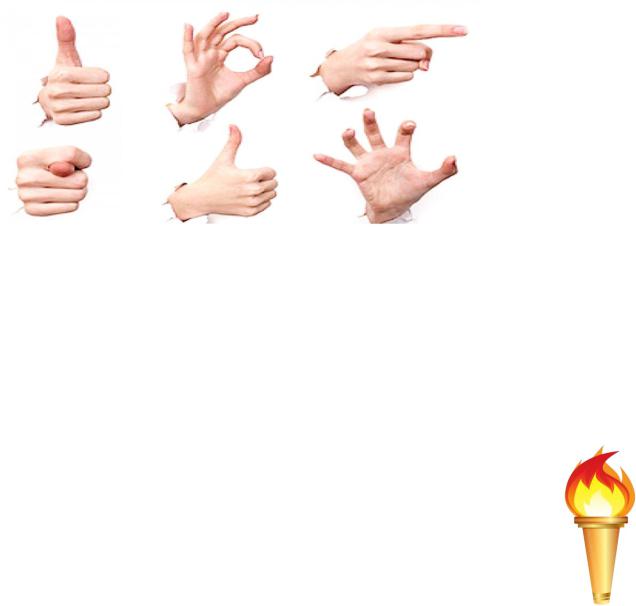
b)Look at the jestures a-f below. What do they mean? Do they imply something positive/negative/neutral in your native country?
a |
b |
c |
d |
e |
f |
Source: Яндекс, [Электронный ресурс]. – Режим доступа: URL: https://www.yandex.ru/search/?text=hfpyst%20%3Btcns%20rfhnbyrf&rdrnd=688314&lr=213&redircnt=156 5476329.1 (время обращения – 11.08.2019).
c) Conduct the research on cultural differences between: 1) European countries, 2) Asian Countries.
Culture and Business in Action
a)Imagine that you are business culture expert. You need to consult international businessman about dealing with Russian companies. What are the most essential aspects of doing business in Russia?
b)Do you know any curious cases when difference in business culture led to unexpected results? Share this information with the class.
54