Материал: anglish
-
Say what position would you like to have at the plant and why?
-
Read and memorize the dialogue
At the plant
Ann: Where have you been, Pete? I haven’t seen you for ages.
Pete: I had my technological practice at the machine – building plant.
Ann: It was interesting, I hope.
Pete: Rather. In our college workshops we mastered some operations and learnt to know some technological properties of materials, the structure and use of certain hand and machine tools. But what I have seen at the plant gave me an idea of what the key branch of modern industry is.
Ann: Please, tell me something about the plant.
Pete: With pleasure. First of all, the plant has four main shops.
Ann: What are they?
Pete: They are foundry, the forge and the engineering and the assembling shops. One of the basic processes of the metal-working industry, as you know, is the production of metal casting. Well, cast ingots are produced in the foundry.
Ann: Is it a simple operation?
Pete: Casting is not as simple as it may seem. The process consists in melting out metal in a furnace and pouring it into molds, where it cools down and is ready for further processing.
Ann: This is clear. Ann what about the forge?
Pete: Its main tools are different: a board drop hammer, a steam drop hammer, a pneumatic hammer, some forging machines and presses. Here the ingots are forged into parts that are further hardened and annealed.
Ann: And where does the machining proper take place?
Pete: It’s done in the engineering shop where you can see all kinds of modern lathes.
Ann: Are lather complex devices?
Pete: Rather. And accurate. Capable of doing a great quantity and variety of work.
Ann: What lathes have they got there?
Pete: A whole lot: turning, milling, planning lathes, boring and polishing lathes. You can’t even remember the names of all of them.
Ann: And now, Pete, I can tell you myself what the assembling shop does. It assembles the ready parts into units and fits them on the body of the machine they are producing.
Pete: Quite right. The most important thing of all is that automation of the production processes in all the shops is well under way. A number of automatic and semi-automatic machines have been installed there, even an automatic line. Besides, they have initiated a movement for operation several lathes simultaneously.
Ann: I see, Pete, that practice was interesting and useful. Good-buy, Pete and thanks a lot.
Pete: Good-bye, Ann. See you tomorrow.
Notes and commentary
to master – освоювати;
learn to know – навчатися;
engineering shop – механічний цех;
assembling shop – складальний цех;
to cast ingots – робити відливки;
to cool clown – охолоджувати;
a board drop hammer – функціональний молот з дошкою;
a steam drop hammer – паровий штампувальний молот;
forging machine – машина для ковки;
forged into parts – перековуються в певні частини (деталі);
are hardened and annealed – загартовуються та відпалюються;
turning, milling, planning, boring, polishing lathes – верстати токарні, фрезерні, стругальні, розточні, шліфувальні;
to assemble ready parts into units and fit them on the body of the machines – збирати готові частини в блоки та монтувати їх на машини
automation of production processes in well under way – широко проводиться автоматизація виробничих процесів.
Exercises.
1. Answer the following questions.
-
Have you ever been at a plant?
-
When did you visit the plant?
-
What did you see at the plant?
-
How many shops are there at the plant?
-
What are they?
-
Is the production of the metal casting an important process of the metal-working industry?
-
Is casting a simple operation?
-
What does this process consist in?
-
What is the equipment of the forge shop?
-
In what shop are the ingots forged into parts?
-
What lathes did you see at the plant?
-
What do they do in the assembling shop?
-
Did you see any automatic and semi-automatic machines at the plant?
2. Write out from the text all the words naming the parts of the equipment you saw at the plant. Learn them.
3. Retell Pete’s part of the dialogue in the form of a narration in the first person. Additional vocabulary Склад підприємства
Set-up of a plant
Дільниця – bay
контроль – inspection
пакування та відвантаження – packing and dispatch
комплектація – delivery
контора, заводоуправління – office block
відділи – administrative departments
технолог – production engineer
працівники збуту – sales personnel
бути відповідальним за – be liable to
склад – store house, stock
їдальня на фірмі – canteen
побутові приміщення – welfare rooms
стоянка – parking area
дочірнє підприємство – subsidiary factory
представник фірми – representative
група експертів – a team of experts
рекламно-видавнича діяльність – promotion
контрольний пакет акцій – controlling interest
в нашому розпорядженні необхідна сировина – raw materials are fully available
оволодіти методами обробки металів – to master the material handling
вводити в експлуатацію – to commission
готові до комерційної експлуатації – ready for commercial operation
інструкція з експлуатації – maintenance and operation instructions
технічні норми – engineering standard
провести ознайомчу екскурсію на заводі – to take smb. round the mill
станок – machine
гвинторізний – screw cutting
кромкостругальний – edger
металорізальний – metal-cutting
свердлувальний – drilling
токарний – lathe
шліфувальний – grinding
почасова оплата – pay of the hour
Text 1
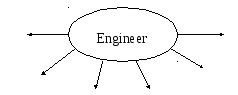
The beginning of civilization is the beginning of engineering and technology.
Basically, the role of engineer has not changed through the centuries. His job is to take knowledge and make practical use of it. He uses scientific theory to design useful products.
Outstanding characteristics of engineers through the centuries have been a willingness to work and creativity.
Another characteristic associated with engineers is the ability to see ahead. The engineer must have a fertile imagination, must be creative, and must be ready to accept new ideas.
But besides it, good engineer must have strong engineering background, he must be industrious well-organized , educated in exact sciences and modern technologies. He must be professional and responsible.
Whether an engineer lived at the time of construction of pyramids or has only recently graduated in nuclear engineering, these characteristics have been an important part of his intellect.
-
Fill in the diagram:
Text 2 Engineering Ethics
Engineers are expected to abide by codes of performance that will be beneficial to society. From this the public gains an understanding of what they may expect from the profession. Engineers tend to take the matter of ethics very seriously, and several of the engineering groups and societies have published codes of ethics. Most of these documents are concerned with fairness in dealings with the public and with other engineers, but they also accentuate honesty and public responsibility. It is taken for granted that no engineer would undertake a project and willingly neglect aspects that could lead to disaster, such as the collapse of a dam in bridge or the failure of an aircraft. Yet, such failures have occurred, either through lack of scientific knowledge or the inadequate formulation of design criteria. Some too have occurred simply because of errors or lack of understanding. Engineers should be professionally prepared to do everything in their power to avoid failure, particularly where lives may by threatened. It may be necessary to halt a project while additional information is obtained. The pursuit of excellence in performance from the engineer’s products is an easily understood goal. Somewhat broader ramifications are involved to ensure the advancement of human welfare. With the size of modern-day technological enterprises it becomes imperative that the various choices that are open in dealing with a new project by very carefully studied in the search for the best solution. Wasted or misdirected effort on a large scale can cause irreparable damage to the environment and to communities. Not only this, but the engineer harms himself in encouraging a line of development if he suspects that the end result will not warrant the expenditure of time and resources, and particularly so if a negative result is likely.
Vocabulary
Expect – чекати, припускати
abide – залишатися вірним
code – кодекс
performance – виконання
beneficial – вигідний, корисний
gain - добувати, мати користь
fairness – справедливість, чесність
dealings – справи
accentuate-акцентувати, підкреслювати
responsibility – відповідальність
undertake – братися, починати
willingly – охоче
neglect – нехтувати
disaster – катастрофа
collapse – занепад, загибель
dam – гребля
failure – невдача, пошкодження, аварія
occur – траплятися
lack (of) – відсутність, недостача
avoid – уникати
threaten – загрожувати
halt – спиняти
obtain – одержувати, здобувати
excellence – висока якість
goal –мета, ціль
ramification – відгалуження
be involved (in) – брати участь, бути причетним
ensure – гарантувати, забезпечувати
advancement – просування, прогрес
welfare – добробут
choice – варіант
in the search of – в пошуках чогось
solution – розв’язання
misdirect – неправильно спрямовувати
effort – зусилля
on a large scale – у великому масштабу
cause – спричиняти
irreparable – непоправний
damage – збиток, пошкодження
warrant – виправдувати, гарантувати
expenditures – витрати