Материал: The United Kingdom of Great Britain and Northern Ireland
· The Herald (1783)
· The Times (1785)
· The Observer (1791)
· The Scotsman (1817)
· The Guardian/Manchester Guardian (1821)
· The Sunday Times (1822)
· Evening Standard (1827)
· News of the World (1843)
· The Daily Telegraph (1855)
· The People (1881)
· Financial Times (1888)
· Daily Record (1895)
· Daily Mail (1896)
· Daily Express (1900)
· Daily Mirror (1903)
· Sunday Mirror (1915)
· Sunday Express (1918)
· The Morning Star/Daily Worker (1930)
· Sunday Telegraph (1961)
· The Sun (1964)
· Daily Star (1978)
· Mail on Sunday (1982)
· Independent (1986)
· Sunday Sport (1986)
· Daily Sport (1988)
· Independent on Sunday (1990).
Magazines
A bewildering range of magazines are sold in the UK covering most interests and potential topics. Famous examples include Private Eye, Hello!, The Spectator, the Radio Times and NME.
Obscure magazines are featured on the topical news quiz Have
I Got News For You, where the missing words round has a 'guest publication' - a
little known magazine that is chosen for its amusing subject matter. Each week
a different magazine is showcased.
Lecture 7.
Education in the UK
. Compulsory schooling
Education in Britain is provided by the Local Education Authority (LEA) in each county. It is financed partly by the Government and partly by local taxes. Until recently, planning and organization were not controlled by central government. Each LEA was free to decide how to organize education in its own area. In September 1988, however, the ‘National Curriculum’ was introduced, which means that there is now greater governmental control over what is taught in schools.education (under 5 years) Children do not have to go to school until they reach the age of five, but there is some free nursery-school education before that age., LEAs do not have nursery-school places for all who would like them and these places are usually given to families in special circumstances, for example families with one parent only. Because of the small number of nursery schools, parents in many areas have formed Playgroups where children under 5 years can go for a morning or afternoon a couple of times a week.education (5 to 11 years)education takes place in infant schools (pupils aged from 5 to 7 years) and junior schools (from 8 to 11 years). (Some LEAs have a different system in which middle schools replace junior schools and take pupils aged from 9 to 12 years.)
Primary School or Infant School, age 4 to 51, age 5 to 62, age 6 to 7School or Junior School3, age 7 to 84, age 8 to 95, age 9 to 106, age 10 to 11
Private education (5 to 18 years)parents choose to pay for
private education in spite of the existence of free state education. Private
schools are called by different names to state schools: the preparatory (often
called ‘prep”, schools are for pupils aged up to 13, and the public schools are
for 13 to 18 year-olds. These schools are very expensive and they are attended
by about 5 per cent of the school population.education (11 to 16/18 years)
Since the 1944 Education Act of Parliament, free secondary education has been
available to all children in Britain. Indeed, children must go to school until
the age of 16, and pupils may stay on for one or two years more if they
wish.schools are usually much larger than primary schools and most children
-over 80 per cent - go to a comprehensive school at the age of 11. These
schools are not selective - you don’t have to pass an exam to go there.1965 the
Labour Government introduced the policy of comprehensive education. Before that
time, all children took an exam at the age of 11 called the ‘11 + ‘.
Approximately the top 20 per cent were chosen to go to the academic grammar
schools. Those who failed the ‘11 + ‘ (80 per cent) went to secondary modern
schools.lot of people thought that this system of selection at the age of 11
was unfair on many children. So comprehensive schools were introduced to offer
suitable courses for pupils of all abilities. Some LEAs started to change over
to comprehensive education immediately, but some were harder to convince and
slower to act. There are a few LEAs who still keep the old system of grammar
schools, but most LEAs have now changed over completely to non-selective
education in comprehensive schools.schoolsschools want to develop the talents
of each individual child. So they offer a wide choice of subjects, from art and
craft, woodwork and domestic science to the sciences, modern languages,
computer studies, etc. All these subjects are enjoyed by both girls and boys.at
comprehensive schools are quite often put into ‘sets’ for the more academic
subjects such as mathematics or languages. Sets are formed according to ability
in each subject, so that for example the children in the highest set for maths
will not necessarily be in the highest set for French. All pupils move to the
next class automatically at the end of the year.
. Educational
reform
In the late 1980s the Conservative Government made important
changes to the British educational system. One of the most fundamental changes
was the introduction of a new ‘National Curriculum’. The aim was to provide a
more balanced education.secondary schools, for example, 80% of the timetable
must be spent on the ‘core curriculum’. This must include English. Mathematics,
Science and a Modern Language for all pupils up to the age of 16. (Before 1989
pupils of 13 or 14 used to choose the subjects they wanted to continue
studying.) At the same time, the new curriculum places greater emphasis on the
more practical aspects of education.are being taught which students will need
for life and work, and ‘work experience’ - when pupils who are soon going to
leave school spend some time in a business or industry - has become a standard
part of the school programme.with the ‘National Curriculum’, a programme
of’Records of Achievement’ was introduced. This programme is known as ‘REACH’,
and it attempts to set learning objectives for each term and year in primary
school, and for each component of each subject at secondary school. This has
introduced much more central control and standardization into what is taught.
Many people think this will raise educational standards, but some teacher?
argue that they have lost the ability to respond to the needs and interests of
their pupils, which may be different from pupils in other areas.part of the
‘REACH’ programme, new tests have been introduced for pupils at the ages of
7,11, 13 and 16. The aim of these tests is to discover any schools or areas
which are not teaching to high enough standards. But many parents and teachers
are unhappy. They feel that it is a return to the days of the ‘ 11 +’ and that
the tests are unfair because they reflect differences in home background rather
than in ability. Some teachers also fear that because of preparation for the
tests, lessons will be more ‘narrow’, with a lot of time being spent on
Mathematics and English, for example, while other interesting subjects which
are not tested may be left out.reform is bringing other changes too. City
Technology Colleges (CTCs) are new super-schools for scientifically gifted
children, who - the Government hopes-will be scientists and technological
experts of the future. These schools are partly funded by industry.addition to
the CTCs, since 1988 the Government has given ordinary schools the right to
‘opt out of (choose to leave) the LEA if a majority of parents want it.
Previously all state schools were under the control of the LEA, which provided
the schools in its area with money for books etc., paid the teachers, and
controlled educational policy. Now schools which opt out will receive money direct
from the Government and will be free to spend it as they like. They can even
pay teachers more or less than in LEA schools if they want to, and they can
accept any children - the pupils do not have to come from the neighbourhood.
Many people fear that this will mean a return to selection, i.e. these schools
will choose the brightest children. The Government says that the new schools
will mean more choice for parents.
3. Exams
At the age of 14 or 15, in the third or fourth form of
secondary school, pupils begin to choose their exam subjects. In 1988 a new
public examination - the General Certificate of Secondary Education (GCSE) -
was introduced for 16 year-olds. This examination assesses pupils on the work
they do in the 4th and 5th year at secondary school, and is often internally
assessed, although there may also be an exam at the end of the course.who stay
on into the sixth form or who go on to a Sixth Form College (17 year-olds in
the Lower Sixth and 18 year-olds in the Upper Sixth) usually fall into two
categories. Some pupils will be retaking GCSEs in order to get better grades.
Others will study two or three subjects for an 'A' Level (Advanced Level) GCE
exam (General Certificate of Education). This is a highly specialised exam and
is necessary for University entrance. Since 1988 there has been a new level of
exam: the 'AS' Level (Advanced Supplementary), which is worth half an 'A'
Level. This means that if pupils wish to study more than two or three subjects
in the sixth form they can take a combination of 'A' and 'AS' Levels. In
Scotland the exam system is slightly different.
. Leaving school at sixteen
Many people decide to leave school at the age of 16 and go to
a Further Education (FE) College. Here most of the courses are linked to some
kind of practical vocational training, for example in engineering, typing,
cooking or hairdressing. Some young people are given 'day release' (their
employer allows them time off work) so that they can follow a course to help
them in their job.those 16 year-olds who leave school and who cannot find work
but do not want to go to FE College, the Goovernment has introduced the
Training Credit Scheme. This scheme allows young people a sum of money to buy
training leading to National Vocational Qualification from an employer or
training organisation that participates in the scheme. Because the young people
pay for their own training it encourages employers to give them work. It also
gives the trainee valuable work experience.
. British
universities
For all British citizens a place at university brings with it a grant from their Local Education authority. The grants cover tuition fees and some of the living expense The amount depends on the parents' income. If the parents do not earn much money, their children will receive a full grant which will cover all their expenses.18 and 19 year-olds in Britain are fairly independent people, and when the time comes to pick a college they usually choose one as far away from home as possible! So. many students in northern and Scottish universities come from the south of England and vice versa. It is very unusual for university students to live at home. Anyway, the three university terms are only ten weeks each, and during vacation times families are reunited.they first arrive at college, first year university students are called 'freshers'. Often freshers will live in a Hall of Residence on or near the college campus, although they may move out into a rented room in their second or third year, or share a house with friends.the first week, all the clubs and societies hold a 'freshers' fair' during which they try to persuade the new students to join their society.well as lectures, there are regular seminars, at which one of a small group of students (probably not more than ten) reads a paper he or she has written. The paper is then discussed by the tutor and the rest of the group. Once or twice a term, students will have a tutorial. This means that they see a tutor alone to discuss their work and their progress. In Oxford and Cambridge, and some other universities, the study system is based entirely around such tutorials which take place once a week. Attending lectures is optional for 'Oxbridge' students!three or four years (depending on the type of course and the university) these students will take their finals. Most of them (over 90 per cent) will get a first, second or third class degree and be able to put BA (Bachelor of Arts) or BSc (Bachelor of Science) after their name.
Students who have completed a first degree are eligible to undertake a postgraduate degree, which includes:
· Master's degree (typically taken in one year)
· Doctorate degree (typically taken in
three years)education is not automatically financed by the State, and so
admission is in practice highly competitive.
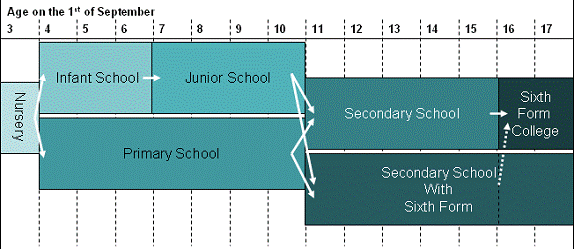
Рис. 1
Lecture 8.
British Culture
The culture of the United Kingdom is rich and varied, and has
been influential on culture on a worldwide scale. It is a European state, and
has many cultural links with its former colonies, particularly those that use
the English language.
. The Arts
Literatureearliest existing native literature of the
territory of the modern UK was written in the Celtic languages of the isles and
dates back to the 6th century.Saxon literature includes Beowulf, a
national epic, but literature in Latin predominated among educated elites.
After the Norman Conquest Anglo-Norman literature brought continental
influences to the isles.literature proper developed in the late 14th century,
with the rise and spread of the London dialect of Middle English. Geoffrey
Chaucer is the first great identifiable individual in English literature: his
Canterbury Tales remains a popular 14th-century work which readers still enjoy
today.the introduction of the printing press into England by William Caxton in
1476, the Elizabethan era saw a great flourishing of literature, especially in
the fields of poetry and drama. From this period, poet and playwright William
Shakespeare stands out as the most famous writer in the world.English novel
became a popular form in the 18th century, with Daniel Defoe's Robinson Crusoe,
Samuel Richardson's Pamela and Henry Fielding's Tom Jones.the early 19th
century, the Romantic period showed a flowering of poetry with such poets as
William Blake, William Wordsworth, John Keats, and Lord
Byron. The Victorian period was the golden age of the realistic English novel,
represented by Jane Austen, the Brontë sisters (Charlotte, Emily and
Anne), Charles Dickens, William Thackeray, George Eliot, Lord Alfred Tennyson and Thomas Hardy.War
I gave rise to British war poets and writers such as Wilfred Owen, Siegfried
Sassoon, Robert Graves and Rupert Brooke who wrote of their expectations of
war, and/or their experiences in the trench.English novel developed in the 20th
century into much greater variety and was greatly enriched by immigrant
writers. It remains today the dominant English literary form. Other well-known
novelists include Arthur Conan Doyle, D. H. Lawrence, George Orwell, Mary
Shelley, J. R. R. Tolkien, C.S. Lewis, Virginia Woolf and J.K. Rowling.poets
include Elizabeth Barrett Browning, T. S. Eliot, Ted Hughes, Philip Larkin,
John Milton, Alfred Tennyson, Rudyard Kipling, Alexander Pope.UK also has an
old tradition of theatre - it was introduced to the UK from Europe by the Romans.reign
of Elizabeth I in the late 16th and early 17th century saw a flowering of the
drama and all the arts. William Shakespeare, wrote around 40 plays that are
still performed in theatres across the world to this day. They include
tragedies, such as Hamlet, Othello, and King Lear; comedies, such as A
Midsummer Night's Dream and Twelfth Night; and history plays, such as Henry IV,
part 1-2. The Elizabethan age is sometimes nicknamed "the age of
Shakespeare" for the amount of influence he held over the era. Other
important Elizabethan and 17th-century playwrights include Ben Jonson,
Christopher Marlowe, and John Webster.the West End of London has a large number
of theatres, particularly centred around Shaftesbury Avenue. A prolific
composer of the 20th century Andrew Lloyd Webber has dominated the West End for
a number of years and his musicals have travelled to Broadway in New York and
around the world, as well as being turned into films.Royal Shakespeare Company
operates out of Shakespeare's birthplace Stratford-upon-Avon in England,
producing mainly but not exclusively Shakespeare's plays.and CinemaWilliam
Byrd, John Taverner, John Blow, Henry Purcell, Edward Elgar, Arthur Sullivan,
William Walton, Ralph Vaughan Williams, Benjamin Britten and Michael Tippett
have made major contributions to British music, and are known internationally.
Living composers include John Tavener, Harrison Birtwistle, Andrew Lloyd
Webber, and Oliver Knussen.also supports a number of major orchestras including
the BBC Symphony Orchestra, the Royal Philharmonic Orchestra, the Philharmonia,
the London Symphony Orchestra and the London Philharmonic Orchestra. Because of
its location and other economic factors, London is one of the most important
cities for music in the world: it has several important concert halls and is
also home to the Royal Opera House, one of the world's leading opera houses.
British traditional music has also been very influential abroad.UK was one of
the two main countries in the development of rock and roll along with the US,
and has provided bands including The Beatles, the Rolling Stones, Led Zeppelin,
The Who, Pink Floyd, Queen, Elton John, David Bowie, Iron Maiden, Status Quo,
the Sex Pistols, Duran Duran, The Jam, The Cure, Depeche Mode, Oasis, Blur,
Radiohead and Coldplay, Massive Attack, The Prodigy, The Chemical Brothers.has
been at the forefront of developments in film, radio, and television.important
films have been produced in Britain over the last century, and a large number
of significant actors and film-makers have emerged. Currently the main film
production centres are at Shepperton and Pinewood Studios.artEnglish
Renaissance, starting in the early 16th century, was a parallel to the Italian
Renaissance, but did not develop in exactly the same way. It was mainly
concerned with music and literature; in art and architecture the change was not
as clearly defined as in the continent. Painters from the continent continued
to find work in Britain, and brought the new styles with them, especially the
Flemish and Italian Renaissance styles.a reaction to abstract expressionism,
pop art emerged originally in England at the end of the 1950s.visual artists
from the United Kingdom include John Constable, Sir Joshua Reynolds, Thomas
Gainsborough, William Blake and J.M.W. Turner. In the 20th century, Francis
Bacon, David Hockney, Bridget Riley, and the pop artists Richard Hamilton and
Peter Blake were of note.recently, the so-called Young British Artists have
gained some notoriety, particularly Damien Hirst and Tracey Emin.illustrators
include Aubrey Beardsley, Roger Hargreaves, and Beatrix Potter.
. Science and technology
Ever since the scientific revolution, the UK has been
prominent in world scientific and technological development. It was home of the
philosopher Francis Bacon, possibly the most famous of all British scientists,
Isaac Newton, who is most famous for realising that the same force is
responsible for movements of celestial and terrestrial bodies, that is gravity.
It is commonly reported that he made this realisation when he was sitting
underneath an apple tree and was hit on the head by a falling apple. He is also
famous as the father of classical mechanics, formulated as his three
laws.Newton's time, figures from the UK have contributed to the development of
most major branches of science. Examples include Michael Faraday, who, with
James Clerk Maxwell, studied electric and magnetic forces; James Joule, who
worked in thermodynamics and is often credited with the discovery of the
principle of conservation of energy; Paul Dirac, one of the pioneers of quantum
mechanics; Charles Darwin, author of On the Origin of Species and discoverer of
the principle of evolution by natural selection., the UK is also amongst the
world's leaders. Historically, it was at the forefront of the industrial
revolution, with innovations especially in textiles, the steam engine,
railroads and civil engineering. Famous British engineers and inventors from
this period include James Watt, Robert Stephenson, Isambard Kingdom Brunel and
Richard Arkwright.then, the UK has continued this tradition of technical
creativity. Alan Turing, Frank Whittle (inventor of the jet engine), Charles
Babbage (who devised the idea of the computer) and Alexander Fleming
(discoverer of penicillin) were all British. The UK remains one of the leading
providers of technological innovations today, providing inventions as diverse
as the World Wide Web and Viagra.
. Religion
Although today one of the more 'secularised' states in the world, the UK is traditionally a Christian country:
· Anglicanism, in the form of the Church of England, is the Established Church in England. The Queen is Supreme Governor of the Church of England.
· Presbyterianism (Church of Scotland) is the official faith in Scotland.
4. Food
Although there is ample evidence of a rich and varied
approach to cuisine during earlier historical periods (particularly so amongst
wealthy citizens), during much of the 19th and 20th century Britain had a
reputation for somewhat conservative cuisine. The stereotype of the native
cuisine was of a diet consisting of "meat and two veg". Even today,
in more conservative areas of the country, "meat and veg" cuisine is
still the favoured choice at the dinner table.British fare usually includes
dishes such as fish and chips; roast dishes of beef, lamb, chicken and pork;
both sweet and savoury pies and puddings, as well as regional dishes such as
the Cornish pasty and Lancashire Hotpot.the period of the 1970s a greater
experimentation with the new ingredients started due to the spread of
supermarkets. The evolution of the British diet was further accelerated with
the increasing tendency of the British to travel to continental Europe (and
sometimes beyond) for their annual holidays, experiencing new and unfamiliar dishes
as they travelled to countries such as France, Italy, and Spain.the mid to late
1990s an explosion of talented new 'TV chefs' began to come to prominence,
(such as Jamie Oliver, James Martin and Keith Floyd). This brought about a
noticeable expansion in the variety of cuisine the general public were prepared
to try and their general confidence in preparing food that had would once have
been considered merely staples of foreign cultures, particularly the
Mediterranean European, South and East Asian diets. As a result, a new style of
cooking called Modern British emerged.immigrants introduced new and exotic
dishes and ingredients to the British repertoire and national consciousness.
Many of these new dishes have since become deeply embedded in the native culture,
culminating in a speech in 2001 by Foreign Secretary, Robin Cook, in which he
described Chicken Tikka Masala as 'a true British national dish'.
5. Sport
The national sport of the UK is football, having originated
in England, and the UK has the oldest football clubs in the world. The home
nations all have separate national teams and domestic competitions, most
notably the FA Premier League, the FA Cup, and the Scottish Premier League. The
first ever international football match was between Scotland and England in
1872. The match ended goalless.famous British sporting events include the
Wimbledon tennis championships, the Grand National, the London Marathon, the
Six Nations rugby championships (of which 4 "home nations"
participate), the British Grand Prix, the ashes series of cricket matches and
the boat race between Oxford and Cambridge universities.great number of major
sports originated in the UK, including: Football, squash, golf, tennis, boxing,
rugby, cricket, snooker, billiards, badminton and curling.
. National costume
There is no specifically British national costume. Even
individually, England, Wales and Northern Ireland have only vestiges of a
national costume; Scotland has the kilt and Tam o'shanter (шотландский берет).
In England certain military uniforms such as the Beefeater or the Queen's Guard
are considered to be symbolic of Englishness, though they are not official
national costumes. Morris dancers (танец в костюмах героев легенды о Робин
Гуде) or the costumes for the traditional English May dance are cited by some
as examples of traditional English costume.is in large part due to the critical
role that British sensibilities have played in world clothing since the 18th
century. Particularly during the Victorian era, British fashions defined
acceptable dress for men of business. As such, it could be argued that the
national costume of the British male is a three-piece suit, necktie and bowler
hat - an image regularly used by cartoonists as a caricature of Britishness.
. Naming convention
The naming convention in most of the UK is for everyone to
have a given name, usually (but not always) indicating the child's sex,
followed by a parent's family name. This naming convention has remained much
the same since the 15th century in England although patronymic naming remained
in some of the further reaches of the other home nations until much later.
Since the 19th century middle names have become very common and are often taken
from the family name of an ancestor.given names were largely taken from the
Bible; however, in the Gothic Revival of the Victorian era, Anglo Saxon and
mythical names became commonplace. Since the middle of the 20th century however
given names have been influenced by a much wider cultural base.
. Religious, political, social and everyday contacts
In comparison with some other European countries, neither
religion nor politics is an important part of people's life in modern Britain.
Of course, there are many people who belong to this or that church or party.
Few people are regular churchgoers and active members of political parties. For
the vast majority of parents in the country (some ethnic groups excepted), the
religion or voting habits of their future son-in-law's or daughter-in-law's
family are of only passing interest and rarely the major cause of objection to
the proposed marriage.people give a relatively high value to the everyday
personal contacts that they make. It is certainly true that the pub, or the
numerous clubs devoted to various sports and pastimes play a very important
part in many people's lives. In these places people make contacts with other
people who share some of the same interests and attitudes. Many people make
their social contacts through work. However British people don’t spend more of
their free time out of the house than most other Europeans do.
. Stereotypes and change
Many things which are often regarded as typically British
derive from books, songs or plays which were written a long time ago and do not
show modern life. There is a popular belief that Britain is a land of
tradition. The claim is based on what can be seen in public life: the annual
ceremony of the state opening of Parliament follows customs which are centuries
old and so does the military ceremony of 'trooping the colour', the changing of
the guard outside Buckingham Palace., in their private everyday lives, the
British don’t follow tradition more than the people of most other countries.
There are very few ancient customs that are followed by the majority of families
on special occasions. The country has fewer local parades or processions with
folk roots than most other countries have. The English language has fewer
sayings or proverbs that are in common everyday use than many other languages
do. In addition, it should be noted that they are the most enthusiastic
video-watching people in the world - the very opposite of a traditional
pastime!are many examples of typical British habits which are simply not
typical any more. For example, the traditional 'British' breakfast is a large
'fry-up' preceded by cereal with milk and followed by toast, butter and
marmalade, all washed down with lots of tea. In fact, only about 10% of the
people in Britain actually have this sort of breakfast. Two-thirds have cut out
the fry-up and just have the cereal, tea and toast. The rest have even less.
The image of the British as a nation of tea-drinkers is another stereotype
which is out of date. It is true that it is still prepared in a distinctive way
(strong and with milk), but more coffee than tea is now bought in the country's
shops. As for the tradition of afternoon tea with biscuits, scones, sandwiches
or cake, this is a minority activity, largely confined to retired people and
the leisured upper-middle class (although preserved in tea shops in tourist
resorts).British have few living folk traditions and don’t mean that they like
change. They may not behave in traditional ways, but they like symbols of
tradition and stability. For example, they don’t consider it especially smart to
live in a new house and, in fact, there is prestige in living in an obviously
old one. They have a general sentimental attachment to older, supposedly safer,
times. Their Christmas cards usually depict scenes from past centuries; they
like their pubs to look old; they were reluctant to change their system of
currency.of measurement are another example. The British government has been
trying for years and years to promote the metric system and to get British
people to use the same scales that are used nearly everywhere else in the
world. But it has had only limited success. British manufacturers are obliged
to give the weight of their tins and packets in kilos and grams. But everybody
in Britain still shops in pounds and ounces. The weather forecasters on the
television use the Celsius scale of temperature. But nearly everybody still
thinks in Fahrenheit . British people continue to measure distances, amounts of
liquid and themselves using scales of measurement that are not used anywhere
else in Europe . Even the use of the 24-hour clock is comparatively restricted.
. The Love of nature
Most of the British live in towns and cities. But they have
an idealized vision of the countryside. To the British, the countryside has
almost none of the negative associations which it has in some countries, such
as poor facilities, lack of educational opportunities, unemployment and
poverty. To them, the countryside means peace and quiet, beauty, good health
and no crime. Most of them would live in a country village if they thought that
they could find a way of earning a living there. Ideally, this village would
consist of thatched cottages built around an area of grass known as a 'village
green'. Nearby, there would be a pond with ducks on it. Nowadays such a village
is not actually very common, but it is a stereotypical picture that is
well-known to the British.history connected with the building of the Channel
tunnel provides an instructive example of the British attitude. While the
'chunnel' was being built, there were also plans to build new high-speed rail
links on either side of it. But what route would these new railway lines take?
On the French side of the channel communities battled with each other to get
the new line built through their towns. It would be good for local business.
But on the English side, the opposite occurred. Nobody wanted the rail link
near them! Communities battled with each other to get the new line built
somewhere else. Never mind about business, they wanted to preserve their peace
and quiet.areas of the country are official 'national parks' where almost no
building is allowed. There is an organization to which thousands of
enthusiastic country walkers belong, the Ramblers' Association. It is in
constant battle with landowners' to keep open the public 'rights of way' across
their lands. Maps can be bought which mark, in great detail, the routes of all
the public footpaths in the country. Walkers often stay at youth hostels. The
Youth Hostels Association is a charity whose aim is 'to help all, especially
young people of limited means, to a greater knowledge, love and care of the
countryside'. Their hostels are cheap and rather self-consciously bare and
simple. There are more than 300 of them around the country, most of them in the
middle of nowhere!