be put into the flames, with the intention of feeding the gods. Taking a small amount of each foodstuff, it should be offered to the fire while intoning the Mantra "SWAHA." This ritual oblation serves to separate the mind from greed, selfishness, and attachment.
The participants prepare themselves in the same way as described previously for the Secret Rite. Sweet-smelling incense is suitable for burning, and if possible there should be some soft, sensual music. We recommend natural rhythmic music rather than highly verbal, aggressive tunes, or rock and roll, and have found Indian sitar, tabla, vina, or similar sounds most appropriate. The fundamental frequency of all Hindu sacred music is between seven and eight cycles per second. This is identical to the resonant frequency of the earth's globe, to the frequency of the Kundalini when activated, and to human brain waves when in a state of deep meditation. In Tantric ecstasy, the whole body resonates at this frequency.
The couple sit together, with the woman on the left side. After the initial preparation, the food and wine should be empowered by encircling it with burning incense sticks, then, after offering a part to the fire, the participants share the remainder. Tantric texts admonish not to debase this holy rite into an excuse for feasting and. orgying, but to respect it for what it is: a unique opportunity to identify and merge with the different elements and life-forms partaken as sacraments in the ritual.
First the wine is drunk, not for intoxication, but for the delight and stimulation of body and mind. Meditate on the wine as an Elixir, an Ambrosia of the gods, symbolic of the primordial fire out of which all life emerged and by which all existence is ultimately reduced. Each may offer the drink to the other, transferring it from mouth to mouth.
Next, while meditating on the animal world, the participants consume the meat, symbolic of the air element, without which we would all immediately die. This is followed by fish, symbolic of the water element and evocative of the aquatic realm of life. Then the cereal grains or fruit are shared, the couple all the while remembering that our bodies are largely dependent on the vegetable kingdom and the earth element. After this ritualized acknowledgment of the elements, the couple should make love with passion.
Love-making symbolizes the element of space, which is all-pervasive and undefinable. Space is inherent in all the other elements. Tantras equate the element of space with the ecstatic blissful feeling of love-making, stating that "space touches all the other elements." Practically this means that love-making should
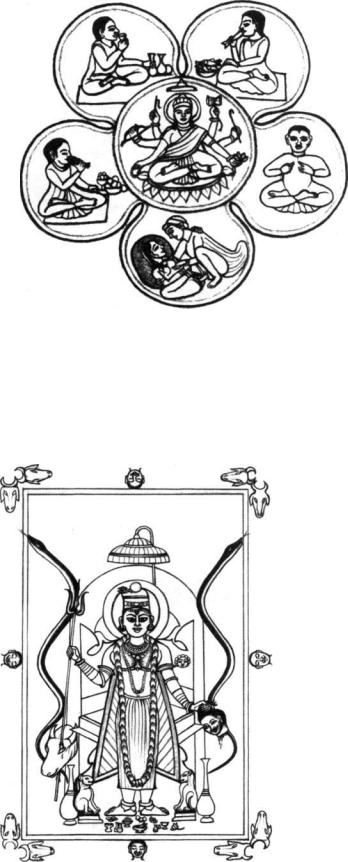
Tantric painting of Kundalini as a goddess. At her feet are shown sacrificial offerings, food, and drink. From a Rajasthani miniature painting of the eighteenth century.
Symbolic diagram of the Rite of the Five Essentials. At the center is a depiction of a transcendental goddess, the idealization of Shakti. The five petals making up a lotus shape show sexual union (Maithuna), the eating of special meat (Mamsa), the drinking of wine (Madya), the eating of fish (Matsya), and a man making a gesture of controlling his vitality (Mudra). From a Rajasthani painting of the nineteenth century.
I follow the cult wherein there is
enjoyment of wine, fish, flesh,
grains, and woman. In the Goddess I seek refuge. To the line of Gurus, I am devoted. I am Shiva, the terrific, the transcendental! She is Shakti, the sensual, the liberator.
RUDRA YAMALA TANTRA