Материал: Snote

Внимание! Если размещение файла нарушает Ваши авторские права, то обязательно сообщите нам

posture of the

gobbling fishes

Chinese texts describe an erotic love posture for Secret Dalliance known as the Gobbling Fishes. It is an exercise of selflessness, designed for complete satisfaction of all the participants. We quote directly from an ancient text that is primarily concerned with the therapeutic benefits of this form of love-making:

The two women lie down in the most normal position for sexual union: one woman on her back and the other on top of her, in such as way that both their Pleasure Places are in direct contact with

each other. They should embrace closely, passionately rubbing their Grottos together until the lower lips open of their own accord, like the mouths of fishes gobbling up water plants while swimming.

The man should kneel between their thighs, waiting until both the women are very excited and approaching their climax. He then separates their Pleasure Grottos with his hand and inserts his Jade Stalk between them. In this way, both women can simultaneously benefit as he moves in and out. This method of lovemaking is pleasurable and beneficial. It helps strengthen the sinews and bones, at the same time effectively doubling the potency. It also cures physiological and psychological afflictions. This posture reminds one of the fish playing among the water plants as they suck in the clear and blow out the murky water.

There is a posture known as Two Dancing Female Phoenix Birds. It takes place with one man and two women. He should tell one of the women to lie on

her back

and the other one to sit on top of her. The woman underneath raises

her legs,

while the upper woman moves her own legs apart in such a way that

their two Jade Gates are in close contact. The man should kneel, facing them. In this way he will be able to enter the upper and lower Jade Gates in turn.

MASTER TUNG

Posture of the Gobbling Fishes. From a contemporary photograph.

sisterhood and sapphism

In ancient India, it was considered normal for women to have intimate relationships with each other. In a wealthy household, a girl would be brought up with one or more

Sakhis, female companions from poor families, who would live together with her like a sister. Close physical contact between women has always been considered normal and healthy in Eastern cultures. Sisters or woman friends would commonly share the same bed.

The word Sakhi or "girl friend" is related to

Shakti, the vital female power principle, the raw Energy of Tantra. To have a Sakhi as a

companion was considered vitalizing, auspicious, and "special." It was widely believed

that such sisterhoods strength-

ened the femininity of all participants.

A Sakhi added her own qualities and experiences to those of her "sister." Often a woman and her Sakhi were inseparable; when a noblewoman married, her Sakhis became co-wives and assisted in ritual love-making. Sapphic activities within such sisterhoods were

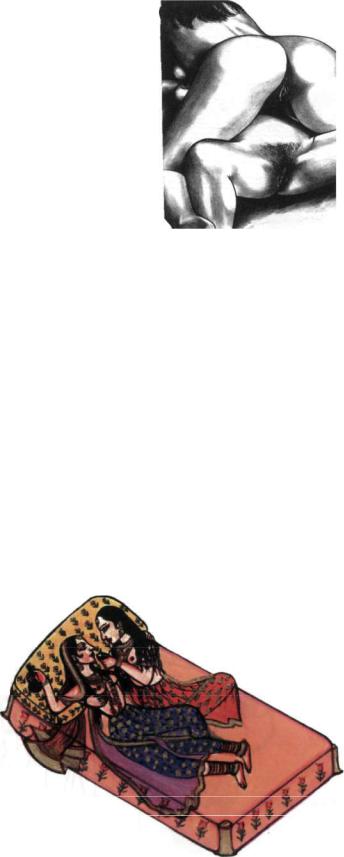
Two women in dalliance together on a bed. From a Rajasthani painting of the eighteenth century.

Vishnu the Preserver 257

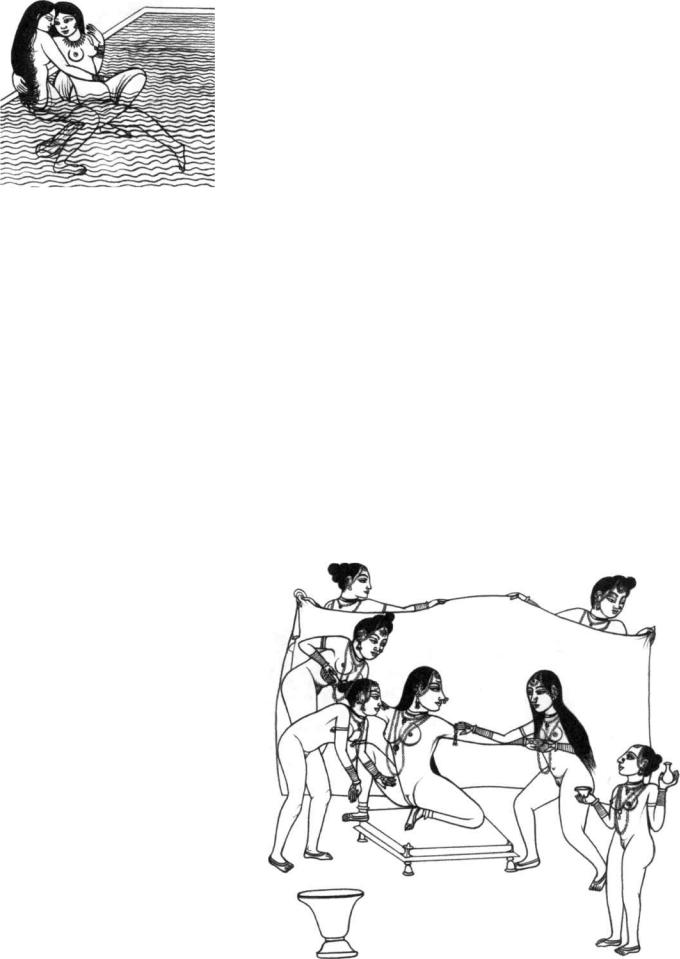
Women bathing and embracing each other. From an Indian miniature painting of the eighteenth century.

My source of happiness is a softskinned girl, her smile adorned with pearls. The moisture of her

mouth is sweet and fresh. Between her legs there is a fissure, as pretty and alluring as the neck of a young

gazelle. That night we spent in

sucking mouths and other parts.

If to love my girl friend in such a way is "sinful," then to love a man is indeed "unlawful."

A WOMAN'S THOUGHTS TO HER LADY-LOVE, FROM THE PERFUMED GARDEN

considered normal and are frequently portrayed in Indian art.

Sisterhoods evolved naturally in a polygamous society. Wives and concubines usually lived in close proximity, often sharing the same bed. Mutual caressing was never considered perverse; it was encouraged and idealized as an expression of real caring. The natural narcissism of woman was exalted in Oriental cultures.

The Ramayana, an important Hindu epic, contains an account of a ménage in which Sapphic sex is poetically described:

There were innumerable women lying on rugs, who had fallen asleep after spending the night in sensual play. Their breath was subtly perfumed with sweetened wine. Some of the girls savored each other's lips as they dreamed, as if they were their master's. Their aroused passions drove these lovely sleeping women to make love to their companions. Some slept in their rich garments, propped up on bracelet-laden arms; some lay across their companions, on their bellies, their breasts, their thighs, their backs; clinging amorously to one another, with arms entwined, the slender-waisted women lay together in sweet intoxicated sleep.

A wealthy Indian woman would normally employ a number of female attendants, whose duties included bathing, oiling, massaging,

and generally beautifying their mistress. In contemporary India this is still the custom. Close contact with maidservants or Sakhis commonly develops into a Sapphic relationship, particularly with single, lonely, or widowed women.

The Kama Sutra describes how women can use their mouths on each other's Yonis and ways of satisfying sexual desires by the use of bulbs, roots, or fruits having the same shape as the Lingam. Unlike male homosexuality, Sapphism was not considered sinful and was not an offense under Hindu law. In miniature paintings of the medieval period, woman are often portrayed fondling each other intimately. Pictures illustrating themes of Krishna and the Cow girls commonly depict Gopis

in sensual dalliance together.

In Buddhist and Hindu Tantric literature, there are references to the transcendental and regenerative power inherent in sisterhoods. Taoist teachings particularly emphasize this view. Five distinct categories of Sapphism are known to contemporary Hinduism. The common form of Western lesbianism, largely aggressive, and replete with sexual role playing, is the lower type. Indians view it as degenerate and far removed from the higher,

more

spiritual forms of sisterhood practiced

in the

East.

There was considerable contact between

Egypt

and

South India, which was famous

for its rich

silks, spices, women, and temple

A noblewoman with six female attendants. They are busy in the bathing, drying, anointing, and decorating of their mistress. From a Rajasthani miniature painting of the eighteenth century.

258 Vishnu the Preserver

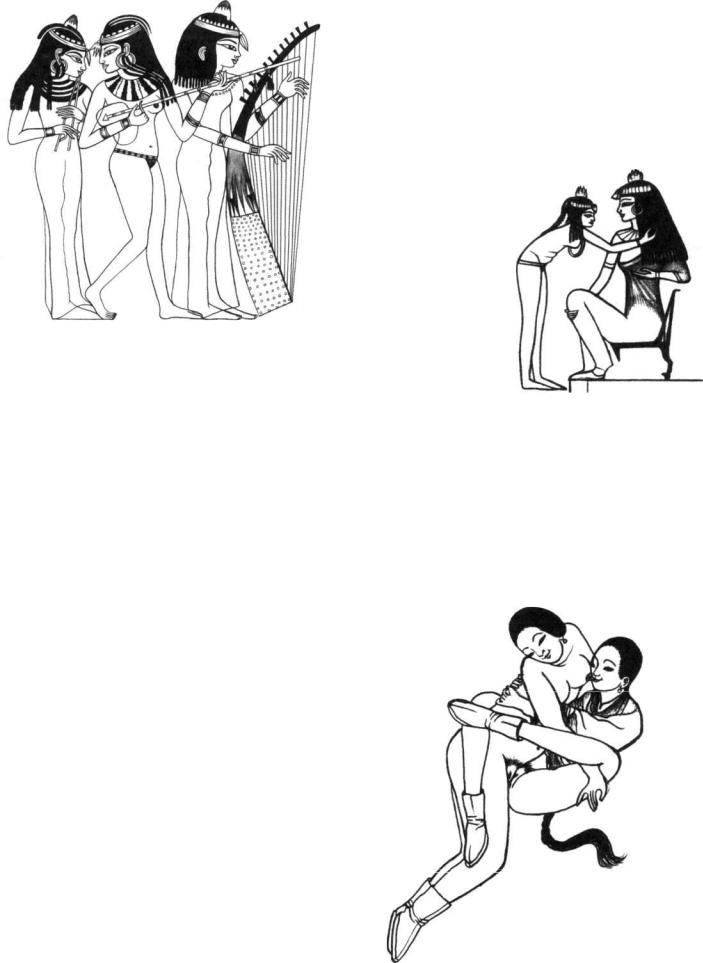
Female musicians and dancing-girls. From a painting of the Eighteenth Dynasty (1567-1320 B.C.).

dancers. In ancient Egyptian society, there was no law condemning Sapphism. Archaeological evidence shows that women were brought up in close contact with one another. Tomb paintings depict female attendants caressing their mistresses and show ménages in the Indian manner. In temple communities dancing girls lived together and sisterhoods were encouraged.

Hebrew law does not condemn Sapphism. In Islamic society, where polygamy was very common, lesbianism has always been popular, both inside and outside the harem. It is curious that Muhammad is believed to have declared lesbianism an unlawful practice, particularly since the thirteenth-century Arab historian Abd-al-Latif al-Baghdadi wrote, "The woman who has not tasted repeatedly of the delights of another woman's body does not exist in our lands." The Arab fear of women gaining power may account for the contradiction. To the Arab mind, women are possessions and status symbols, to be controlled rather than exalted or liberated through the power of mystic sex. The enlightened view of femininity expressed in Tantras is not a part of Arabian thought.

In many pagan cultures throughout the world, intimate sexual contact between women is considered natural. This is particularly so in matriarchal societies. Most tribal groups in Africa, Asia, the Pacific Islands, and South America include Sapphism as an integral part of the socio-religious system. For

example, a woman of the Paia, a Bantu tribe of Africa, is only allowed to have her virginity taken by another woman. This woman is carefully chosen by her and becomes her "sister," living with her for three days every month, during which time they practice Sapphism. Luduku women of the Congo also

pair off together early in life. Among tribes

in N e w Guinea it is customary for a girl to perform oral love-making with her older female friends, in the belief that by so doing she absorbs some of their feminine wisdom.

In China and Japan, Sapphism is also very common. According to Taoism, woman has an unlimited supply of Yin-essence, which is r e g e n e r a t e d every m o n t h w i t h the completion of her menstrual cycle. The concept of women nurturing each other's vital essence is a fundamental principle of Taoist teaching.

Sisterhoods have been greatly misunderstood in the West. R e - cent polls indicate that a large proportion of Western women have some form of Sapphic experience during their lifetime. Nonetheless, it is common in the West to associate Sapphism with perversity and to make no distinction among the forms of lesbianism. The most renowned of Western female homosexuals was the

Greek poet Sappho.

The majority of her

Egyptian girl in attendance on a lady. From a painting of the Eighteenth Dynasty (1567-1320 B.C.).

According to Taoist teachings, Sapphism allows women to nurture each other's nature. From a Chinese painting of the nineteenth century.

Vishnu the Preserver 259

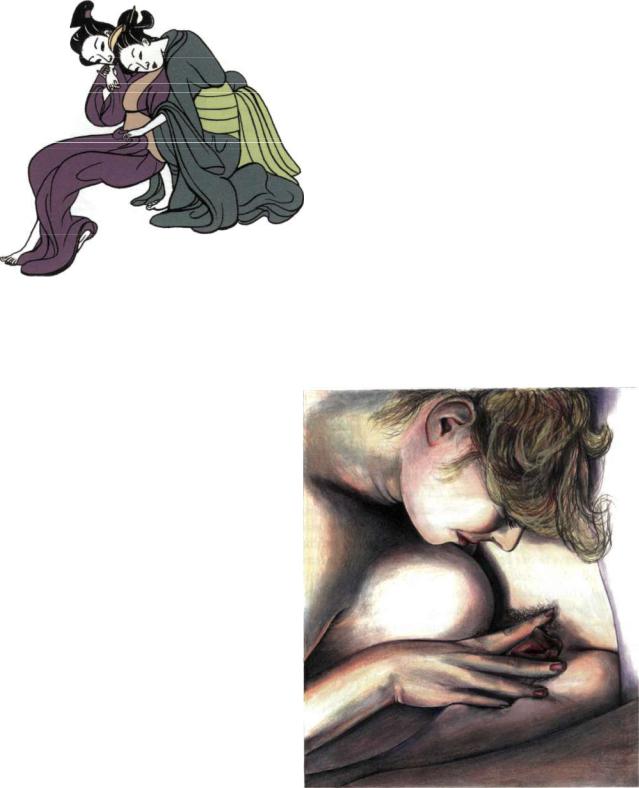
Two Oriental ladies sharing intimacies. From a Japanese print by Suzuki Harunobu, circa 1760.

writings were destroyed in A.D. 1073 on the orders of Pope Gregory VII.

Sappho lived on the island of Lesbos during the sixth century B.C. The words lesbianism and Sapphism derived directly from her reputation as a lover of women. According to

Socrates, she was

u n c o m -

monly beautiful.

Plato re-

garded her as the "Tenth Muse," and Ovid recommended that all girls read her works. Only with the advent of Christianity did

her name become infamous. Sisterhoods need not involve sex between

women. However, if sexual contact evolves spontaneously, there are a variety of ways in which women can satisfy one another. Esoteric teachings emphasize the importance of the kiss between women. The watery element evoked during kissing is associated with

the moon, which governs womanly cycles. Taoist teachings emphasize oral stimulation of the mouth, Yoni, and breasts as the way for woman to nurture their natures.

Eastern teachings endorse and encourage loving relationships between women. How - ever, the modern Western woman seeking to explore her sexuality with another woman should be aware that Sapphism is not an alternative to heterosexual love. The exclusive practice of Sapphic love is not promoted by Taoist or Tantric teachings, which give supreme significance to the male/female unit, the cosmic couple.

A Sapphic or sisterly relationship requires real caring and generosity. The modern woman is often conditioned to view other women as competitors rather than allies. Women of the ancient East knew sisterhood and solidarity. Contemporary women can gain insight into the real meaning and practice of women's liberation from the Tantric tradition.

According to Taoism, "When softness is in close proximity with softness, the female Yin-essence is enhanced." This thought was basic to the argument in favor of Sapphism.

Women are peonies, spring flowers, lotuses, and bowers.

Women are pomegranates, peaches, melons, and pearls.

Women are receptacles, crucibles, vessels, and worlds.

Women are the fruit of life, the nourishing force of Nature.

YUAN-SHIH YEH-TING CHI, TAO TSUNG-I

260 Vishnu the Preserver

masturbation/

self-gratification

Until recently, open discussion of masturbation was taboo. Masturbation was referred to euphemistically as self-abuse, playing with oneself, the solitary vice, or self-gratification. Many are the children who have endured

lectures about the "sinful dangers" of this

practice. Such warnings, at an early and impressionable age, often cause neuroses later on in life.

The atmosphere of "sin" or "guilt" surrounding the act of masturbation can produce a kind of vicarious thrill or rush, rather like that felt in committing a punishable crime. Fear can be immediately stimulating, but its long-term effect is debilitating.

During the last several years, there has been a tendency to bring sexual matters out into the open. Masturbation has emerged as a topic that people are willing to discuss. An analysis of popular sex-oriented magazines indicates a groundswell of interest in this particular aspect of sexuality. The once "solitary vice" has been elevated into a "therapy," a "variation of love-making" and an important part of the repertoire of sexually liberated lovers. What do Eastern teachings have to say about this volatile subject?

First of all, a clear distinction is drawn between male and female masturbation. Second, mutual masturbation between a man and a woman is not considered masturbation per se. Since it is not looked on as an end in itself, it is categorized as foreplay. A different view is taken of mutual masturbation between two men or two women. We shall examine each of these situations thoroughly.

Both Taoist and Tantric teachings agree that "semen is a man's most precious possession." It is not to be carelessly wasted. The medical texts state that ejaculation of this vital essence by a male who has not yet reached maturity is potentially detrimental to his health, since important body elements are dispersed. The Charaka Samhita says, "If a young boy, whose body elements are not yet fully formed, practices masturbation, he is liable to lose vitality. If he continues to do

so, then his body will become weakened and his internal organs damaged. This is particularly true up to the age of sixteen years, by which time the male body is completely formed."

Masturbation involves the physical, emotional, and mental aspects of an individual. If practiced as a solitary exercise, the breath and imagination perform a major role. Though self-gratification can be momentarily stimulating, there is no long-term benefit to a man. His physical reserves become depleted without an opportunity for replenishment; that

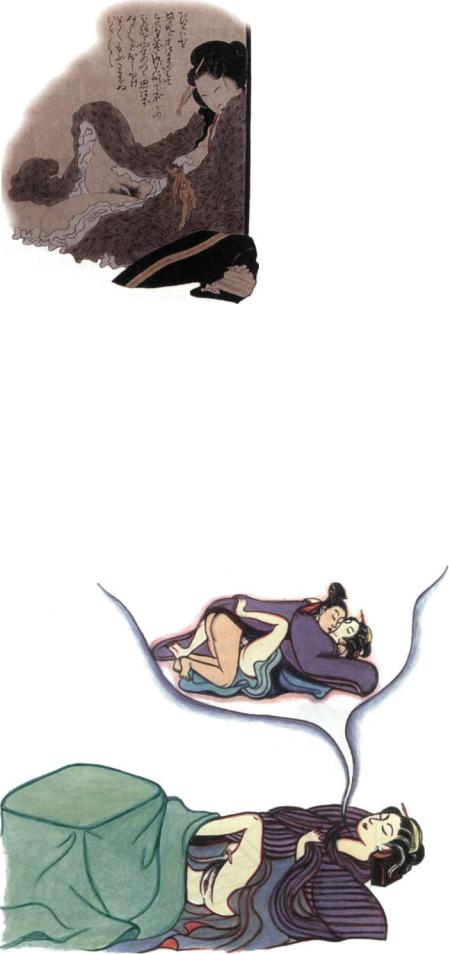
A solitary woman fondles her Jade Gateway. Shunga painting on paper, Meiji, Japan, circa late eighteenth century.

Sexual fantasy or dream, depicted as arising from the throat region. From a Japanese print of the eighteenth century.
Vishnu the Preserver 261