Материал: Snote
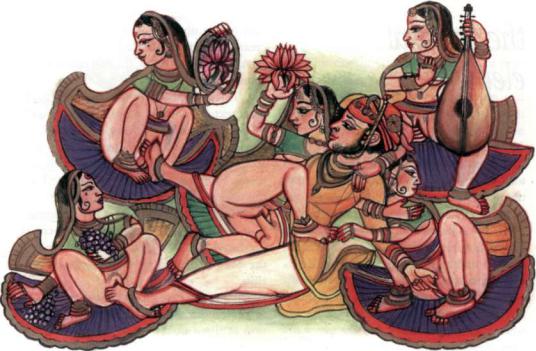
In Tantric symbolism eroticism is often used to conceal cosmic truths. Here, a maharaja makes love with five women simultaneously. They hold a musical instrument, a mirror, fruit, a flower and touch his body, symbolizing the five senses of hearing, seeing, tasting, touching, and smelling. Tantra teaches that Liberation can be attained through the conscious evocation of the sensual elements. From a Rajasthani miniature painting of the mideighteenth century.
expanding, n o w contracting, essentially composed of a mixture of Potent Voidness and Creative Energy, living in the Temple of the Body." It is the sensual elements that nourish and transform the inner being, al-
lowing evolution to take place. The human body contains all the elements essential for Self-realization and there are no limits to individual potential once this is recognized.
Heaven and Earth have their opening and closing; Yin and Yang develop from each other. Mankind is modeled after Yin and Yang and embodies the sequence of the seasons and elements. If one abstains too much from sexual union, then one's Spirit will not develop, since the interchange of Yin and Yang will have come to a halt. It is possible to derive great benefit from the enjoyment of the senses through sexual intercourse, so substituting new elements for old ones.
I-HSIN-FANG
commitment
Commitment implies absolute trust. The bond of commitment keeps a couple together. Once established, commitment helps the couple overcome many of life's difficulties by providing a storehouse of strength upon which to draw. Whether commitment is made formally or informally, in the bed-
room or a law court or a church, it must be sincere and each partner must have absolute confidence in its validity. Mutual commitment is an essential ingredient of the sexual secrets.
In the Tantric tradition commitment must precede serious effort and is itself an opening into potency. Commitment is also an integral element in every initiation along the way. For the Tantric lover, commitment means being true to one's inner reality and sharing this truth with the beloved.
The couple should share their innermost
92 Brahma the Creative
feelings about each other, within the context of their sacred bond of mutual trust. Dispense with self-reproach and feelings of guilt and let yourselves experience the joyous release of sharing. Verbalizing your innermost feelings will create a mystic bond of trust. Explicit commitments can be made without any verbalization whatsoever, merely by "opening up the heart" and letting it commune directly with the heart of the partner.
Love-making is the perfect opportunity for establishing a lasting bond of commitment. During the love-act, the life-force enters the central Subtle Nerve and ascends to the region of the head. According to Tantric teachings, whatever the mind visualizes at such an occasion will inevitably come about. A wish made at the heights of ecstasy is said to have a very good chance of success. People often find themselves unconsciously wishing and fantasizing while making love. If this tendency is made conscious, it will be possible to use ecstatic love-making to create lasting commitments of a liberating nature.
Commitment can take many forms but ideally it should transcend worldly values and selfish desires and be oriented to higher ideals. Commitment to a high spiritual ideal helps to unify the couple and exalts love to a higher dimension. Commitment strengthens self-confidence and leads to increased awareness of spirituality in oneself and the other. True love implies an absolute commitment based on a couple's desire for spiritual evolution together.
In the Tantric tradition commitment is formalized in various ways. Commitment to a teacher implies selfless service. Commitment to a spiritual path or specific teaching requires unquestioning faith and patience. Sexual commitment is of two kinds: lifelong, and just for the duration of a particular rite. The lifelong commitment is similar to Western marriage, except that in the Tantric belief structure it is sustained beyond death. Hindus believe that if a couple are
truly committed to each other, they will share Eternity.
Commitment "for the duration" means that a couple get together for an agreed period and for a specific purpose; they commit themselves to each other and undergo a brief "marriage ritual" that formalizes their agreement to give the most of themselves to each other. The sexual rites of Tantra generally require a formal commitment by the partners, even if they are not married and do not intend to become married. A kind of minimarriage takes place. The woman receives a new sari, some ornaments and jewelry, flowers, perfume, fruit, and other symbolic items. She is worshipped as an embodiment of the Goddess. Then the woman and man hold hands and are covered by a cloth. They make a statement of commitment to each other and together say Swasti, meaning "It is well." Then they recite the following: "It is Kama [love] who gives and Kama who accepts. It is Kama who is taking the Kamini [woman] for the satisfaction of Kama. Inspired by Kama, I take thee. May both our Kama be fulfilled." The man then lights a fire. A small quantity of food is prepared and some of it is offered back into the fire. Then the couple circumambulate the fire together and meditate on Brahma, Shiva, and Vishnu in union with their goddesses, identifying themselves with them. The "bride" then takes seven steps accompanied by her partner, both are garlanded and the ceremony is complete.
Commitment strengthens a relationship and gives it meaning. Whether formal or informal, commitment is very much a part of the Tantric lifestyle. Sexual ritual requires commitment of ensure lasting success. When commitment is moti-
vated by true love, a couple is ready to explore the sexual secrets.
Generally speaking, there is commitment if one does not counteract that which one has taken upon oneself to do. Commitment plays a role in Mantra teaching, and especially in the Tantric discipline, when, having obtained the initial confirmation, one does not fail in one's commitment to look upon the world as divine mansion and upon all beings as gods and goddesses. In the highest application of commitment one should try to live in such a way that the unitary experience does not fall to pieces, one never becomes separated from service and attention, one partakes of spiritual nourishment, one retains its mystic character, and one guards the authenticity of one's being.
NARO CHOS DRUG
Marriage under the Law of Shiva is of two kinds. One is terminated at the conclusion of the rite, and the other is lifelong. Both require a high level of commitment. When it is stated aloud, "Approve our marriage according to the Law of Shiva," a marriage commitment is truly made.
MAHANIRVANA TANTRA
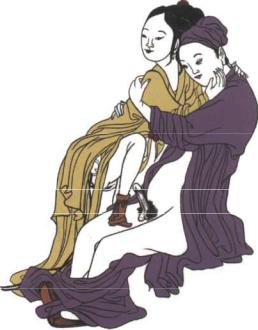
Commitment implies absolute trust and mutual service. Both Taoism and Tantra teach the importance of commitment to achieving Liberation through sexual acts. From a Chinese painting of the Kang-hsi period, circa seventeenth century.
Brahma the Creative 93

Side view of virasana (heroic posture) with prostration, which helps channel energy in an evolutionary direction.
People are bound by the shackles of Karma only when engaged in actions other than work performed for the sake of service.
BHAGAVAD GITA
The mind, imbued with love and compassion in thought and deed, should ever be directed to the service of others.
GAMPOPA
service
Selfless service is truly a sign of spirituality. Radically different from subservience or "bowing to the will of another," it is the genuine desire to give service as an act of love. Service means giving
without preconditions or selfish motivations. It should be cultivated, particularly in an intimate relationship.
If a couple cultivate service within their relationship, they will become an integrated interdependent unit. Loving service leads to deeper commitment, which in turn strengthens the relationship. Service should be joyously rendered and accepted, without feelings of resentment or expectancy.
It's essential to maintain equilibrium be-
tween the "server" and the "served." This doesn't mean that one should automatically expect something just because one has given something; there will inevitably be different needs and situations. Service should be spontaneous, true giving, from the heart. If one of you comes home from work tense or exhausted, the other may offer service in the form of massage; this will relieve tension and also bring you into touch with each other. Similarly, some unexpected help with housework will lead to a more spontaneous experience of freedom than any rigidly worked out system of duties or chores. If every part of one's relationship becomes infused with the spirit of selfless service, communication will be greatly enhanced and love will grow.
Selfless service creates a positive aura or psychic atmosphere that becomes charged with uplifting spiritual energy. Suddenly things begin to work out right of their own accord; this is the spiritual effect of real service. Sexual service is the ability to intuit the sexual needs of the other and to give freely, without any thought of return. True service is an act of worship, and as such is a potent tool for lovers.
Know that the act is not of the same complexion as its result; a service rendered is not homogenous with something given in return. Everything becomes lovely when it leads you to your beloved.
RUMI
The Goddess resides in all women and the Lord abides in all men.
JVALAVALI VAJRAMALA
the art of worship
Worship is the spirit of love and a sure way of awakening the gods within. A creative attitude is the seed of worship and ecstasy the fruit. The Tantras teach that man and woman should always strive to honor their divine origin. Worship is fundamental to spirituality, regardless of what form it takes.
The Temple of the Body is a place of
worship, where you can commune with your original nature. There is no holier temple than the bodily temple with its nine "gateways," its solar and lunar energies, five elements, senses, and mind. Flowers, incense, candlelight, music, perfume, and food are all used in Tantric worship to gently guide the mind to a knowledge of the spirit.
Worship can, according to Tantra, be of three kinds: external, internal, or a combination of the two. The teachings declare: "Those same actions that bind us to worldliness and unconsciousness can, if used correctly, liberate us." Another view is expressed
94 Brahma the Creative
in a popular Tantric aphorism: "One can rise by that same thing by which one falls." This is the criterion for Tantric worship, which involves both external and internal, blended together. The very word "Tantra" implies a conscious weaving together of inner and outer realities.
Such basic activities as eating, drinking, walking, and sleeping can be imbued with the spirit of worship simply by performing them consciously and with discrimination. There is no human activity that does not benefit from contact with the spirit of worship. Worship in the Temple of Love, through acts of love, is the most direct route to the experience of ecstatic Oneness.
Tantric and Taoist mystical teachings exalt the initiatory power of the Goddess, the Divine Principle of transcendental intuitive Wisdom. This female force or Shakti exists in both man and woman, as well as in all phenomenal things, animate and inanimate. Symbolized by the female form, the Goddess may take a variety of names—Isis, High Priestess, Divine Mother, Kali, Inner Woman, Anima, or simply the Compassionate One. In all cultures, her force has been recognized, and either exalted in worship or decried in fear.
Woman's role is multifarious; she is the host and nourisher of every human being who enters this world and the embodiment of eroticism. We spend about nine months inside the womb of our mother, growing and feeding on her pregnant vitality, gradually acquiring organs and senses through her subtle nourishment. Each of us is like a fruit of our mother's womb; when we are ripe, we are born into the world. Entering this world through the Yoni of our mother, we undergo our first sexual initiation and prepare ourselves for the pains and pleasures of life.
Worship of the Yoni, the female sex organ, is found in most ancient cultures, as is worship of the Lingam, the erect male organ. Great insights can be gained from focusing the mind on this mystery of the original cause w h e n in sexual union . Although present-day India tends to be puritanical because of Moslem and European influence, it is still fairly common to encounter worshippers of the Lingam and Yoni. Honoring the female principle as embodied in women is a firmly established practice throughout India, as are Tantric rituals such as the Kumari-puja, the worship and honoring of young virgin girls. The male principle is also honored in
the way a wife treats her husband, or through the worship of Sadhus, the holy men who wander over India. The custom of pouring oil and water over the erect Lingam of a Yogi or Sadhu at particular times of the year to ensure prosperity is still practiced. In the Tantric tradition the sexual organs are depicted in amulets. Some of these are worn on the body, others appear as sculptures on the walls of temples.
Meditation on and visualization of the sexual act is a common feature of all pagan and animistic religions. An early Hindu text gives the following beautiful meditation: "Think of the sexual region of a woman as a sacrificial altar, her hairs as the sacrificial grass, her skin as the elixir dispenser, the two lips
of her Yoni as the tongues of flame that rise
up from the offering." The text goes on to declare that those who respectfully worship "on this altar of love" will be granted their desires. Other texts exalt the power of the Lingam and advise a woman to honor the Lingam as the living embodiment of Shiva, the force of Transcendence.
Tantric visualizations commonly begin with highly erotic themes designed to awaken and stimulate the emotions. A secret visualization technique of the Tantric Black Hat sect of Tibetan Buddhism begins thus:
Imagine that your body is in the form of the Wisdom-goddess, a complete virgingirl, naked, with hair flowing. Imagine yourself as her, in the center of an effulgence of light, holding an elixir bowl close to her heart and garlanded with red flowers. Think to yourself that the Guru enters you through your open Yoni and resides in your heart. Then imagine the Wisdom-goddess above the crown of
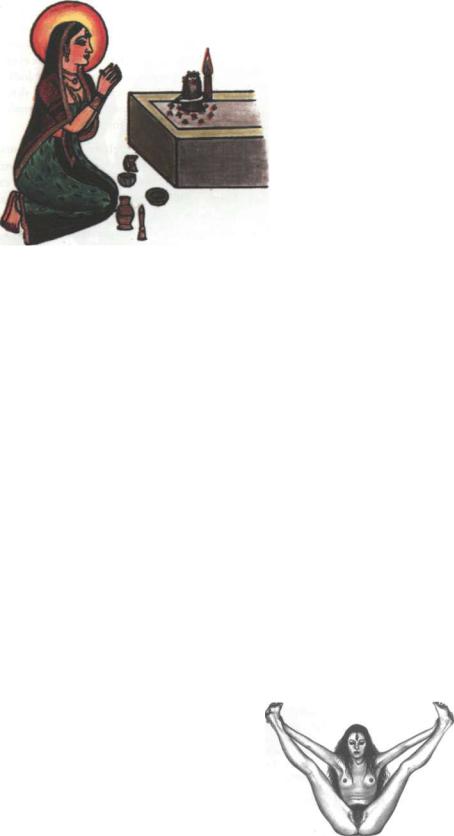
Ritualized worship helps the channeling of energy. In Hinduism idols and symbols are used to help focus the mind on transcendental goals, serving to remind the worshipper of the indescribable nature of godhead. Worship at a Shiva shrine is depicted in this Mughal miniature, circa 1735.
At all times, whether washing the feet or eating, rinsing the mouth, rubbing the hands, or girding the hips with a loincloth, going out, making conversation, walking, standing, in wrath, in laughter, the wise man should always worship and honor the lady.
HEVAJRA TANTRA
Erotic visualization serves to awaken and consciously stimulate the emotions. The Third Eye at the forehead symbolizes the attainment of an all-seeing mystic awareness.
Brahma the Creative 95
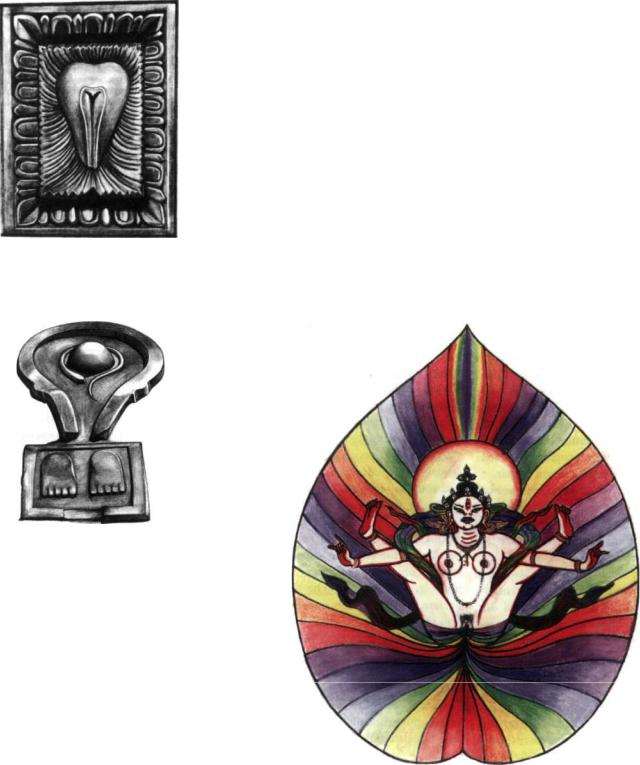
Icon of the Yoni, emanating rays of energy. From a South Indian wood carving of the nineteenth century.
In this Hindu shrine a Kundalini-snake is coiled around the Shiva Lingam and two footprints are at the entrance to the Yoni.
This is a glyph of the ideals of worship. The feet symbolize the lineage of teachers, the Yoni the all-powerful energy of femininity, the snake the Kundalini tamed and controlled, and the Lingam ultimate transcendence. Stone sculpture from Bagh, India, circa fourteenth century.
your head, having just consummated the act of love; she is naked, with disheveled hair, and her Yoni is moist and overflowing with sexual secretions. Her three eyes are filled with erotic emotion and look toward the vast expanse of the sky, which, as she begins to dance, becomes filled with similar forms of herself.
This precise and relatively simple visual-
ization serves to identify the W i s d o m -
goddess with the meditator. A typical example of Tantric inner worship, this visualization is most effective in captivating the emotions and the imagination.
In the Tantric tradition the attitude of worship is referred to as Sadhana, meaning
"the direct way." Sadhana is an individual's art of worship and implies commitment and actual practice. The potential to step aside from purely mundane activities and practice Sadhana is inherent within each of us. For Sadhana to be complete, it should involve all activities and should not be seen as separate from one's overall lifestyle. Throughout this first section we have outlined ways in which the individual or couple can learn to recognize and channel energy creatively. The art of worship is essential to the success of these practices. Worshipping the inner spirit during love-making leads to mystical awareness and self-realization. Then love takes on its liberating and truly eternal character.
Visualization image of a Wisdom-goddess of the Tantric Kargyudpa sect of Lamaism.
Energy flows outward from her Yoni and forms the shape of a Bodhi-tree leaf, under which the Buddha was enlightened. This initiatory image expresses the spontaneous nature of erotic energy. From a Tibetan painting of the late eighteenth century.
The Knower of Yoga should always worship the female power, according to the
revelation of the |
Tantras. One should worship mother, sister, |
daughter, wife, |
and all women. |
During this kind of worship there should be |
contemplation of |
the essential unity of Wisdom and Means, the female and male principles.
ADVAYASIDDHI
96 Brahma the Creative