Материал: Snote
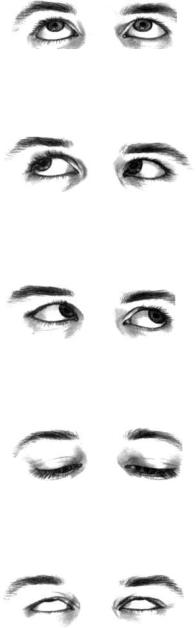
The eyes create an intense first impression.
The overthrowing gaze, linked to exhalation of breath.
The subduing gaze, linked to inhalation of breath.
The conjuring-forth gaze, linked to retention of breath.
The petrifying gaze, with the breath relaxed but motionless.
Turning the eyes upward while retaining the breath focuses energy in a transcendental direction and aids control of orgasm. It is a technique familiar to both Taoism and Tantra.
the inner eye
The eyes have long been called the windows of the soul. They certainly indicate much about an individual's inner state, both physically and psychologically. For this reason, physicians are taught to inspect the eyes of their patients as an aid to diagnosis, and Tantric teachers examine the eyes of wouldbe students to help determine their needs.
We all receive impressions unconsciously, especially when meeting a person for the first time; it is the look in the eye that creates the first impression. Sometimes a twinkle or a flash unaccountably creates a lasting impression; other times a glare or a certain "look" influences one's opinion of that person. Tantra holds such signs as significant and recognizes different categories of "looks."
The Tantric teachings list four main types of gazes associated with different eye positions and breathing practices. In the overthrowing gaze of Tantra the eyes are directed upward, toward the forehead, while the breath is exhaled. In the subduing gaze the eyes look to the left, while the breath is inhaled. For conjuring forth the two eyes are turned to the right, slightly upward, while retaining the breath. Finally, for petrifying or "causing rigidity" the gaze is central, looking toward the tip of the nose, with the breath relaxed, but motionless. Such techniques, long known to Tantric Yogis, are familiar in the West only to professional hypnotists, magicians, and the odd salesman or confidence trickster. For these gazes to be truly effective, prescribed meditation techniques must accompany them. Fortunately such techniques have remained largely secret.
The eyes have nerve structures very similar to those in the brain; they function in much the same way as a computer and can predict movements before they actually happen. The eyeballs are never still, even for a moment, and during dream experiences make very rapid movements. It seems there is a direct link between eye movements and fantasy; it's easy to tell when a person is listening just by looking at the eyes. Likewise, a lie or half-truth can easily be determined by studying eye movements.
The Gheranda Samhita gives a simple tech-
nique for gaining conscious control over the eyes. Known as trataka or "gazing," it is described in the text in the following way: "Gaze steadily, without blinking, at a small object held some distance away. Empty the mind and continue gazing until tears begin to flow. By practicing this, all eye diseases are destroyed and clairvoyance is induced." In the East, fixing the gaze on the tip of the nose is a common meditation technique, serving to still the eye as well as the mind; it allows the sense of "seeing" to be drawn inward. In this exercise one should focus on breathing, noticing when one is breathing in, retaining, and exhaling. A clairvoyant can perceive the elements in the breath according to color and shape as the breath is inhaled. When the body is in balance and the mind at ease, an inner vision that transcends the normal limitations of time and place is awakened.
Sentiments are easily recognizable in the eyes, especially anger, joy, humor, and eroticism. The "reflection" of emotions in the eyes is due to a subtle nerve connecting them with the Navel Chakra. You may consciously evoke a sentiment using breathing techniques and visualization; unconsciously, sentiments occur and change all the time. Retention of breath creates a subtle force that travels from the Navel Chakra to the eyes. When this force is linked to a visualization, the eyes show the relevant sentiment. If, for example, you wish to evoke the erotic, first stimulate the inner fire by a number of deep breaths, concentrating on retention and channeling the energy upward. Then, imagine something erotic and focus on all the details; you'll find yourself becoming "emotionally involved." By regulating breath, emotions, and breathing, you'll be able to consciously channel erotic energy outward, through the eyes. Treat the force with care and try to instill it with deep, compassionate love. This is effectively achieved by visualizing another subtle nerve connecting the Heart Chakra with the eyes and channeling compassion outward, mixing it with
the force from the Navel Chakra.
The |
right side of the brain is connected |
to the |
left eye, the left side of the brain to |
the right eye. A headache from overwork can often be cured by gentle finger pressure at points just above the eyeball, right up to the nose; sinus troubles or migraine can be alleviated by light massage of the region directly under the eyes, stroking outward, away
82 Brahma the Creative
from the nose. The eyes themselves are helped by head massage, cold water, fresh air and especially by inverted Yoga postures, which increase the flow of blood to the head.
Eastern teachings stress the importance of careful tending of the eyes. Since heat is considered especially harmful to the eyes, it is advisable to shield them with a cool cloth when taking a steam bath or a hot shower. The most ancient eye balm known to humanity is kohl, used by both men and women in the Near and Far East. Today there are many artificial kohls on the market. These "kohls" are merely black preparations made from dark substances mixed with a base; they have little beneficial effect and some preparations are actually dangerous. Real kohl is made by burning beneficial cooling herbs, oils, or compounds and collecting the soot on a cool surface, such as the outer part of a pot filled with water. Some of the best kohl
is made from camphor mixed with herbs and burned. When kohl is properly prepared, it cools, cleans, and protects the eyes, at the same time darkening the rims in a dramatic and erotically pleasing way.
According to both Tantric and Taoist teachings, the eyes have a function that is directly related to control of the mind. For example, in order to control premature ejaculation, the eyes may be rolled several times, all the way around. Texts state that this effectively controls the "ascent of fire" at the Navel Chakra and creates a stabilization of the urge to orgasm.
Harmonious love-making is beneficial to the eyes and gives them luster and power. By becoming aware of the "inner" qualities of vision, the couple can acquire enhanced sensitivity and creativity. Instead of taking the eyes for granted, try to familiarize yourself with their secret power.
Dissolve your whole body into vision, so to become seeing, seeing, seeing....
RUMI
When worldly passion begins to subside, a wife does not look straight into the husband's eyes.
ANANGA RANGA
If a man makes love without ejaculating, his vital essence is strengthened, his body becomes harmonized and his subtle hearing and vision will become acute. Although such a man has repressed his passion, his love for the woman will increase; it is as if he cannot get enough of her.
YU-FANG-PI-CHUCH
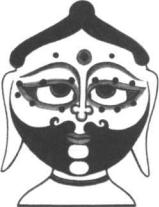
Tantric diagram showing the subtle energy points around the eyes. Pressure on these areas eases eyestrain and also aids the development of clairvoyant vision. From a Rajasthani miniature painting of the late eighteenth century.
inner scenery
The mind has tremendous powers of imagination, which are commonly lost in adulthood. This natural faculty can be reawakened and put to the service of the sexual secrets. All great poets, artists, scientists, and philosophers have a natural faculty for creative imagination. Many of their greatest discoveries and works are the products of an imagined inner world. According to Eastern teachings, in this world of imagination contact is made with the true source of wisdom and intelligence. The mystic traditions prescribe specific techniques to create an inner scenery in which creativity can flourish. When we think visually
rather than through inner dialogue or "mental chatter," the opportunity for inner scenery to unfold is greatly enhanced.
The Kena Upanishad, an early Hindu text, states: "Through knowledge of the Self we obtain power; through the inner vision we attain Eternity." This metaphysical statement is helpful in understanding why Tantric teachings emphasize visualization as an aid to Liberation. Knowledge of the Self certainly awakens our enormous inner potential, but a developed visionary faculty is required to channel our inner power creatively. Fortunately, every individual is capable of developing inner vision as a tool of Self-discovery.
In Tantra the development of the visionary faculty is a twofold process: an open introspection of images as they come to mind and an eager stimulation of imagination
Brahma the Creative 83
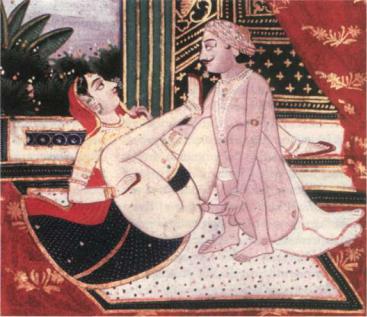
A couple making love, the man squatting and his partner moving into the Stepping Beyond Position. A Rajasthani miniature painting, circa 1850.
The river of life impetuously rushes. It has five streams of sense feelings, which come from the five sources, the five great elements. Its waves are moved by five kinds of winds and its origin is the fivefold fountain of consciousness. The river has whirlpools and rapids.
SVETASVATARA UPANISHAD
through visualization. Two basic philosophical principles serve as the foundation of Tantric visualization.
The first is the principle of expansion and contraction. All created things expand and, eventually, contract; the process is repeated over and over again. Stars, suns, whole galaxies, as well as atoms, compounds, inorganic and organic life forms, and individuals all exhibit the tendency to expand and contract. In the sexual act this expansion and contraction play a major role.
The second principle is that all phenomena are inherently "empty." However we view reality, emptiness is a consistent discovery. Tantra does not take a negative view of this "emptiness" but instead sees the qualities of consciousness and blissfulness rising out of the emptiness. This may seem a strange contradiction, yet the Tantric view is that in order for emptiness to be experienced, consciousness must be present. From about the second to third century A.D., Tantra emerged as a metaphysical teaching in its own right, with the threefold interaction of emptiness, consciousness, and blissfulness as its philosophical base. No matter what internal or external object the mind focuses on, emptiness is found to be its first characteristic, consciousness its second, and blissfulness its third. Emptiness, or the "space element," permeates the object and is quantitatively greater than the other elements. For example, most of the universe is but empty space. Similarly, a single atom is composed largely of emptiness; the human body, if viewed under great
magnification, would also seem to be a great expanse filled with small concentrations of pulsating energy. Emptiness also dominates the psyche, yet on introspection, emptiness is found to be filled with consciousness and bliss. This mystic view of reality is common to all evolved spiritual traditions and is but another way of saying that the universe is sustained by the blissful Will of God.
This saying is attributed to the Buddhist Tantric teacher Aryadeva: "Just as a clear gem is colored by the color of other objects around it, so also is the gem of the mind colored by the constructive imagination." If you wish to awaken and channel the visionary faculty, it's only necessary to color your mind with your own inner scenery.
Take a comfortable position, either seated or lying down, and relax the body by breathing deeply and fully. If you have a problem relaxing, concentrate the mind on different parts of the body in turn, from the feet up, tensing and relaxing each part. Tensing (contraction) and relaxing (expansion) help the psycho-organism to harmonize itself. Once the body feels at ease, slow the breathing and focus the mind on the air entering and leaving the body.
Imagine that the body is completely vacuous, as empty as the farthest reaches of outer space. See only the surface of the body, the outer skin, holding the outer shape of it in the mind's eye. Steadily concentrate on the inherent emptiness of the body and imagine that when you inhale, the outer surface expands, and when you exhale, it contracts.
84 Brahma the Creative
Watch this vision of yourself with the inner
eye and try to keep calm and emotionally detached, all the time becoming more and more aware of the expansion and contraction. Recognizing that the outer universe expands and contracts also, see yourself as mirroring this process of interplay between Yang and Yin. Try to become absorbed in this mirroring process and feel that your heartbeat is the center of the universe. Imagine Brahma dwelling there as the innermost Self, sending out rays of visionary light to fill
the "emptiness" within . Identify with Brahma (the creative spirit) as the sound
" O M " at the center of the body. Recognize that the Brahma within is not different from the Brahma at the center of the macrocosm.
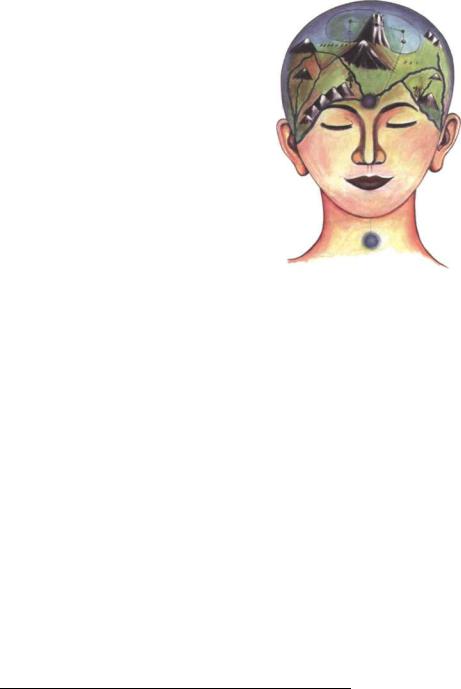
Having contemplated Brahma both within the body and the universe, visualize inner scenery; just as the outer world is composed of elements, energies, heat and cold, fire and water, mountains, volcanoes, oceans, deserts, forests, hills, valleys, rivers, gardens and sanctuaries, so is the inner world. From the focus of the heart, creative rays of effulgent light emanate to the outer surface of the body. Think of the outer contours of the body as hills, the hairs as trees, the right and left eyes as the sun and the moon. Imagine the arteries and veins as rivers and streams, the internal organs as shrines and sanctuaries, the brain as Mount Meru, the peak of an inner holy mountain. Imagine the Subtle Body with its myriad subtle channels; think of the Kundalini, the inner sun at the Navel Chakra and the inner moon at the Head Chakra. Try to visualize them as if the Brahma residing in your heart is creating them.
When you inhale, imagine the life-force entering the inner world of the body from the center of the universe. During the period of breath retention visualize the primordial vitality of Brahma dividing into the Prana,
Apana, Samana, Udana, and Vyana life currents. Each of these takes on the appearance of colored lights that illuminate and sustain the inner being, controlling the functioning of vital body functions and sense faculties.
The chart below indicates the relationships. Once you are able to evoke inner scenery at will, you can use it to enhance eroticism.
Practice expanding and contracting the vision of inner scenery, increasing and decreasing the scale. Instead of hills or valleys, imagine rising crags and deep canyons; instead of rivers and pools, imagine torrents and rolling oceans. Link your emotions to these inner visions and they'll become stronger and more real.
Imagine that the body fills the universe, then visualize it as small as an atom. Con - centrate on the fine details, always looking for more perfection in the vision. As you expand and contract the vision of the Self, it will become more concentrated, more controlled, and transcendental. The Prajnopaya, a medieval Tantric text, gives some good advice about this process: "One must proceed in such a way that the mind does not swerve, for when a jewel-like mind swerves from the transcendental unity and lapses into contraries, perfection is not attained."
The visualization of inner scenery can serve an important function in eroticism. During love-making the person in the active role should visualize Yang things like fire, mountains, and volcanoes, while the one in the passive role should hold in mind Yin things like water, valleys, and pools. This has a very real and powerful effect on the quality of love-making. Most people fantasize while making love, but when this natural tendency is controlled and directed as outlined, the effects are quite different. Once the faculty for visualization has developed, it opens a new range of possibilities for creative love-making.
Inner scenery is the mind's discovery of the relationships between microcosm and macrocosm. This drawing, from a contemporary Balinese painting, shows the mind contemplating itself as Meru, the Holy Mountain, with pilgrimage routes to the Third Eye and Aperture of Brahma.
Brahma dwells within the heart's lotus, where, like the spokes of a wheel meeting the hub, the subtle nerves meet: Meditate on Brahma as "OM" and cross the ocean of darkness.
MUNDAKA UPANISHAD
Life Current |
Color |
Vital Body Function |
Sense Faculty |
Prana |
Emerald-blue |
Circulation and respiration |
Smell |
Udana |
Red-violet |
Sensations and swallowing |
Touch |
Samana |
Solar red |
Assimilation and digestion |
Sight |
Vyana |
Blue-white |
Muscles and posture |
Hearing |
Apana |
Orange-red |
All excretions |
Taste |
|
|
|
|
These are the imaginary forms that appear in the mind's eye before the final vision of resolution; a mist, smoke, a sun, wind, fireflies, afire, lightning, clear crystal, a moon.
SVETASVATARA UPANISHAD
Brahma the Creative 85
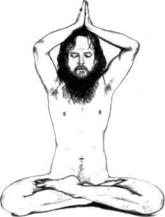
Yoga postures are helpful in the development of mental concentration and visualization.
After one has meditated on Brahma, one should visualize one's chosen deity with all the force of one's soul. By constantly thinking, "This is I," one becomes the deity. A complete consecration of oneself as the deity takes place after the offering of a flower to oneself. "I am god; all instruments of worship, such as eatables, perfume, incense, and flowers, become divine through visualization of them as such. I am the abode of god, I am god." Thus one should meditate, bringing god to god and making everything pure and eternal by the re-creation of god in oneself.
KALIKA PURANA
visualization
Tantric teachings are largely expressed in visual terms, which naturally aid the understanding of deep intuitive truths. In coming to terms with our inherent nature we must learn how to "switch off" mental chatter and allow the
mind to remain open . T h e Chandogya
Upanishad, an important early Hindu text, declares: "Wherefrom do all these worlds emerge? They come from space. All being and things emerge from space and into space they ultimately return; space is indeed their beginning and space is their final end." When we can consciously bring to mind the vastness of inner space, the ground is laid for the practice of visualization. By filling our inner space with creative visualization we effectively "make our own reality."
Though Tantric visualizations are of many different kinds, the common feature of them all is their origin in emptiness and space. As we have already explained in "Inner Scenery," the emptiness of Tantra is, paradoxically, filled with consciousness and bliss; it is a plenum void. A preliminary Tantric visualization sees the body as internally vacuous and externally as a surface with sense organs, elements and energies. Tantric texts outline different ways of developing enhanced receptivity and spontaneity through visualization techniques. The Chakrasambhara Tantra, an important metaphysical treatise that evolved in the sixth to eighth centuries A.D., gives the following visualization for awakening and enhancing the senses:
Find a quiet place and take up a comfortable position. Contemplate the inherent voidness of all phenomena and recognize that consciousness and blissfulness are to be found within the inner space. Visualize rays of light emerging from the heart center; these rays proceed through the body and reach out into space, shedding light on everything they encounter. Draw back the rays and gather them within; draw in the male and female breaths of the right and left and focus them in the region of the Heart Chakra. Imagine yourself as filled with heroism, fearless, and visualize a lineage of Tantric teachers above your head. Pray to them to aid the
process of inner awakening and imagine a red and white disc resting on the junction of nerves in the Heart Chakra. On that disc imagine a point of light the size of a sesame seed and fix your mind intently on it. Regulate the breath, balancing the right and left until a gentle balance prevails. Hold the mind firm, so it doesn't run astray, and a blissful clarity will result. Then transfer the imagination to the other sense organs.
Imagine two very fine bright white points within the pupils of the eyes. Close the eyes and imagine that the points are still there, and, when the mind is accustomed to it, focus on various objects, all the while keeping the bright points of light before the mind. With practice, the points will be ever more vivid, no matter what the eye falls upon. Having attained stability, draw in the points within the cavern of the heart and imagine the heart gaining brilliancy and clarity. Next, transfer the imagination to the two ears.
Imagine a fine blue point inside each ear and meditate on them, in a totally quiet place. When you have succeeded in fixing the mind upon them, move to a place where there are sounds, but always keep the mind fixed on the two fine blue points. With practice, the points will be more vivid, no matter what one hears. Having attained stability, draw in the points and focus them in the Heart Chakra. Then transfer the imagination to the nose.
Imagine a fine yellow point inside each nostril and meditate on them in a place totally free from odors. Concentrate the mind on them and, when the visualization does not waver, move to another place where there are odors. Keep the mind focused on the two fine yellow points no matter what, and they'll become more vivid. Having attained stability, draw them in the Heart Chakra. Next transfer the imagination to the tongue.
Imagine a fine red point at the root of the tongue and meditate on it without tasting anything. Concentrate the mind on the red point and, when the visualization is steady, taste some different flavors. No matter what you taste, keep the mind focused on the point so it becomes more brilliant. Once stability is attained, draw it into the Heart Chakra.
Transfer the imagination to the body and focus on a fine green point at the
86 Brahma the Creative