Материал: Russian Journal of Building Construction and Architecture

Russian Journal of Building Construction and Architecture
9.Kanygina S. Yu. Prognozirovanie ostatochnykh deformatsii dorozhnykh odezhd nezhestkogo tipa na zemlyanom polotne iz glinistykh gruntov. Avtoref. diss. kand. tekhn. nauk [Prediction of residual deformations of road pavement of non-rigid type on the roadbed of clay soils. Cand. eng. sci. diss.]. Moscow, 1999. 20 p.
10.Leonovich I. I., Vyrko N. P. Vodno-teplovoi rezhim zemlyanogo polotna [Water-heat regime of the roadbed]. Minsk, BNTU Publ., 2013. 332 p.
11.Mavledinov Z. A. [Determination of the depth of the core of the soil of the roadbed]. Trudy MADI-TU "Problemy stroitel'stva i ekspluatatsii, avtomobil'nykh dorog" [Proc. of MADI-TU "Problems of construction and operation of roads"]. Moscow, 1998, pp. 45––47.
12.Matua V. P., Chirva D. V., Mironchuk S. A. Ispytanie materialov [Material test]. Avtomobil'nye dorogi, 2012, vol. 7 (968), pp. 86––89.
13.Matua V. P. Issledovanie napryazhenno-deformirovannogo sostoyaniya dorozhnykh konstruktsii s uchetom ikh neuprugikh svoistv i prostranstvennogo nagruzheniya. Diss. d-ra tekh. nauk [Study of the stress-strain state of road structures taking into account theirinelastic properties and spatialloading.Dr.eng.sci.diss.]. MADI,2002.484p.
14.Matua V. P., Chirva D. V., Isaev E. N. Metodika issledovaniya svyaznykh gruntov na nakoplenie ostatochnykh deformatsii [Method of investigation of cohesive soils on the accumulation of residual deformations]. Vestnik Tomskogo gosudarstvennogo arkhitekturno-stroitel'nogo universiteta, 2016, no. 3 (56), pp. 186––194.
15.Matua V. P., Mironchuk S. A. Novoe laboratornoe oborudovanie i metodika provedeniya ispytanii dorozhnostroitel'nykh materialov pod vozdeistviem dinamicheskikh nagruzok [New laboratory equipment and methods of testing road-building materials under the influence of dynamic loads]. Nauka i tekhnika v dorozhnoi otrasli, 2012, no. 4, pp. 16––18.
16.Matua V. P., Mironchuk S. A., Isaev E. N. Primenenie datchika WaterScout dlya monitoringa vlazhnosti grunta zemlyanogo polotna [Application of the WaterScout sensor for monitoring the soil moisture of the roadbed]. Vestnik Tomskogo gosudarstvennogo arkhitekturno-stroitel'nogo universiteta, 2017, no. 5, pp. 1921––99.
17.Matua V. P., Mironchuk S. A., Nikulin Yu. Ya., Isaev E. N. Energoeffektivnoe oborudovanie dlya obespecheniya kachestva asfal'tobetonov [Energy-efficient equipment for asphalt concrete quality assurance]. Nauchnoe obozrenie, 2014, no. 7, vol. 3, pp. 884––887.
18.Matua V. P. e. a. Pribor dinamicheskikh ispytanii [Dynamic test device]. Patent RF, no. 2014137088, 2015.
19.Chmshkyan A. V. Sovershenstvovanie metodov rascheta prosadochnykh deformatsii [Improvement of methods of calculation of subsidence deformations]. Inzhenernyi vestnik Dona, 2012, no. 4, vol. 2. Available at: ivdon.ru/ru/magazine/archive/n4p2y2012/1256.
20.Masrouri F., Bicalho K. V., Kawai K. Laboratory hydraulic testing in unsaturated soils. Geotechnical and Geological Engineering, 2008, vol. 26, no. 6, pp. 691––704.
21.Tuller M., Or D. Water Retention and Characteristic Curve. Encyclopedia of Soils in the Environment. Elsevier Ltd., 2015, pp. 278—289.
22.Parikh A. K., Mehta M. N., Pradhan V. H. Тranscendental Solution of Fokker-Planck Equation of Vertical Ground Water Recharge in Unsaturated Homogeneous Porous Media. International Journal of Engineering Research and Applications, 2011, vol. 1, no. 4, pp. 1904—1911.
23.Zhang J., Jiang Q., Zhang Y., Dai L., Wu H. Nondestructive Measurement of Water Content and Moisture Migration of Unsaturated Red Clays in South China. Advances in Materials Science and Engineering, 2015, no. 1, pp. 1––7. doi: 10.1155/2015/542538.
80

Issue № 3 (43), 2019 |
ISSN 2542-0526 |
DOI 10.25987/VSTU.2019.3.43.007
UDC 625.7/.8
A. N. Tiraturyan1
NEW APPROACH TO TECHNICAL MONITORING OF THE CONDITION OF FLEXIBLE ROADWAY PAVEMENTS
Don State Technical University1
Russia, Rostov-on-Don
1PhD in Engineering, Assoc. Prof. of the Dept. of Highways, tel.: +7-951-820-03-03, e-mail: tiraturjan@list.ru
Statement of the problem. Ensuring an increased life cycle of flexible road pavements requires significant improvement of the organizational and technical mechanisms for managing their condition. One of such elements is the monitoring the condition of flexible road pavements, which receives insufficient attention in the road practice of the Russian Federation. The development of a conceptual framework for monitoring the state of flexible pavements is the main objective of the study reported in this article.
Results. The main parameter characterizing the state of flexible road pavement is to use the density of the energy dissipated during the passage of the settlement car determined based on the area of its dynamic hysteresis loop. The article looks at the methods of constructing dynamic hysteresis loops at the design stage and operation stage. The results of full-scale and cameral studies on the establishment of statistical laws for the distribution of structural parameters of flexible pavements at the operational stage are presented.
Conclusions. A new approach to monitoring the state of flexible road pavements was developed based on the analysis of the energy dissipation density in the pavement structure and taking into account the stochastic nature of the distribution of its main structural parameters allowing for operational planning and management of the technical condition of flexible road pavements.
Keywords: pavement, technical monitoring, residual life, density, dissipation energy, dynamic hysteresis loop, damping coefficient.
Introduction. Due to a transition to a 24-year gap in the maintenance of flexible pavements, it is increasingly important to improve their management mechanisms. Recent years have seen a significant development in the infrastructure of diagnostic equipment for their instrumental evaluation. A number of effective solutions have been set forth for its integration into a current technical base available in the Russian Federation.
© Tiraturyan A. N., 2019
81

Russian Journal of Building Construction and Architecture
One of the ways of addressing this is by designing effective decision-making mechanisms. There are comprehensive unified systems of road maintenance which rely on the major assumptions of the Guidelines on the Road Evaluation and Maintenance (ОДН 218.0.006-2002) [1, 3, 4, 12]. Individual approaches to the maintenance of flexible road pavements are employed based on the evaluation of their residual life [2, 5, 10, 13] and condition prior to the commencement of the project [16––18]. It should be noted, however, that one of the essential elements in any management system is monitoring. In this country’s road industry the term is seen as a superficial one meaning nothing except a set of comprehensive measures to evaluate road pavements in order to assess their deterioration rates [8, 14]. The analysis of foreign literature on the topic suggests that new technologies of collecting, storing and processing road evaluation data have been a focus of attention [11, 17, 19]. At the same time in accordance with the GOST (ГОСТ) Р 54257-2010 “Reliability of Building Structures and Foundations”, identification of a particular technological monitoring method is a broader effort that involves systemic assessment of the structure in order to control its quality, compliance with the project specifications and guidelines, predicting actual load-bearing capacity and residual life cycles resulting in informed decision-making with regard to ensuring longer emergency-free operation of the object.
1. Modelling the effect of a dynamic hysteresis on the road pavement surface under the impact of a calculated vehicle. Existing system of road pavement evaluation criteria involves the design of a comprehensive set of operational (longitudinal evenness, adhesion coefficient, rutting) and structural characteristics of flexible road pavements (the overall elasticity modulus, average visual evaluation score). At the same time there is no energy parameter that would describe a road structure and account for a combination of all of the above factors. This could be the density of dissipated energy as the calculated vehicle passes through which is defined as
|
|
ij d ij dS Eпов EP,S E*, |
(1) |
0 |
|
where the left-hand part of the expression identifies energy losses in the environment under the impact of a surface source with a contact spot ; ij , ij are the strains and deformations on the surface of a road structure; Eпов is the energy infinitely transferred by surface waves;
EP,S is the energy of volumetric waves; E* is the energy dissipated in the road structure due to the viscosity properties and internal anomalies.
82
Issue № 3 (43), 2019 |
ISSN 2542-0526 |
This can be calculated using the area of a dynamic hysteresis loop [9, 25] obtained while modeling a vehicle’s wheel path along a pavement surface. The solution will be implemented by applying the mechanic and mathematical modeling of the stress-strain of flexible road pavement. The mathematical model is based on the solution of a system of boundary integral equations and is described in [11, 25].
Considering that in real conditions under the wheel impact on the road pavement surface, there is a spatial dynamic stress-strain. The energy density should thus be given by the formula
|
|
|
|
W xx d xx yy d yy zz d zz , |
(2) |
||
0 |
0 |
0 |
|
where W is the density of the dissipated energy, J/m3.
For more on the results of the numerical modeling of the density of the dissipated energy of road structures with different rigidity ratios of their layers see [25].
2. Restoring the parameters of dynamic stress-strain of flexible road pavement at the operation stage. Implementation of a system of technical monitoring of flexible road pavements involves obtaining similar parameters at the operation stage, which requires restoring the parameters of its dynamic stress-strain.
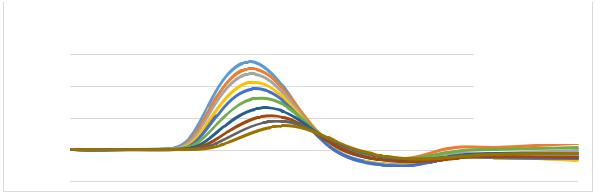
The use of modern equipment and software packages allows the elasticity modulus s of construction layers of flexible road pavements to be identified at the operation stage using the elastic deflection measurements [6, 7, 22, 23]. The area of a dynamic hysteresis loop is determined apart from the elasticity modulus s by its attenuation characteristics. This could be a damping coefficient of the layer determined based on the amplitude-time characteristics of displacements measured on the road pavement surface under shock loading using FWD for measuring vertical deformations at the load application point as well as away from it using 9 sensor geophones (Fig. 1).
 Sensor 1 (0 mm)
 Sensor 2 (200 mm)
 Sensor 3 (300 mm)
 Sensor 4 (450 mm)
 Sensor 5 (600 mm)
 Sensor 6 (900 mm)
 Sensor 7 (1200 mm)
 Sensor 8 (1500 mm)
 Sensor 9 (1800 mm)
 Sensor 10 (2100 mm)
Fig. 1. Amplitude-time characteristics of displacements measured under shock loading
83

Russian Journal of Building Construction and Architecture
The results of imitation modeling presented in [24] allowed us to conclude that changes in the damping coefficient of the asphalt concrete layers are associated with a time difference between the extremums of amplitude-time characteristics of the displacements in the area 0––0.30 m away from the shock loading point, the foundation layers in the area 0.3––1.2 m, the subgrade soil –– 1.2––2.5 m.
The damping coefficient can be identified in accordance with the formula [20]:
|
|
|
|
|
, |
(3) |
|
|
|
|
|||
2 2 |
2 |
|||||
|
ln |
A1 |
t 1 |
, |
||
|
|
|||||
|
|
A |
|
|
||
|
|
2 |
|
|
|
|
where is a logarithmic attenuation decrement; A1 , |
A2 |
are the extrema of the amplitudes of |
||||
vertical displacements where the damping coefficient is calculated.
Based on the natural experiments, the method of restoring the parameters of the stress-strain of flexible road pavements at the operation stage was designed (Fig. 2).
Instrumental evaluation of flexible road pavements
Measurement of amplitude-time characterristics of displacements and deflection bowls of flexible road pavements using a shock loading setup
Determining the thickness of the layers of flexivle road pavements using a georadar intubation
Statistical distribution of the elasticity modulus |
|
Statistical distribution |
s and damping coefficients in the investigated areas |
|
of the thickness of the road |
of the highway |
|
pavement layers |
Analytical model of the dynamic stress-strain of the road structure
Distribution of the main components of the stress-strain of the road structure
σxx (εxx );σyy (εyy );σzz (εzz )
Statistical processing of the results:
––identifying the character of the distribution;
––evaluation of the mean value with 95 %, 5 % of the available sources
Fig. 2. Algorithm for restoring the parameters of a dynamic stress-strain of flexible road pavements at the operation stage
84