Материал: Possibilities of Internet resources in Teaching English Vocabulary
Possibilities of Internet resources in Teaching English Vocabulary
MINISTRY OF EDUCATION AND SCIENCEOF
KAZAKHSTANNational University named after L. N. Gumilevof Philologyof Theory
and practice of foreign languages
Paperof Internet resources in
Teaching English Vocabulary
Written by S.K. Kaldybayevapupil5B011900by D.K.
Anashevateacher
2014
The contents
Introduction
1. Theoretical aspects of relationship between technology and language
1.1 Research-based principles of vocabulary instruction and multimedia learning
1.2 Strategies that use Internet resources to engage pupils in vocabulary learning
1. Learn from visual displays of word relationships within text
2. Take a digital vocabulary field trip
3. Connect fun and learning with online vocabulary games
4. Have pupils use media to express vocabulary knowledge
5. Take advantage of online word reference tools that are also teaching tools
6. Support reading and word learning with just-in-time vocabulary reference support
7. Use language translators to provide just-in-time help for ELLs
8. Increase reading volume by reading digital text
9. Increase reading volume by listening to digital text with a text-to-speech tool and audio books
10. Combine vocabulary learning and social service
1.3 Vocabulary.com - an adaptive learning system
2. Analysis of examples of vocabulary learning strategies available on the Internet during the lesson
2.1 Analysis of examples of using Web application during the lesson
2.2 Analysis of examples of teaching vocabulary using Games from the Internet
Conclusion
References
Introduction
Vocabulary refers to the words used in a language.
The theme of our research work is "Possibilities of Internet resources in teaching English vocabulary”
The topicality of our research is defined by the fact that for many years, possibilities of internet resources did not receive priority in teaching English vocabulary. Vocabulary is the first and foremost important step in language acquisition. In a classroom where pupils are not finding themselves comfortable with the second language, language learning can be made interactive and interesting with the introduction of appropriate vocabulary exercises. This paper is an attempt to study and explore the various methodologies that can be incorporated in the teaching of vocabulary items in a language classroom. Online virtual worlds are becoming important tools in foreign/second language instruction in view of the fact that they enhance learner motivation; promote autonomy and social presence in a 3D environment. Internet is a type of reality in which pupils can meet and communicate with other learners in the target language using text, voice or video as well as share ideas related to language learning. Furthermore, internet provides learners with the opportunity to take part in virtual language courses or lessons as well as visit places connected with the target language culture.
The aim of our research is to investigate the effectiveness of using online activities and a browser-based virtual world in teaching English vocabulary.
The object of the research is possibilities of internet resources in teaching English vocabulary.
The subject of the research is teaching primary school children to use internet resources in learning English vocabulary.to the aim, object and subject of our research we have to fulfill the following objectives:
To identify the useful methods of teaching English vocabulary.
internet teaching english multimedia
To find strategies that use Internet resources to engage pupils in vocabulary learninganalyze the role of using internet resources in teaching English vocabulary at primary schools.our research we used immediate constituent analysis method.
Theoretical significance: We have done an analytical work, made a valuable contribution to the studying of the beneficial strategies that use Internet resources to engage pupils in vocabulary teaching at primary schools. And in our opinion, it will be quite right to research this problem on the basis of works of outgoing scholars such as Lubliner & Scott, Stanovich, Dalton, B. and Grisham, D. L., Son, J. - B.
The practical significance of our research work: The materials given in our work can be used at the seminars and can be the reference to defined internet programs, books, sites for people who are interested in using internet resources in teaching English vocabulary at primary schools.
The structure of research
includes Introduction, theoretical part, practical part, Conclusion and
Reference. In Introduction the aim, objectives, object and subject,
methods of investigation, theoretical and practical significances, also the
materials under analysis of research were considered. In the theoretical part
of research we considered about the theoretical aspects of relationship between
technology and language. In the practical part of the research we have
given the analysis of examples of using Web application during the lesson at
primary schools. In conclusion: the result of our research is considered. In
Reference: the list of works foreign scientists that were analyzed
during the investigation.
1. Theoretical aspects of relationship between technology and language
1.1 Research-based principles of vocabulary instruction and multimedia learning
Vocabulary is central to English language teaching because without sufficient vocabulary pupils cannot understand others or express their own ideas. Why is vocabulary learning so important? To understand a text, one must understand the words that represent the ideas or concepts. Studies confirm the high correlation between vocabulary knowledge and reading comprehension. We also know that there are degrees of word knowledge, from "I've never heard this word before," to "I know this word and can apply it in multiple contexts", as well as metacognitive knowledge about how to apply prior knowledge and strategies to vocabulary learning.
Usage of Internet resources is one of the important objectives in learning foreign language. Many studies have been conducted about the relationship between technology and language. Some of them have focused on attitudes of the participants while some have taken concrete test scores into account. Overall, the results of multiple studies seem to suggest that active leisure use of the Internet is beneficial for one’s English skills. Reading online texts, both in one’s own time and when assigned, are extremely good for acquiring necessary language skills. Linguists conducted a study exploring the correlation of language acquisition and reading for pleasure online. The result was that the pupils who spent more time reading on the Web scored better on reading tests. Furthermore, scholars studied ESL business pupils’ approaches and attitudes towards learning vocabulary through Internet reading. In the study, he divided the participants into two groups, consisting of readers and non-readers. Interestingly enough, he also monitored the participants’ vocabulary knowledge throughout an 8-week period. The results showed that those who were assigned to do online reading scored higher in the post-test. The youth themselves also feel that they learn through browsing the Web. Scientists studied upper secondary pupils’ motivation in relation to learning English in the Internet. Aim was to chart how the Internet affected young people’s motivation, skills and attitudes towards learning English. The results showed that over 80% felt motivated to learn English. In addition, well over 50% of the web pages they browsed were English-based. Finally, 10 out of 21, that is, 48% of the participants stated that the Internet has been of great help when learning English. All in all, young people view learning through the use of Internet positively. They enjoy visiting English sites for pure leisure purposes.know that there is a wide range in pupils' word knowledge and that as early as age 5 there is a 30-million-word exposure gap between. The results of this gap are manifested in pupils' literacy learning, particularly reading comprehension. The Matthew Effect, where strong readers get stronger and weak readers get weaker, as well as the fourth-grade reading slump, can be attributed, at least in part, to a less developed store of conceptual knowledge and vocabulary.good news is that we can improve vocabulary learning and address the gap by actively and systematically teaching vocabulary to pupils. Teaching words, morphology, and word origins is an important component in any vocabulary learning program. It is also necessary to provide multiple exposures to the word in different contexts and to teach word learning strategies, such as using context clues, cognate information, and deciding when a word is important to know and remember. Although teaching can make a real difference in vocabulary learning, explicit teaching of vocabulary is not enough; a dedicated teacher can teach perhaps 300-400 words per year.vocabulary instruction is essential, but research indicates that pupils with well-developed vocabulary learn many more words indirectly through reading than from instruction. Two strategies that encourage children to read widely and deeply are to provide an array of reading materials that capitalize on their interests and to set aside time for reading during the school day and at home. Conversations about their reading with adults and peers also strengthen pupils' word learning.directly teaching vocabulary and word learning strategies, or increasing pupils' volume of reading, an important research-based principle that applies across the board is to promote a lively interest in words through pupil expression and participation in a learning community that enjoys playing with words, builds on individual interests as well as curriculum needs, and emphasizes self-efficacy in word learning [3].are several main actions for learning vocabulary which should be used during the English class.
Listening Carefully
Careful listening to the words may be a good option in teaching vocabulary items in a heterogenic classroom. "Let the students hear the word in isolation and in a sentence. If the sounds of the word have been mastered, the students will hear it correctly with two or three repetitions." (Robert Lado: 121) Slow pronunciation without distortion will help. Breaking the word into parts and building up to the whole word will also be helpful.
Pronouncing the Word
Pronouncing the word enables the students to remember it longer and identify it more readily when they hear or see it.
Methods of Grasping the Meaning
The teacher should try to get the meaning to the class without using translation. This is not preferable on the ground that translation may or may not provide the meaning of the word accurately and precisely. It is advocated as it enables the class to go without grasping the meaning of a word that they have learned to pronounce rather than to depend upon the translation.
Dramatization
This method can be practiced at ease. It can win the favor of the students as learners like dramatizations and can easily learn through them. Many situations can be dramatized or demonstrated.
· Sing [Sing a song]
· Open [Open a book]
· Close [Close the book]
Pictures and Drawings
Pictures of many types and colours can be used successfully to show the meaning of words and sentence. Handmade pictures can also be used as there is no need to be very artistic.
Examples
· into [Raj goes into the circle.]
· in [Rahman is in the circle.]
Drawings can be used to explain the meaning of things, actions, qualities, and relations. A line drawing of a head, for example, provides many useful nouns and verbs.the ubiquity of technology and media, it is not on teachers' priority lists of vocabulary instruction strategies and materials [3]. We address this gap by offering 10 Internet-based strategy strategies organized into three instructional areas. First, we offer strategies for teaching words and word learning strategies. Second, we focus on on-demand digital language tools to support just-in-time strategic vocabulary learning and reading. Third, we suggest ways to increase the volume of reading to support pupils' incidental vocabulary learning. Along the way, we offer ways to stimulate pupils' interest in words and self-efficacy. Technology, when used flexibly in response to pupils' varied needs and interests, can and should be part of the solution to the vocabulary gap. It’s a fun way for English Language Learners to build and reinforce vocabulary.
1.2 Strategies that use Internet resources to engage pupils in vocabulary learning
An Internet-based strategy is an electronic strategy that teachers can use to develop pupils' vocabulary learning and interest in words. The term Internet-based strategy is used both to highlight that the strategies rely on digital tools and resources and to suggest the evoking of learning potential that is possible when technology and media are part of the instructional mix.is also an area where teachers are asking for guidance on instructional approaches, strategies, and materials. Internet and media are available in most schools that teachers could harness now to improve vocabulary learning, tools that capture the interest of pupils and that provide scaffolds and contexts in which to learn with, and about, words more profitably.on research-based principles of vocabulary instruction and multimedia learning, this paper presents 10 strategies that use free digital tools and Internet resources to engage pupils in vocabulary learning. The strategies are designed to support the teaching of words and word learning strategies, promote pupils' strategic use of on-demand web-based vocabulary tools, and increase pupils' volume of reading.
1. Learn from visual displays of word relationships within text
Developing breadth and depth of vocabulary depends on building connections between words and developing elaborate webs of meaning [5]. Graphic organizers and visual displays highlight the relationships between words [8]. Two words mapping tools that support visual representation are Wordle and Wordsift.
Wordle <#"807768.files/image001.gif">
A multimedia composing and presentation tool that
is often underused is PowerPoint. We have certainly seen many poor PowerPoint
examples (e. g., the ubiquitous three bullet points and silly clip art
approach). However, we have found that PowerPoint can be used creatively for
expression. In addition to benefiting from reading and viewing multimodal
representations of vocabulary, recent research suggests that pupils may also
benefit from creating multimedia representations of words in PowerPoint slides
that are hyperlinked together. Working with fifth graders, we created an
example of a multimedia glossary item for camouflage, a word from the science
curriculum (see Figure 3).
Figure 3: Multimedia glossary example of camouflage using a PowerPoint template
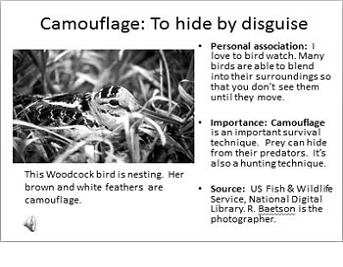 model elaborates word
knowledge in context and illustrates how design influences the message. To
provide a structure to guide pupils in creating their own entries, Bridget
created a template that pupils could fill in and adapt. The template includes a
space for the word, a short definition, an explanation for why the word is
important, a graphic, an audio recording or sound, and a source. As pupils
create and revise their entries, they reflect on the word's meaning (What does
this mean?), its representation (How does this particular graphic and sound
effect illustrate this word?) and process (What images did you consider and
discard?).' glossary items can be combined into a master document and sorted by
word to show multiple meanings and representations [15]. Another approach to
compiling pupils' individual work is to teach them how to hyperlink their
slides so that a view of one version of a word includes hyperlinks to others'
versions of that word. Although this example uses PowerPoint as the media
format, these types of vocabulary collections can be created in different modes
and published online as a word wiki or word blog. This kind of collaborative
publication and engagement with an external audience is characteristic of
successful multimedia learning (Fadel & Lemke, 2008). There really is no
end to the creative possibilities when pupils use media to develop and
celebrate the wonder of words.
model elaborates word
knowledge in context and illustrates how design influences the message. To
provide a structure to guide pupils in creating their own entries, Bridget
created a template that pupils could fill in and adapt. The template includes a
space for the word, a short definition, an explanation for why the word is
important, a graphic, an audio recording or sound, and a source. As pupils
create and revise their entries, they reflect on the word's meaning (What does
this mean?), its representation (How does this particular graphic and sound
effect illustrate this word?) and process (What images did you consider and
discard?).' glossary items can be combined into a master document and sorted by
word to show multiple meanings and representations [15]. Another approach to
compiling pupils' individual work is to teach them how to hyperlink their
slides so that a view of one version of a word includes hyperlinks to others'
versions of that word. Although this example uses PowerPoint as the media
format, these types of vocabulary collections can be created in different modes
and published online as a word wiki or word blog. This kind of collaborative
publication and engagement with an external audience is characteristic of
successful multimedia learning (Fadel & Lemke, 2008). There really is no
end to the creative possibilities when pupils use media to develop and
celebrate the wonder of words.
5. Take advantage of online word reference tools that are also teaching tools
Many online word reference tools are also excellent teaching resources. For example, the Visual Thesaurus website <#"807768.files/image003.gif">
A Whole Lot of Questions, a Whole Lot of Learning
The heart of The Challenge is more than 100,000 vocabulary questions that are designed to evaluate and teach vocabulary words. Each question tests a particular meaning of a word, provides helpful hints, and is followed by an explanation of the correct answer. Many studies have shown that the best way to learn is through multiple exposures to a word, with challenging questions that make you think.
They use their own adaptive learning system to ensure that you get the right question at the right time. They build a model of your vocabulary and abilities as you answer each question, and then serve you up with questions that are not too hard and not too easy. From the results of these questions, they determine what words to focus on in your personalized learning program.
A Personalized List of Words Just for You
As you answer questions, they begin to compile a list of words to learn. If you get a question wrong or choose to use a hint, the word is added to the list. Once They add a word to this list, They keep working with you until you’ve mastered that word. You can see your list by clicking on the My Progress tab on the top of the screen.
Hints and Explanations Help You Learn
If you’re having trouble with a question, they
will sometimes provide a hint to help you along. Depending on the word, you can
use your hint to eliminate a choice, to see sentence examples, or to see
definitions of the word. If you get a question wrong, they provide you with a
friendly Vocabulary.com description of the word. Read it! It’s designed to help
you remember the word.
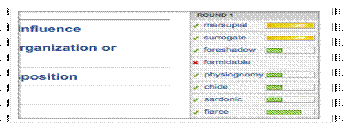
Four Question Categories
On the upper right hand corner of each question is a question category and a point value. There are four question categories:
· Assessment - These questions can be about any word and are chosen based on how you’ve done on all previous questions. (100 points without a hint, 50 points with a hint)
· Review - If you get a question wrong or ask for a hint, they’ll give it to you again as a review question. (75 points)
· Progress - Once a word has been added to the list of words you’re learning, they’ll continue to ask you new Progress questions about it until you’ve mastered the word. (100 points)
· Mastery Review - Even after you’ve mastered a word, they still check up on you every once in a while with a Mastery Review question. (100 points)
Earn Points and Achievements
As you answer questions correctly and learn words, you earn points. And as you earn more points, you are assigned a badge that represents your level. You start as a "novice," and then as you hit different point goals, you’ll earn new badges.can also earn extra badges based on various achievements, such as answering 5 questions correctly in a row, or acing a round. Click on My Profile to see a list of available achievements and levels.
Chart Your Progress
You can find out more about how you’re doing by clicking on the My Progress tab. From there you’ll see charts on overall progress, as well as progress on any individual word.
The Dictionary
The Vocabulary.com dictionary is designed to be the fastest, most useful English dictionary in the world. Unlike most online dictionaries, They want you to find your word’s meaning fast and then get on to better things. They don’t care how many ads you see or how many pages you view. In fact, most of the time you’ll find the word you need after typing only one or two letters.
Predictive Magic
Their search box is smart. So smart that it
predicts what you’re looking up as you type. Try it. You’ll see that as you
type, They’re making their best guess as to what word you’re looking for. If
you see your word in one of the first five choices, you can click on it to see
the word page, or if your word is number one, They’ll choose it for you.
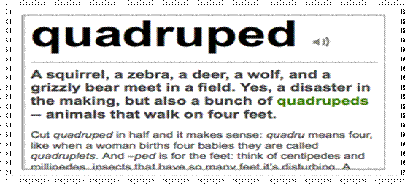
Easy-to-Read Definitions with a Little Bit of Attitude
They made an exhaustive review of the dictionaries out there, and they came to a not-so-startling conclusion. Current dictionary definitions can be difficult to understand and not much fun to read. This is OK if you’re looking up a word for reference, but if you’re actually trying to learn how a word is used in the real world and to make it part of your vocabulary, the typical dictionary definition is not going to do it.
Over 100 Million Sentence Examples
Each word has usage examples from their corpus of over 100 million sentences. You’ll see how words are used in edited language by some of the best writers in the world, from periodicals such as The New York Times, Scientific American, and from great works of fiction by writers as diverse as T. S. Elliot and Upton Sinclair. Seeing a word in context is a great way to understand how it’s used in the wild.
Keep Track of Your Favorite Words with Vocabulary Lists
One of the best features of Vocabulary.com is that you can easily make and share Vocabulary lists. Create a Vocabulary List quickly from assigned words, grab words from any text, or generate a list from the Advanced Search. Then, you can add descriptions to words, name your list, make your list public, and share it with your friends.
Share the Wealth, Share your Words
By making your vocabulary lists public, you can share them with your friends and colleagues. People can comment on the lists, favorite them, and even use them as the basis for a new list.
How the Blog Works
If You Really Love Words, Check Out The Blog.
The Vocabulary.com Blog
<#"807768.files/image006.gif">
Students will most likely conjecture that the article is about bees. Some pupils may notice the less prominent words-dead and poisons-and wonder if the bees are sick. When asked about the color choice, they may speculate that the author/designer chose bright colors to get your attention, or that black goes with poison. What is important in this kind of pre-reading discussion is pupils' close attention to the words and how they might relate to one another and to the larger text that they represent. Students actively engage with meaning as they draw on background knowledge about words and concepts as well as on visual literacy skills.
· The same bees word cloud could prompt a discussion after reading the article, guided by questions such as, Do you think the word cloud captured what was most important to learn?
· Are there keywords or ideas that are left out?
· What super-ordinate terms reflect the main ideas?
As pupils manipulate the word cloud's layout,
color, and font, they integrate verbal and visual representations,
strengthening the multimedia learning effect [2] while developing an important
digital literacy skill in our visual society.some pupils, the creative design
aspect serves as the hook to engage them in meaning making; for others, it is
the words themselves that entice them to explore meanings and relationships.
Although Wordles can be published to the public gallery and printed, another
option is to use a screen capture program to save the Wordle as an image,
creating a bank of images on your desktop or school server. They can then be
inserted into a document, PowerPoint, class blog, or other text.gives some
information about the theme, then gives pictures and shows the video using the
Internet. The pupils have to put the pictures in a correct order. Then pupils
share their ideas with another pupil and after they in a pair write what place
is given in the picture. In this lesson all strategies of using Internet
resources that were mentioned in the theoretical part of the research are
followed, because the teacher using Web application show the pictures and
pupils learn from visual displays word relationships within textgeneral, the
lesson is well-planned and the single is to add is that, cartoons also can be
useful way of developing vocabulary of primary school children, because it is
more interesting to watch cartoons than films for children in the primary
school. [16]next chapter of research is dedicated to identifying useful methods
of teaching English vocabulary using Games from the Internet at primary school.
2.2 Analysis of examples of teaching vocabulary using Games from the Internet
There are a lot of methods of teaching vocabulary for primary school children, and the most useful of them is teaching by Online-games. As it was mentioned in the theoretical part, vocabulary learning consists of 3 necessary actions:
Listening Carefully and Pronouncing the Words
According to Davies and Pearse [17], this stage is useful to prepare the learners for what they are going to hear. Firstly, the teacher tells the topic of the game and asks children what they think about it. This stage is important for primary school children, because they should know what they are going to listen about.switch on Web-application, choose the game where there are new words read aloud and pupils should repeat after the recording.aim of listening and pronouncing, as pointed out earlier, is to give pupils an idea of what the listening material sounds like. This may also be termed free listening.
Dramatizationwords through actions and visuals. This stage is useful to help the learners understand the text through activitiesreads words aloud and asks the pupils to listen and follow from the monitor. The following well-known game, "Head, Shoulders, Knees, and Toes”, [19] illustrates the activity. Pupils look at the monitor that is in front of the class and touches their Head, Shoulders, Knees or Toes with both hands repeating after Web application.: say "head” and touch their heads as shown in the picture: say "shoulders" and touch their shoulders as shown in the picture: say "knees" and touch their knees as shown in the picture: say "toes” and point to their toes as shown in the picture: say "eyes," "ears," "mouth,” and "nose” and meanwhile touch the corresponding body parts as in the previous examplesthis stage, it is important to double-check pupil comprehension of words and actions; pupils may say they understood everything because they want to proceed to the next stage right away. To check pupil understanding, teacher randomly name the vocabulary that she has taught and ask the pupils to do the accompanying actions.listen again the song and are guided by teacher to do the actions that they have already been taught. This time, the pupils are asked to just listen and do the actions under teacher’s guidance. Hearing the teacher sing the song and seeing the teacher do the actions help pupils overcome feelings of shyness and lack of confidence. Besides, pupils find it funny and interesting when they see their teacher doing the actions of the game.