Материал: Peculiarities of economic growth in developed countries at the end of XX-beginning of XXI century
.2.3 The organization for economic
cooperation and developmentorganization for economic cooperation and
development (or OECD) had many different names a few decades ago, such as a
science center or a club of the richest countries, but none of the titles did
not reflect the full essence of it.is the international economic association
that unites 30 member developed countries, whose governments have the
opportunity to discuss, develop and improve economic and social policies. At
the forum, representatives of the countries share their experiences, seek
different solutions to solve common problems and develop a coherent internal
and external policy. The basic condition for membership in this club is the
country's commitment to a market economy and a pluralistic democracy, which
comes from the fact that not a person, not people, but the group is the main
driving force of policy in a modern democratic society.organization for
economic cooperation and development was established in 1947 as a part of the
Marshall Plan to rebuild Europe after World War II. The original name of the
organization is the Organization for European Economic Cooperation. However, in
the 1960 the list of participants has expanded considerably. The new name the
organization received in 1961, which reflects geography of the countries of the
OECD better than the previous. Also, it is thought that the countries of the
OECD produce about 60% of the world GDP., the OECD consists of 34 member
countries, including the most industrialized ones such as U.S., Australia,
Canada, almost all of Western Europe - the UK, France, Germany, and others,
some of the ex-socialist countries, such as Poland, Hungary, Slovenia, and the
country from the former Soviet Union - Estonia. The European Commission takes
part in the OECD’s meetings on the rights of the individual participant as the
highest body of executive power of the European Union.organization for economic
cooperation and development mission is to promote policies that would increase
the economic and social welfare of people around the world and hence take into
account the health of population. It can be noticed in the Figure 4.
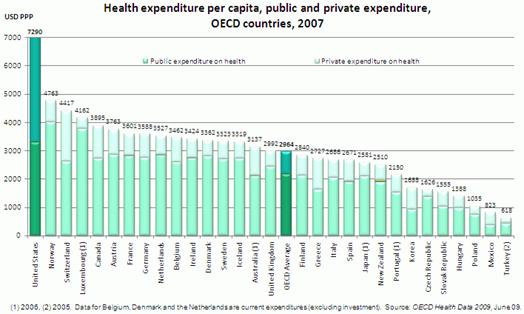 4. Health, public
and private expenditure per capita in OECD countries. Source: Healthcare
charts.
4. Health, public
and private expenditure per capita in OECD countries. Source: Healthcare
charts.
Through their activities, OECD
collects information about the economic situation, not only in the
participating countries, but also in the whole world, holds discussions, takes
decisions and makes recommendations in economics and politics., it is necessary
to note that all the work of this organization is carried out under the
guidance of the OECD Council, which has the authority to make decisions and
which consists of one representative from each country and one representative
from the European Union. Also,OECD periodically publishes its forecasts for
short-term and medium-term development. The OECD also analyzes the condition of
the member countries’ economies and makes the forecast of their development for
the next half year.addition, it is responsible for developing recommendations
connected with regulation of the economy at the macro and the sectorial level,
including international trade and policy coordination in financial assistance
to developing countries., the OECD is actively involved in special questions
directly related to globalization. For example, the organization aims to create
optimal conditions for the free flow of capital and intangible products
(services and intellectual property rights) in the world economy.
Chapter 3. Industrialized countries:
distinctive features and ways of development
.1 The distinctive features of the developed countries
industrialized countries have a dominant position in all forms of international economic relations. They are distinguished by intensive type of economic development and a high level of development of productive forces from the other countries. Also, the developed countries are characterized by absolute domination of the industrial productive forces. Production with use of mechanisms provides the bulk of production. The mechanization of labor reaches a high level not only in proprietary material production but in services too. Furthermore, developed countries stand out among all the sub-systems of the world economy with a high level of economic development. In the production of GDP per capita, calculated on the basis of exchange rates, they are 5.4 times higher than the world average. Over the last decade, the gap in these rates did not decrease, but increased.
As it is accepted, profit is
determined as main role of output, which induces increase in productivity,
introduce new technology and new production management system. Also, creation
of unique products and services, cheeping of production are leaded to the
expansion of markets., agriculture loses its importance with the time. Now, the
leading position is taken by services sector. The overflow of resources to
services accelerates the development of education, health, social security and
environmental protection. It also contributes to a rapid increase in the volume
of work associated with the service of tourism, leisure, entertainment, as well
as the development of the complex maintenance of computer equipment and
information on the Internet. Changes in the sectoral structure of the economy
under the impact of scientific and technological progress are significant
feature of the modern developed countries.importance is participation in world
trade which is one of the necessary conditions for obtaining financial and
technological resources to achieve economic growth. Foreign trade in the
developed countries is characterized by high growth rates and serious changes
in the commodity structure, reflecting shifts in the economy., it is important
to highlight that scientific knowledge and new personnel are becoming the basis
of the international competitiveness of the country. Innovative development of
industrialized countries is manifested in the production and commercialization
of high quality new goods, the application of new methods of production
(technology), development of new markets and new sources of raw materials., one
of the main features of the developed countries is a relatively equal
distribution of income, as well as relatively uniform economic development of
the territory. These countries have a social orientation of the economy,
including support for low-income segments of the population (pensioners,
students, the disabled, etc.). Large investments in science (2-3% of GDP) and
the introduction of its achievements in the production are determined the high
intellectual level of labor. Humanization of the economies means a high
percentage of spending on health care, education and culture. Significant costs
are accounted for environmental protection (3.4% of GNP), which confirms the
high level of greening the economy.
.2 Developed countries at the beginning of XXI century
start of the millennium is marked by
the transformation of a group of developing countries from exporting to
importing capital. Since the Asian economic crisis of 1997-1998 years, capital
is increasingly moving "from bottom- to up" - from developing to
developed countries. The significance of this phenomenon has led some observers
to conclude that some developing countries have established a global "glut
of savings." In the United States and the developed countries of the
European Union by the end of 2007, the total capital inflows were exceeded
outflows, while the Emerging Markets and developing countries were a net importer
of capital., it is necessary to mention that after the end of the "Cold
War" profound changes took place in the world politics and economy.
Sometimes, the scientists explain these changes with the help of globalization.
Talking about globalization, it should be distinguished that it is a process of
interaction and integration among the people, companies, and governments of
different nations, a process driven by international trade and investment and
aided by information technology. Also, this process has two types of influence
on the economic sphere. On the one hand, it formed a single economic system in
the center of which developed democratic countries of the West are located. On
the other hand, it generated a transnational sector of the global economy,
which really is not controlled by the governments of individual states.
Moreover, globalization has the negative consequences, for example, the massive
displacement of the population of developing to developed countries.the end of
the twentieth century the demographic crisis is started, affecting developed
countries. This crisis is noticed in the sharp decrease in population growth,
the aging of population and the reduction of the workforce. However, developed
countries have completed the demographic transition. The economy of these
countries is acted as a limiter of population growth in the scientific and
technological revolution. It means that there is no need to have a large amount
of workforce because not the amount of the labor force, but its quality is
evaluated.is worth to mention that there is a very high level of infrastructure
in this group of countries. Moreover, they take almost monopolistic position in
the field of computer science and high technology. The sphere of services and
the development of financial capital are the leading activities in the
industrialized countries. Also, medical advances, the increase in the standard
of living and distribution of healthy lifestyle lead to enlarge in life
expectancy in developed countries.main trend of the world economy, as well as
the economies of developed countries at the turn of the XX-XXI centuries is the
post-industrialization, the transition from industrial to post-industrial
society. This society has such features as the predominance of services in
production and consumption, high levels of education, greater attention to the
environment and humane economy. Post-industrialization leads to profound
changes in the world economy. The abundance and availability of economic
information in combination with the reduction in the cost of communication and
transportation has been a powerful incentive for the international movement of
capital. Of course, post-industrialization is a positive trend inherent to the
developed countries.
.3 Development prospects of the developed countries
are a lot of disputes between economists about development prospects of the industrialized countries. On the one hand, there is a thought that there will be no development in this group of countries and hence it will lead to a decline in the spheres of production, a decrease in the Total GDP and hence in the standard of living. Another part of the economists claim that there will be a positive change in the all of indicators of the industrialized countries.majority of economists believe that the acceleration of the growth of the world economy can be expected at the end of 2013.
1. Growth forecasts for the world
economy and developed countries.
the growth rate of GDP at PPP,%
UN
IMF
WB
2012(evaluation)
3,4
3,3
3,3
2013(forecast)
4,4
3,6
3,9
2014(forecast)
4,0
4,1
4,2
Sourсe:
ЦМАКП. Итоги 2012 года и прогноз экономического развития на среднесрочную
перспективу. Обзор макроэкономических
тенденций
№ 73.
The first type of development is the
implementation of the program of monetary stimulus from the Federal Reserve and
the Bank of Japan will continue to significantly increase the amount of
available funding in the global market, which, in turn, will help to prevent
potential liquidity crises. The countries, where there are expectations of
recovery (for example, in the U.S.), liquidity growth will soften the loan
terms, which so far remain extremely high., expectations of maintaining a
balanced growth path of the U.S. economy are remained, accompanied by a
decrease in unemployment. Reducing unemployment at the end of 2013 will be
lower than in 2012. Managing expectations of sustained growth of the world's
largest economy will have a positive impact on the world economy and hence to
the developed countries., acceleration of the growth of world trade is expected
at the end of 2013. At the same time, lack of demand for imports in the
European countries will slow world trade and have a negative impact on growth in
countries which have close foreign trade ties with Europe.dynamics of the main
macroeconomic indicators at the end of 2012 can expect a stable (in the range
2-2.5%) growth. During 2012, unemployment fell from 8.5% to 7.8%, which enabled
it to support household consumption.important factor of development of
industrialized countries is the steady growth in exports, accompanied by slower
growth of imports. This trend may continue in the future to the extent of
implementation cumulative competitive advantage of U.S. in the crisis.addition,
the revival of production, post-crisis recovery in consumption and investment
will boost the economies of developed countries. Industrial production growth
will be supported by the expanding demand for technology imports from the
rapidly developing countries of the Asia-Pacific region, the steady increase in
the volume of world trade. With low interest rates and loose monetary policy
the growth of investment will store in high-tech sector and improvements of the
competitiveness of products., it is important to mention that, a moderate
increase in the wage fund is expected during the 2013-2014 year. The percentage
to 2011, the growth in nominal wages fund will be 124.8%
industrialised economy
quality
Conclution
development of industrialized
countries has a fundamental impact on structural, scientific and technical
restructuring of the world economy, on the situation on the world market. Also,
there are some important indicators of industrialized countries such as Total
Real GDP, GDP/GNP per capita, sectoral structure of the economy, the level and
quantity of life and measures of economic performance which allow to evaluate
the development of this group of countries.
Furthermore, it must be mentioned
that economic growth in developed countries can be both positive (increase in
standard of living) and negative (environmental pollution) measurement of
development.addition, there are several groups of developed countries such as
G7, the European Union and the Organization of Economic Cooperation and
Development which have common features and special goals of improving the
world.developed countries dominate the world economy. They are distinguished by
a single sociologic and economic plan of the reproductive process in the
national economy, intensive type of economic development, a high level of
development of productive forces. About 15% of the world population is lived in
the economically developed countries, but it concentrates the bulk of economic,
scientific and technical potential of the world. The service sector (60%) takes
the first place in the total GDP of industrialized countries, industry is
accounted for an average of about 25%, and agriculture - just over 3%. In
general, the industrialized countries are the leaders in the electrical,
electronics, aerospace, automotive and chemical industries.the beginning of the
nineteenth century, the development of industrialized countries has become a
recurring character associated with periodic crises of overproduction. Since
2008, the rate of production again began to fall. The reason for this was the
financial crisis, which had affected almost all countries of the world.
Analysts estimate the rate of decline in production in early 2008 which was
approximately 50%., the cyclical development is associated with an excessive
expansion of production arising from the desire to earn extra income. At the
same time, the reduction of production during the crisis leads to a massive
renewal of fixed capital, improve the level of development of productive forces
and, as a consequence, the adaptation to the new conditions of capital
reproduction. This is the very foundation of economic cycle and frequency
fluctuations of national economic development., it must be noted that the
industrialized countries play a leading role in international trade and
international capital movements. They determine the ways of development in
different spheres of human life., the overflow of resources to services
accelerates the development of education, health, social security and
environmental protection. It also contributes to a rapid increase in the volume
of work associated with the service of tourism, recreation and entertainment.
But it contributes to the development of the complex maintenance of computer
equipment and information on the Internet in the greatest extent. Also, the
bulk of investments is directed to expand the scope of services. Foreign
investments are increasing rapidly in the telecommunications and
software.general, developed countries are still leading in the world economy.
Only few developing countries have been able to catch up with them, which
suggest that industrialized countries are quite resilient to economic hardship
and can, though not without loss, to overcome them.
Bibliography
English literature:
). John Sloman “Economics”
fifth edition, Prentice Hall, 2010.
). International Monetary Fund.
World Economic Outlook. May 1998. Washington,
1998.
Russian
literature:
). Заяц Д.В. «Европейский Союз:
бросок на Восток» (статья электронной версии газеты «География»).
). Куликов Л.М. Основы экономических
знаний - М.: Финансы и статистика, 2000.
). Мостовая Е.Б. Основы
экономической теории: ИНФРА-М; Новосибирск: НГАЭиУ, 1997.
). Пузакова Е.П. “Мировая экономика
и международные экономические отношения”. Ростов н/Д: Феникс, 2004.
). Чепурин М.Н., Киселевa
Е.А., “Курс экономической теории”, “АСА”, Киров 1997г.
). ЦМАКП. Итоги 2012 года и прогноз
экономического развития на среднесрочную перспективу. Обзор
макроэкономических тенденций № 73.sites:
). Central Intelligence Agency
(US).
). Healthcare charts.
). True economics.
). True economics.
). Economic Education.
). OECD.