Материал: Peculiarities of economic growth in developed countries at the end of XX-beginning of XXI century
Peculiarities of economic growth in developed countries at the end of XX-beginning of XXI century
Federal Agency for EducationState Educational Institution of Higher Professional Education
“Plekhanov
Russian University of Economics”of financeof economic theory
On discipline «Macroeconomics»
Topic:
Peculiarities of economic growth in developed countries at the end of XX -
beginning of XXI century
student of group
2101facultyDaria
2013
Contents
Introduction1. Economic growth and indexes of the industrialized countries
.1 Economic growth: benefits and costs
.2 Characteristics of economic developed countries
.2.1 Total Real GDP
.2.2 GDP/GNP per capita
.2.3 Sectoral structure of the economy
.2.4 The level and quality of life
.2.5 Measures of economic performance2. Classification of developed countries
.1 The definition of economic developed countries
.2 The division of countries
.2.1 “The group of seven”
.2.2 The European Union
.2.3 The organization for economic cooperation and development3. Industrialized countries: distinctive features and its ways of development
.1 The distinctive features of the developed countries
.2 Developed countries at the beginning of XXI century
.3 Development prospects of the
developed countries
Introduction
global economy is a complex economic system that is influenced by many factors. The processes taking place in the world economy directly impact on the development of the national economies of individual countries, affecting their economic interests. Therefore it is necessary to know the trends and patterns of development of the world economy. Furthermore, national economies are differ in scope, pace, efficiency, economic development, the type of economic growth, the social structure of the economy, the level of development and the nature of foreign economic relations and other parameters and hence the analysis of the world economy is used the classification of countries according to various criteria.countries are usually combined in the group in the global economy with similar parameters of economic development, the same type of organizational structure of economic management, the general principles of organization of production, the same problems of development. As for the developed countries, they have some common features: the high GDP per capita, the dominance of technical, scientific production and service system, the existence of market open economy.is worth to be noted that the most important part of the global economic system is a group of economically developed countries, which largely determine the state of the world market, main directions of scientific and technological development.aim of this work is to determine the role of developed countries in the functioning of the world economy and the impact of the industrialized countries to the different spheres of humanity such as political, economic, technical, scientific and spiritual., there are some goals which must be completed to achieve the aim of this work:
• to clarify the concept, consider the basic criteria of the developed countries;
• to provide a brief description of economic systems of developed countries;
• to consider ways of influences the
developed countries on the world economy and on the other groups of countries;
Chapter 1. Economic growth and
indexes of the industrialized countries
.1 Economic growth: benefits and costs
growth is the most important characteristic of social production in all economic systems. Economic growth is determined as the positive change in the level of production of goods and services by a country over a certain period of time. Economic growth means that the solution to the problem of limited resources becomes easier at any given time interval and hence it becomes possible to meet a wider range of human needs. The main aim of the economic growth is to increase the potential and real gross national product (GNP) and to rise the economic power of a nation, country, region. Increase in the capital stock, advances in technology, and improvement in the quality and level of literacy are considered to be the principal causes of economic growth.
Also, there are some types of
economic growth. The first type is extensive, where the increase in production
occurs due to three factors: capital (funds), labor and material costs (natural
raw materials or energy). This is the easiest way to increase the pace of
economic development. With it, there is a rapid development of natural
resources, and occurs an opportunity to relatively quickly reduce or eliminate
unemployment and provide greater employment of labor. The more complex type of
economic growth is intensive. Its main distinguishing feature is to increase
the efficiency of production factors on the basis of technical progress.
Intensive expanded reproduction is more progressive because a crucial role in
raising the efficiency of the real conditions of production begins to play the
new "engine" - the achievements of science and technology. In this
regard, the production of scientific and technical information is developed in
the scale of society. Also, cultural and technical level of workers increases.is
important to highlight that there are some benefits and costs of economic
growth. On the one hand, if economic growth is high, it will lead to a rapid
rise in the standard of living. Also, it will help to the economy to achieve
the full employment, to put the government in a good position to redistribute
income from high income groups to low income groups. However, if there is a
high economic growth in the country, it means that people’s incomes rises and
they become more concerned with a clean environment. On the other hand, there
are some costs of economic growth. The first is the lower standard of living in
the short run period. There may be a short-run trade-off between economic
growth and the standard of living. Economic growth could increase due to the
diversion of resources from the production of consumer goods, such as bread and
cakes, to the production of capital goods, such as factories and machinery. If
this thing happens, the amount of goods and services available for consumption
and hence the standard of living may decrease in the short run period. second
cost of economic growth is the generation of demands. Economic growth may
generate demands which may make people feel less contented. An increase in
national output will lead to an increase in the amount of goods and services
available for consumption. However, when people have more to consume, they may
want to attain a higher level of consumption. Therefore, if economic growth
makes people more materialistic, it may make them feel less contented. The next
cost is the environmental. It means that the economic growth may lead to
environmental degradation. If the national output is high, we can assume that
it will lead to the environmental pollution and hence to the contamination of
water and atmosphere. Also, the depletion of non-renewable resources can be a
cost of economic growth which will deplete non-renewable resources, which may
lead to shortages for future generations, unless alternatives can be found.
However, the worsening income inequity is the cost too. growth may worsen
income inequity. The government may decrease corporate income tax to attract
foreign direct investments to increase economic growth. If this happens, given
that corporate income tax is progressive, income inequity will worsen. Also, it
can be noted that high economic growth may lead to high structural
unemployment. Nevertheless, rapid technological advancement will cause skills
and knowledge people to become obsolete at a fast pace which will lead to high
structural unemployment. Likewise, high economic growth will cause high import
growth which may lead to a persistent balance of payments deficit resulting in
adverse consequences such as high imported inflation, falling national income
or rising unemployment.conclude, it needs to be mentioned that economic growth
is the central economic problem facing all countries. It can help to observe
the development of national economies and living standards of the population,
the ways of solving the problem of limited resources., economic growth can be
both positive and negative indicator of the development of the countries.
.2 Characteristics of economic developed countries
size of the progress of a country
can be seen from the successful development of the country. Total Real GDP, income
per capita, economic growth, unemployment and population growth rate are partly
the indicators to measure the success of development.
.2.1 Total Real GDPGDP is determined
as an inflation-adjusted measure that reflects the value of all goods and services
produced in a given year, expressed in base-year prices. Gross domestic product
is the main indicator used to determine the level and pace of economic
development of the country. The increase in GDP is accompanied by an increase
in employment and rising living standards, which is reflected in the growth of
consumption of goods and services. The increase in GDP is determined by
investments, their share in the GDP and the excess of the total amount of
investment of the capital consumed in the production process. Periods of
economic growth can be replaced by the decline in production, employment,
reduction of GDP per capita and living standards, respectively. , if the
development over long periods is considered, it is clear that the basis for
raising the living standard of the population is the growth of production of
goods and services, the GDP and per capita income. The main factors in the
growth of GDP are the involvement in the production of additional resources,
physical capital and labor, as well as increase productivity of the factors of
production as a result of technological progress, the use of more productive
technologies and improvement of professional skill workers. The increase in
labor force is due to population growth in general and in the working-age
population. Simultaneously, educational level, professional training and thus
the quality of the labor force are increased. with the growing number of
employees, the amount of accumulated industrial buildings, equipment and other
assets and working conditions increases. In connection with the irrigation
works the number of farmland may slightly increase; geological exploration
leads to increased potential for use in the manufacture of mineral deposits.
The increase in the use of resources is an important factor in the growth of
GDP. However, much of its growth is achieved through scientific and
technological progress, which allows to produce new types of products, to
improve the quality of traditional products and better use of the resources
used. It is necessary to mentioned that Total Real GDP and GDP per capita are
in the connection. It means that the higher GDP per capita, the higher Total
Real GDP and hence there will be an increase in the standard of living and
economic growth.
.2.2 GDP/GNP per capitaNational
Product (GNP) per capita is similar to GDP per capita. It is a measurement of a
country's economic output per person. However, it's also a measurement of
income. It counts all income earned by a country's residents and businesses,
regardless of where the money is made. In other words, it includes all
investments made by the residents and businesses, whether it's inside or
outside its borders. This means it also includes the value of the products made
by its businesses, even they are manufactured overseas. GDP per capita is
especially useful when there is a need to compare one country to another
because it shows the relative performance of the countries. A rise in GDP per
capita signals that there is a growth in the economy and tends to translate as
an increase in productivity. gross domestic product (GDP) is one of the primary
indicators of a country's economic performance. It is calculated by either
adding up everyone's income during the period or by adding the value of all
final goods and services produced in the country during the year. GDP per
capita is sometimes used as an indicator of standard of living as well, with
higher per capita GDP being interpreted as having a higher standard of living.
GNP per capita shows what part of a country’s GNP each person would have if
this GNP were divided equally. Knowing a country’s GNP per capita it is a good
first step to understand the country’s economic strengths and needs, as well as
the general standard of living enjoyed by the average citizen. A country’s GNP
per capita tends to be closely linked with other indicators that measure the
social, economic, and environmental well-being of the country and its people.
For example, generally people living in countries with higher GNP per capita
tend to have longer life expectancies, higher literacy rates, better access to
safe water, and lower infant mortality rates. However, there are regional
disparities in GDP per capita in some countries such as Estonia and these
inequalities are remarkably affected by the sectoral structure of the counties’
economy. Additionally to sectoral structure, the location of a country,
measured by the distance between the capital city and counties’ center, has a
significant impact on GDP per capita.
.2.3 Sectoral structure of the economystructure of the economy is the most important factor in the development of the country. Every state in the world has a different kind of absolute and comparative advantage over other countries. The presence of advantages in certain areas is the reason that countries are specialized in the production of certain products. It is logical that, depending on the presence or absence of certain benefits, sectoral structure of the economy is generated. The sectoral structure of the economy is the composition and the ratio of the major economic activities that are carried out within the country. Depending on what activities are dominated, the internal economic structure of the state is formed, as well as its position in the global market. In fact, the sectoral structure of the economy is a major factor in forming the general government as a participant in the global economy. Also, a logical chain of three links can be derived: the availability of natural resources - industry structure - the position in the global market.the impact of the economic structure of the state on its position. For example, the sectoral structure of the Russian economy is built in such a way that it is dominated by mining and heavy industry. Naturally, the advantageous location of natural resources determines the main directions of activity. In turn, the structure of the Russian economy determines its position on the world market as an exporter of oil, gas, metals, and heavy industry, because our country has a great reserves of these natural resources. In turn, Ukraine, which is located near, has substantial agricultural resources - vast areas of high land and hence agriculture and food production is the main leading industries. As a result, Ukraine is standed as a food exporter and importer of energy, and Russia, on the contrary, is imported, and exported the products of Ukrainian energy. Sectoral structure of the economy is classified by two systems: the international classification of branches of economic activity and the classification system of national accounts.to the industrial classification, the sectoral structure of the economy consists of the following elements:
.The primary sector of the economy. It includes such areas of economic activity, as the extraction of raw materials (wood, ores, oil and gas), as well as agriculture. In fact, the primary sector includes all activities, including direct interaction with nature, in which nature gives any resources.
. Secondary sector of the economy which includes all enterprises engaged in processing of raw materials and producing finished products. The secondary sector also includes producers and semi-finished products which later become the "raw material" for the production of the final product.
. Tertiary sector of the economy. It is determined as the sphere of services, or as it is called, the non-production sphere which includes consulting, insurance, banking and securities.by national accounts involves clarification of the contribution to GDP the following sectors:
.The small business sector. 2.Sector
of medium and large businesses. 3. State-owned enterprises.to the scientists,
an indicator of a highly developed economy is the predominance of its
industrial structure of small businesses operating primarily in the service
sector. The approach to this standard industry structure is a sign of true
favorite way of economic development of the state. According to David Ricardo,
English economists, each state in the world has comparison and absolute
advantages over other countries. The presence of these benefits in different
spheres of life is the reason of the specializing on production of certain
products. Logically, if the country is involved in different kinds of
production or service sphere, the economy will growth and hence the level and
quantity of life will increase too.
.2.4 The level and quality of lifeof
the needs, the exhaustion of traditional resources and population growth cause
the solution of the main problem: economic growth and economic efficiency.
Economic growth is an increase in volume to create useful and, therefore, there
is a rise in the living standards of the population. In other words, economic
growth is the movement in the development of the national economy, which is
characterized by the change of macroeconomic indicators such as gross national
product and national income. Also, economic growth implies the achievement of
important goals, such as increased life expectancy, reduced disease and injury,
increase the level of education and culture, the rationalization of
consumption, social stability and overcoming poverty, achieving full
employment, protect the environment and improve environmental safety and crime
reduction. of life is seen as a set of indicators of overall well-being of
people, characterizing the level of material consumption (standard of living),
and the consumption of goods that people do not pay. It is necessary to mention
that financial security of community, unity with nature, responsibility for
future generations and much more things is meant by quality of life. In
addition, for the people it is associated with certain goals that they set for
their lives, that is, with the efficiency of life, not only for satisfaction
with their personal lives, but also with the satisfaction of its position in
the country and the world, which affects the health of people. Despite the fact
that the economic growth of developed countries requires the improvement of the
quality of life of citizens, it is worth to note that an increase in production
is accompanied with the use of more natural resources, most of which are
non-renewable. Also, for the construction of new factories, offices,
considerable areas of forest are being cut down, waste is merged into rivers
and the air is polluted. Consequently, the environment is deteriorated and
hence health of the population is under attack. Although, a lot of scientists
around the world are trying to find solutions to mitigate the impact of
innovation on the environment, but, unfortunately, there is virtually no
progress.the other hand, economic growth is beneficial for the development of
countries. It can be achieved through extensive and intensive development. The
essence of the extensive way comes to economic development by increasing
involvement in the production of a larger number of workers, raw materials,
instruments of labor and land. With the extensive growth the society is tackled
important issues such as employment and reduction of unemployment, development
of new industries, determination of the direction of the economy in accordance
with the needs of the market, the involvement of new territories and resources
into the economy, as well as the elimination of regional imbalances, which
allows to pull depressed and underdeveloped regions to the national average. The
essence of intensive development of the economy is expressed in the way by
improving the quality of labor, application of advanced technologies, higher
labor productivity. However, the intensive development of the economy allows to
use of available resources economically, to improve the competitiveness of
national products through the quality improvement and lowering costs of
production. Also, implementation of achievements in scientific and technical
revolution production is important part of measures of economic performance,
increasing the economic growth and hence the standard of living too.
.2.5 Measures of economic performanceindicators are values or characteristics, showing the state of the economy. Their dynamics are given by the statistical range of calculation, usually a weekly, monthly or quarterly value, which helps to find new trends of development in the economy and predict its future. Also, it is necessary to mention that economic efficiency is measured by two types of indicators: one is characterized by the results of per capita output, the other - the ratio of outcomes and costs.most important indicators of the first type are gross national product per capita and national income per capita.to the second type, performance indicators, comparing the results with its production costs are:
) Productivity of social labor . It is determined as the ratio of national income to the number of workers in material production or to the working time spent in material production. This indicator expresses the amount of national income that is generated by an average of one employee of material production, or an average per unit of time in the production of goods. In addition to the productivity of social labor, measures of productivity in key sectors of the economy are calculated in the industry, agriculture, construction and transport.
) Material intensity of national income is defined as the ratio of material costs to national income. Sometimes more specific indicators are calculated: the metal, energy and others. Consumption of materials may also be considered in terms of gross domestic product (instead of national income). It characterizes the level of objects of labor costs per unit of output.
) Capital productivity. It is the
ratio of national income (or GDP) to the cost of production assets. It shows
the output of the final output per unit of production assets. Sometimes,
instead of return on assets can be used indicator of capital intensity, which
is the inverse of capital productivity.conclude it is important to highlight
that the economic efficiency can be measured with the help of two types of
indicators such as effectiveness of output per capita and the ratio of outcomes
and costs. In addition, economic efficiency is the state of the economy in which
there is no opportunity to change the allocation of resources in the way that
the increase of meet the needs of one subject can’t lead to a decrease in the
meet needs of the other.
Chapter 2. Developed countries:
classification and distinctive features
.1 The definition of economic developed countries
developed countries are defined as a group of independent countries of the modern world with a high standard of living and a dominant position in the world economy. Developed countries tend to have a large stock of produced capital and population, which is mostly engaged in highly specialized activities. 15-16% of the world's population lives in the group of developed countries, but they have also produced three quarters of the gross world product and provide the bulk of economic, scientific and technological potential of the world. Developed countries are also called industrial countries or industrially developed. Furthermore, there are some criteria which are let countries to enter into the group of industrialized countries such as:
• A high level of social and economic development, which is expressed in high levels of Total Real GDP and GDP per capita, and a high standard of living;
• market economic system;
• openness of the economy;
• dominance of the service sector (60%) over industry and agriculture;
• transition from mining and material-intensive industries to the new high-tech and knowledge-intensive sectors in the industry;
• a high level of mechanization and agricultural productivity. Hence, 3-8% of the working population engaged in agriculture in these countries, fully provide their countries with food security and transformed agriculture in the export sector of the economy in most countries in this group.countries by the end of XX century had:
15.9% of the population of the world;
More than half of world GDP;
72.2% of world exports and 74.6% of
imports of goods and services., it is important to mention that there was a
creation of a large sector of economic knowledge and the industry of knowledge
in the developed countries. Moreover, human capital has become a major
productivity factor of growth and the development of the industry of knowledge.
Its share is up to 80% of their national wealth. However, the leading countries
of the world with innovative economy created favorable conditions for the rapid
implementation of ideas of scientists and innovators in competitive products
and high technology. High investments in human capital provide leadership in
science, education, medicine, high technology and in the industry of
knowledge.group of countries with developed market economies in the beginning
of XXI century includes just under 40 countries which are located in Western
Europe, North America, Asia, Australia and Oceania., developed countries form
different foundations such as the "Group of Seven", the European
Union, the Organization for Economic Cooperation and Development and the North
American Free trade Agreement. In addition, these associations are defined the
direction of development of the whole of the world economy and the trend of
social and economic progress in all countries and regions.
.2 The division of countries
countries are united in
organizations that define the parameters of economic, technical, scientific,
and spiritual development of other countries and solve various problems of
global importance.
2.2.1 “The group of seven”President Valéry Giscard d'Estaing was the organizer of the meeting, which was hold in 1975, where the leaders of the six industrialized countries took part in. A year later, namely in 1976, Canada joined this forum. Thus was formed the international organization called "Group of Seven".
Group of Seven (or G7) is an
association of seven leading industrialized countries, which includes the
United States, Germany, Japan, Britain, France, Italy and Canada. According to
the fact, that G7 consists of only developed countries, it should be noticed
that economic growth is high and hence there is an increase in GDP too. The
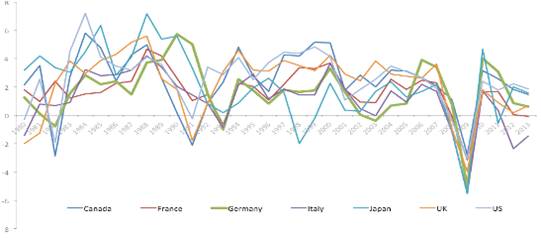
fluctuations in Gross Domestic Product are given in Figure 1.
 1. Real GDP in the
group of seven. Source: True economics.
1. Real GDP in the
group of seven. Source: True economics.
the graph, it can be concluded that the rate of Real GDP is quite unstable and fluctuates through the time. In addition, the highest volume and a huge decrease of GDP were in Canada.
Also, the set of developed countries
produce two-thirds of the world production. Considering the participating
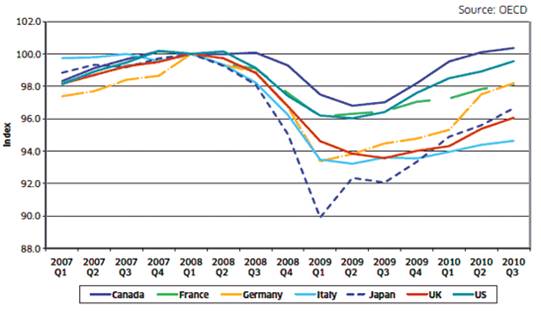
countries individually, it can be noticed that in generally, Canada is taken
the first place in production among G7 and that Japan had the huge reduction in
output in 2009. An illustration of the output in the group of seven is provided
in Figure 2.
 2. Level of Output
in G7 : OECD
2. Level of Output
in G7 : OECD
seven great economic powers, through their finance ministers, seek to increase economic growth and stabilize the exchange rate. G7 was established during the oil crisis of the 1970s of the last century as an informal club in order to find economic and political way out of it. This association was aimed to establish the financial and economic ties, to develop and to conduct effective anti-crisis policy, to decline unemployment, to reduce the rate of inflation, to seek all possible ways to overcome the contradictions that arise between countries - participants of G7 and with other states. Also, decisions made at the meetings can be realized through the system of international economic organizations such as the International Monetary Fund (IMF), World Trading Company (WTC), the organization for Economic Cooperation and Development (OECD), as well as through the state institutions of "Seven" .meetings are held several times a year. In addition, its location was designated by countries in turn. Sometimes, representatives of the other countries take part in the convocation of the Group of Seven.
It is also worth to highlight some
of the indicators of economic growth in this group of countries. The low rate
of unemployment, the high quality of life, the developed mechanical engineering
and industrial production, the dominance of the service sector are inherent to
this group of countries. Later, at the next summit in 1997, which was held in
the United States, Russia joined the organization. Thus a new international
institution called the Group of Eight (or G8) began its existence.
.2.2 The European UnionEuropean
Union (or EU) is an economic and political unification of 27 European states
with a total population of 483.7 million people, and the total area about 4326
square kilometers. It was founded in 1993 after the signing of the Maastricht
Treaty in 1992. This agreement provided for the creation of a political,
economic and monetary union, the completion of the establishment of the
internal market, based on the "four freedoms" - free movement of
goods, services, labor force and capital between the EU member states., the EU
consisted of 12 combined countries: Belgium, Great Britain, France, Germany,
Denmark, Greece, Ireland, Spain, Italy, Luxembourg, Netherlands and Portugal.
Also, Austria, Finland and Sweden are entered the organization in 1994. Later,
Bulgaria, Hungary, Cyprus, Latvia, Lithuania, Malta, Poland, Romania, Slovakia,
Slovenia, Czech Republic and Estonia became a part of the European Union.main
objective of the EU is to organize cooperation between EU member states, as
well as among their inhabitants. The most important goals of the Union include
security guarantees, economic and social development, protection of freedoms,
rights and interests of citizens. The European Union recognizes the national
identity of the EU Member States, and respect their history, traditions and
culture. Strengthening of European integrity, spreading the ideas of peace,
improving security in Europe and in the world are the purposes of joint
activities in the field of foreign policy and security., the EU has abolished
trade barriers, adopted a common currency, and is striving toward convergence
of living standards. Internationally, the EU aims to bolster Europe's trade
position and its political and economic weight. Because of the great
differences in the GDP per capita among member states (from $13,000 to $82,000)
and Total Real GDP , in national attitudes toward issues like inflation, debt,
and foreign trade, the EU faces difficulties in devising and enforcing common
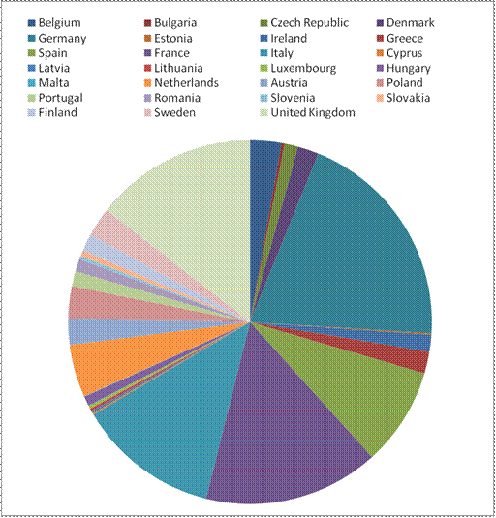
policies. Figure 3 shows the Total Real GDP in the countries-members.
 3. GDP of EU.
Source: web site: True economics.
3. GDP of EU.
Source: web site: True economics.
Moreover, the EU has some
responsibilities and characteristics that distinguish it from other
international organizations. This organization has its own autonomous legal
system, its own autonomous budget and monetary system, its own nationals and
also territory allotted to the member countries of the European Union.those
days, the European Union consists of 27 countries. In addition, Iceland,
Croatia, Turkey and Macedonia have the status of a candidate in the EU.