Материал: Management-and-Organization-Behavior
Characteristics of Communication
The following are the characteristics of communication.
1.Communication is a two-way process because orders, instructions, directions, guidelines, etc., are directed or communicated downwards while suggestions, complaints, grievances etc., are communicated upwards. This not only involves giving ideas but also receiving them.
2.No business organisation can exist without communication because it is necessary to have a congenial relationship between the different employees working at different levels and that is why it is a continuous process.
3.The communication process continues to the extent that ideas and messages are communicated and received.
4.It may be formal or informal and it may be in different mediums.
The Communication Process
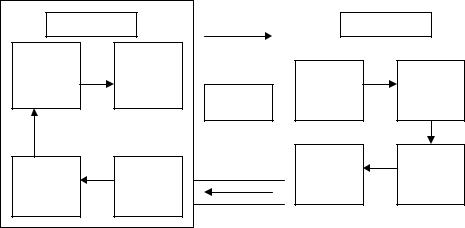
Communication process contains the following elements:
SENDER |
|
|
|
RECEIVER |
Create |
Encode |
|
|
|
Message |
Message |
|
Receive |
Decode |
Noise |
|
Message |
||
|
|
Encoded |
||
|
|
|
||
|
|
|
|
|
Decode |
Receive |
|
Encode |
Create |
|
|
|
||
Feedback |
Feedback |
|
Feedback |
Feedback |
|
|
|
Figure 19.1: The Communication Process
1.The Communicator
Communication commences with the communicator. He is the sender of the message. He realizes the need for conveying something to someone else. A communicator or the sender is the source of
235
communication. He has a purpose of communicating some information to one or more persons.
2.Encoding
Encoding means putting message into code. A message is initiated by encoding a thought. The communicator encodes the information to be transmitted. It is done by translating into a series of symbols or gestures. Encoding is essential because information can be conveyed only through representations or symbols. The sender of the message should establish mutuality of meaning with the receiver. Coded messages may be oral or written words or gestures.
3.The message
A message is the output of encoding process. It is the physical form of the encoded message. The message may be in any formoral, written or gesture. But it must be unambiguously understood by the receiver. Speech may be heard. Written words may be read. Gestures may be seen or felt. Message must be clear and precise.
4.The Medium
The communicator can communicate the message through a medium. The medium is the carrier of communication. The communication channel is the mode of transmission. Air is the medium for oral message. The medium is inseparable from the message. It links the sender with the receiver. The message may be conveyed through a memorandum, letter, telegram, the telephone, a computer or T.V., but the channel or the medium must be appropriate for the message. At times, multiple media are used for effective communication. A telephone talk may be confirmed by a letter later. Since the choices of channels are many, proper choice of the channel is vital for effective communication.
5.Decoding
Decoding refers to the finding of the meaning of something conveyed in code. It is the process by which the receiver interprets the message. It
236
means translating the message that is significant and meaningful to the receiver. The recipient has to be ready for the message. Then only the message can be decoded into thought. In decoding, the receiver converts the message into thoughts. Decoding is affected by several factors such as the recipient’s knowledge, past experience, personal interpretations of the symbols and gestures used expectations and mutuality of meaning. Thus, decoding is very important for understanding the message.
6.The Receiver
Communication requires atleast a couple of people, the sender and the receiver. One “encodes” and the other “decodes” the message. It will be complete only when the receiver perceives the message intact. The receiver must decode the message without distortion. If the message does not reach a receiver, communication cannot be said to have taken place.
7.Feed Back
Feedback refers to the reaction of the receiver. It is a reversal of the communication process. Feedback enables the communicator to know whether his message is received and interpreted correctly or not. Further, Feedback enables the communicator to know the reaction of the receiver so that future communication can be modified, if necessary. The importance of Feedback is incalculable. It helps to check the effectiveness of communication. It makes communication a two-way process.
8.Noise
“Noise” is the enemy of Feedback. It refers to any factor that interferes with communication. Interference may occur in all the above stages of the communication process. It hinders or blocks communication.
Importance of Communication
Civilization will cease without communication. Over the years, the importance of communication has increased tremendously thanks to the advent of various modern devices. The following points bring out the importance of communication in management.
237
1.Smooth Running of the Enterprise
Effective communication ensures the smooth running of an enterprise. Communication plays a vital role in all kinds of organisations. In the case of complex organisations, effective communication solves lot of problems. The work of the subordinates depends to a large extent upon the communication they receive from their superiors. Similarly, successful completion of the task by the superior depends upon the nature and flow of communication from the subordinates to the superiors.
2.Quick Decisions and Implementation
Communication greatly facilitates decision making. However intelligent the personnel may be, it would be of no use, if the top management cannot effectively communicate policies and decisions to them. Effective implementation of decisions depends upon the nature of communication. It is said that communication acts as a lubricant and keeps all the individuals working in line with the expectations of top management.
3. Planning and co-ordination
Communication greatly helps in planning and co-ordination. Participation in planning is essential in order to successfully execute it and this is secured by communication. Similarly, co-ordination between various individuals and activities is brought out by communication.
4. Maximum Productivity
Maximum output with minimum input is the aim of all managers; this can be achieved by effective communication. Communication helps in minimizing costs and friction and maximizing production.
5. Morale Building and Democratic Management
When there is an effective system of communication, employees
238
will have the opportunity to present their ideas, suggestions and complaints. If the grievances are not set right at the early stage, they will ultimately result in industrial unrest. It is pointed out that many conflicts arise because of lack of communication or mis-understood motives. Democratic management is possible only when there is an effective communication system.
Types of Communication
We spend a great deal of our time in communication. No one can afford to waste time be indulging in unnecessary communication. It is often very difficult to determine which communication is necessary and which is not necessary. Again it is difficult to determine the extent of information to be passed on. The method of presentation is also to be decided - narrative, statistical or graphical form. The following are some of the types of communication.
Verbal or Oral Communication
In this method of communication the two parties exchange their ideas or the message with the help of word of mouth. The message, instruction, order, directive etc., is conveyed through spoken words. Examples of verbal communications are – telephone talk, oral orders, face to face talks, counseling etc. Some of the advantages of verbal communication are as follows:
-- It saves time and money. No other device is so short, simple and quick.
-- Because of the face contact or personal touch, it is effective.
-- Oral communication is easily understood. Even when there are doubts they can be cleared on the spot.
-- |
The effect of the communication or response to the communication |
|
|
can be |
easily measured. Suitable changes can also be |
|
done immediately. |
|
-- |
During periods of emergency, oral communication is the best |
|
|
method. |
|
239