Материал: Management-and-Organization-Behavior
220

Lesson - 18 : Stress Management
Objectives
After going through this lesson, you should be able to:
ӹӹKnow The Meaning Of Stress And Its Causes;
ӹӹUnderstand How Stress Levels Change On The Basis Of Occupational And Individual Differences;
ӹӹAcquaint With The Consequences Of Stress On Employee Performance And Behaviour; And
ӹӹAppropriate Strategies For Managing Stress.
Lesson Outline
ӹӹCauses Of Stress
ӹӹOccupational Differences And Stress
ӹӹIndividual Differences And Stress
ӹӹConsequences Of Distress
ӹӹManaging WorkRelated Stress
ӹӹReview Questions
People often think of stress in negative terms and believe that it is caused by something bad in the environment. For example, a family member becomes ill, a student fails to get admission into the desired course or an employee is scolded by his superior for late coming. All this is a form of stress. However, there is a positive side of stress caused by good things like a student securing admission into medicine or an employee getting promoted as a manager. This is called eustress. The Greek word eu means good. Therefore, at work places employees may experience bad stress as a result of demotion or good stress caused by increased job responsibility and time pressure that go with a promotion.
In fact, there are numerous definitions of job stress. Ivancevich and Matteson define stress simply as “the interaction of the individual with the environment”. They give a more detailed definition of stress as “an adaptive
221
response, motivated by individual differences and/or psychological processes that are a consequence of any external (environmental) action, situation, or event that places excessive psychological and/or physical demands on a person”.
Beehr and Newman define job stress as “a condition arising from the interaction of people and their jobs and characterized by changes within people that cause them to deviate from their normal functioning”.
As such, stress is an adaptive response to a situation that is challenging or threatening to the person. It may be noted that stress is a person’s reaction to a situation but not the situation itself.
Causes of Stress
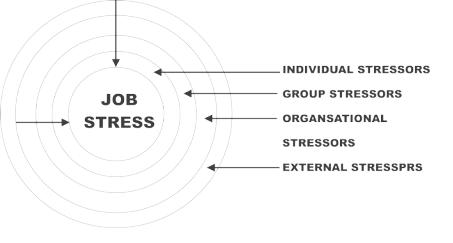
Let us examine the causes of stress now. The factors contributing to stress are called stressors. Stressors exist in the environment and they make a physical or emotional demand on the person. Stressors emanate from both within the organization and outside which can be classified as external stressors, organizational stressors, group stressors and individual stressors as shown in the following diagram.
Figure 18.1: Factors contributing to Job Stress
External Stressors
In the analysis of job stress, we tend to ignore outside forces or events. In fact, they have a greater impact on stress. Quite often, we experience plenty of stress situations outside the organizational settings. External stressors stem from societal changes, globalization, family
222
economic conditions, relocation, race, religion and community conditions. You have to remember that when employees join the organizations, the stressors are also carried over which affect their behaviour. In the changing situation, inspite of the advancement in medical sciences modern living is associated with increased stressful conditions. Obviously, it all tells on the health and well being of an individual. The life styles have changed significantly giving rise to several anxieties and tensions. As a result, potential job stress has increased.
Outside the organization, a person’s family also plays an important role in contributing to stress conditions. An illness of the family member or a strained relation with spouse or a child may create stress for an employee. Not able to properly balance the family responsibilities and the job responsibilities, employees experience a lot of stress. For example, a psychologist reports that divorce between wife and husband interferes with work more than any other trauma in a person’s life. It is pointed out that in the first three months after a spouse walks out, the employee becomes incapable of focusing on work.
In addition, now-a-days various developments in the macro level scenario like frequent communal riots, strikes, violence, religious conflicts, oppressions, harassments, kidnaps, suicides, attacks by extremists have all become a common place. Living in such an environment, a person is exposed to a variety of stressful situations.
Organizational Stressors
Organizational stressors are many and manifest themselves in different forms. You may note that any change in organization is stressful. Technological changes and structural changes happen too frequently. Mergers and acquisitions are increasingly resorted to. It is needless to say that downsizing of workforce is extremely stressful to those who lose their jobs. Layoff survivors also experience stress due to higher workloads, feeling of guilt, job insecurity, and the loss of friends at work.
In the physical environment of an organization, you find stressors in the form of high temperature, excessive noise, lack of privacy, poor lighting, safety hazards and poor quality of air. A study observed that in a noisy plant, level of stress significantly decreased when they were supplied
223
with ear protectors. In another study, it was found that clerical employees experienced significantly higher stress levels in noisy open offices than in quiet areas.
Group Stressors
As you are aware, within an organization, there are several groups that function at different levels. A number of stressors arise at group levels which are discussed below.
Lack of Group Cohesiveness:
Cohesiveness means “togetherness”. Employees should remain a cohesive group. If the cohesiveness does not exist among employees, it may lead to job stress. Cohesiveness of the group may be lost because of the task design, or animosities of group members, or the supervisor trying to limit it.
Lack of Social Support:
Employees have different social groups for different purposes. These play an important role in extending support to an employee. By sharing their joy and sorrow with others, they feel comfortable and happy. In the absence of this kind of mutual social support, the situations prove to be very stressful. There are research studies indicating that lack of social support is so stressful that it results in health care costs. You may note that group level dynamics may also act as stressors. A study indicated that organizational politics was a potential source of stress in the work environment.
Interpersonal Stressors
Interpersonal stressors like group competition, ineffective supervision, office politics, and other conflicts are many in the organizations. The more an employee is required to interact with other people, the more is the scope for stress. As you are aware, in banks and call centers, the employees experience a lot of stress because of the uncooperative customers and high targets to be achieved.
224