Материал: Management-and-Organization-Behavior
Motivational Sources
Having understood the concept of motivation, now let us understand the various sources of motivation. You may note that motivation may sometimes come from external environment in the form of rewards or punishments and sometimes it is generated from within an employee in the form of intrinsic motivation. It may be recognized that under the same set of external factors, all employees are not equally motivated. It depends upon various factors which you can understand when you go through the different motivational theories. The motivational sources are explained below.
Positive vs. Negative Motivation
Motivation may be either positive or negative. Positive motivation takes place when management recognizes the employee’s efforts towards the achievement of organizational goals. It is positive because, this kind of motivation increases the level of performance, promotes team spirit, a sense of cooperation and generates a feeling of belongingness and happiness. The positive motivational factors are:
-- Praise and reward for good performance. -- Concern for the well being of an employee. -- Confidence reposed in the employee.
-- Delegation of authority
-- Scope of participation given in the decision making.
Negative motivation, on the other hand, results from the use of force, pressure, fear or threat. You may note that fear of punishment also affects motivation and thereby the behaviour of a person. In the organizations, negative motivation may come from the fear of being transferred, demoted or removed. This fear of punishment prompts the person to work hard and achieve the goals. It may, however, be realized that negative motivation is not desirable because employees do not like to be punished. Hence, it is desirable to motivate the employees by positive means.
190
Extrinsic Vs. Intrinsic Motivation
Motivation may be either extrinsic or intrinsic. Extrinsic motivation is induced by external factors primarily financial rewards. It is expected that the behaviour caused by positive rewards is likely to be repeated. But the reward should be sufficiently powerful for desirable behaviour to be repeated. Money acts as a significant incentive for positive behaviour of employees. Realizing the value of financial incentives as motivators, managements now-a-days make use of wage increments, bonus payment, fringe benefits, stock options, profit sharing schemes, paid holidays, medical benefits, etc. for motivating the employees.
Intrinsic motivation is something that is generated within an individual. It is an inner feeling. It may be a sense of achievement or recognition leading to satisfaction that motivates the employee further. Since this kind of motivation comes from within, it is called intrinsic motivation. There are many retired doctors who work free in the hospitals because it gives them a sense of accomplishment and satisfaction. Some of the intrinsic motivators include praise, status, recognition, esteem, challenge, risk and responsibility in job.
Mc GREGOR’S PARTICIPATION MODEL
It was McGregor who set forth – at opposite extremes – two pairs of assumptions about human beings which he thought were implied by the actions of autocratic and permissive managers. First set of assumptions are known as “Theory X” and the second set of assumption are known as “Theory Y”. It is important to note that these sets of assumptions are not based on any empirical research. They, according to McGregor, are intuitive deductions.
Theory X
Managers with Theory X orientation make the following assumptions about people:
-- Average human being has an inherent dislike for work and will avoid it, if he can.
-- The average human being is lazy and avoids responsibility.
191
-- The average human being is indifferent to organisational goals.
-- The average human being prefers to be directed, wishes to avoid responsibility, has relatively little ambition and wants security above all.
According to McGregor, this is a traditional theory where workers have to be persuaded and pushed into performance. Management can offer rewards to a worker who shows higher productivity and can punish him if performance is below standard. This is also called ‘carrot and stick’ approach to motivation. It suggests that threats of punishments and strict control are ways to control the people.
Theory Y
Managers with Theory Y orientation make the following assumptions about people:
-- The average human being does not inherently dislike work. Depending upon controllable conditions, work may be a source of satisfaction or a source of punishment.
-- The average human being will exercise self direction and self-control in the service of objectives to which he is committed.
-- Commitment to objectives is a function of the rewards associated with their achievement.
-- The average human being learns under proper conditions, not only to accept, but also to seek responsibility.
-- The capacity to exercise a relatively high degree of imagination, ingenuity and creativity in the solution of organisational problems is widely, not narrowly, distributed in the population.
Theory Y assumes that goals of the organisation and those of the individuals are not necessarily incongruent. Worker’s commitment is directly related to the satisfaction to their needs. Thus, this theory places great emphasis on satisfaction of the needs, particularly the higher ones of the employees. It does not rely heavily on the use of authority as an instrument of command and control. It assumes that employees exercise self-direction and self-control in the direction of the goals to which they feel themselves committed.
192
Application of Theory X and Theory Y
Theory X and Theory Y are important tools in understanding the behaviour of human beings and in designing the incentive schemes to motivate the employees. Neither of the two sets of assumptions is applicable fully in all situations and to all types of people. It appears that Theory X is more applicable to unskilled and uneducated lower level workers who work for the satisfaction of their basic needs of food, clothing and shelter. Theory Y appears to be more applicable to educated, skilled and professional employees who understand their responsibility and are self-controlled. However, there can be exceptions. A lower-level employee may be more responsible and mature than a well-qualified higher level employee. The examples of employees at higher levels in modern organisations shirking responsibility are not uncommon. Therefore, management should use an amalgamation of both the theories to motivate different types of employees.
Theories of Motivation
There are two types of motivational theories - content theories and process theories (cognitive theories). While content theories explain what motivates and what does not motivate, the process theories examine the variables that go into the motivational process taking place within an individual. Some of these theories are explained below.
Maslow’s Need Hierarchy Theory
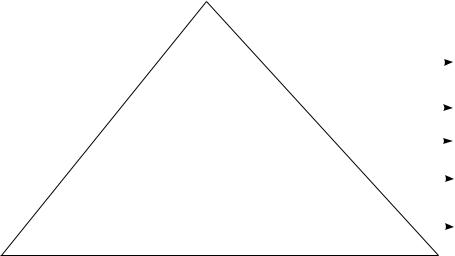
Abraham Maslow has propounded this need hierarchy theory as early as in 1943. Maslow points out that human beings have divergent needs and they strive to fulfill those needs. The behaviour of an individual is determined by such needs. These needs range from biological needs at lower level to psychological needs at the highest level. Further, these needs arise in an order of hierarchy or priority such that lower level needs must be satisfied before higher level needs become important for motivation. Maslow postulates five basic needs arranged in an hierarchical fashion as follows:
193
|
|
|
Self-actualization |
|
|
|
|
|
|
|
|
5 |
|||||
|
|
|
|
|
|
|
|
|
|
|
|||||||
|
|
|
Needs |
|
|
|
|
|
|
|
|
|
|
|
|
|
|
|
|
|
Esteem Needs |
|
|
|
|
|
|
4 |
|||||||
|
|
|
|
|
|
|
|
||||||||||
|
|
|
|
|
|
|
|
|
|
|
|
3 |
|||||
|
|
|
Social Needs |
|
|
|
|
|
|
||||||||
|
|
|
|
|
|
|
|
||||||||||
|
|
|
|
|
|
|
|
|
|
|
|
|
|
|
|
|
|
|
|
|
Safety and Security Needs |
|
|
|
|
2 |
|||||||||
|
|
|
|
|
|
||||||||||||
|
|
|
|
|
|
|
|
|
|
|
|
|
|
|
|
||
|
|
|
Physiological Needs |
|
|
1 |
|||||||||||
|
|
|
|
||||||||||||||
Figure 16.2: Maslow’s Hierarchy Needs
The first three levels of needs at the bottom are known as lower order needs as they are related to one’s existence and security. The top two levels of needs are called higher order needs as they are concerned with personal development and realization of one’s potential. The needs are explained below.
Physiological Needs
The physiological needs are the basic needs having the highest strength in terms of motivation. These are the needs arising out of biological tensions created as a result of deprivation of food, water, shelter, rest, etc. If these basic needs are gratified, then the next level needs become important and act as motivators.
Safety and Security Needs
Once the physiological needs are fulfilled, safety and security needs become predominant. These are the needs for self-preservation while physiological needs are for survival. These needs include security, stability, freedom from anxiety and a structured and ordered environment. Safety and security needs arise out of the concern for the fulfillment of physiological needs in the future. An individual seeks economic or social protection against future threats and dangers that he is exposed to. If once these needs are gratified, they fail to serve as motivators any more. The individual, then, moves on to the next level needs and strives for their fulfillment.
194