Материал: Management-and-Organization-Behavior
External Factors Influencing Selection
The external factors influencing selection are nature, intensity, size, contrast, repetition, motion, and novelty and familiarity.
Nature
By this we try to understand the nature of the object. Is it a visual object? Does it have words, pictures, people or animals? Pictures attract attention more than words and a picture with human beings attracts attention more than a picture with inanimate objects. That is why cartoons and caricatures draw more attraction.
Intensity
The intensity principle conveys that if the external stimulus is more intense in nature, the more it is likely to be perceived by the individual. That is why people pay more attention to loud noise, strong odour or bright light. At work places, superiors speak loudly to subordinates for this reason only.
Size
Like intensity, size also matters very much. Larger objects are likely to be perceived more by the individuals than the smaller ones. A maintenance engineer gives greater attention to a bigger machine than a smaller one.
Contrast
The contrast principle suggests that the external stimulus that stands out distinctly against the background or the one that is quite unusual will receive greater attention of the people.
Repetition
The principle of repetition suggests that a repeated external stimulus draws more attention than a single one. The several advertisements of various products shown daily on TVs are based on the principle of repetition only. This principle also explains why supervisors have to give directions to workers repeatedly for even simple tasks.
165
Motion
According to this principle, people pay greater attention to moving objects rather than stationary objects. That is why advertisers create signs that incorporate moving parts.
Novelty and Familiarity
This principle states that either a novel or a familiar external situation can better serve to draw attention. New objects in familiar settings or familiar objects in new settings are likely to draw the attention of the perceiver. Job rotation is followed in organizations for this reason. For instance, workers will pay greater attention to the tasks assigned to them in the new jobs in order to prove themselves and gain acceptance in the new job.
Internal Factors Influencing Selection
Internal factors influencing selection of stimuli are personality, learning, and motivation. They are explained below.
Personality
It cannot be disputed that personality has a significant impact on what and how people perceive. The various personality dimensions influence the perceptual process. A conscientious person is likely to pay greater attention to external environmental stimuli than a less conscientious person who is likely to be careless, impulsive and irresponsible. On the other hand, conscientious people tend to organize their perceptions into clear categories, receive information quickly and in an organized manner. They are careful and methodical in their perceptual selection and organization.
Learning
Perceptual selection is also affected by learning. Learning determines the development of perceptual sets. Perceptual set means the expectation of particular interpretation based on past experience with the same object. This is also known as cognitive awareness by which the minds
166
organizes information and form images and compare them with previous exposures to similar stimuli. In organizations employees’ experiences are influenced by their perception very much. In making decisions, managers are also influenced by their functional background. However, it is necessary for managers to rise above their own experiences and be able to solve the problems in an appropriate way. Individual differences lead to perceptual bias. This bias can be overcome through education and experience.
Motivation
Motivation also plays an important role in influencing the process of perception. For example, a hungry person is likely to be sensitive to the sight or smell of food than a non hungry person. Likewise if the person is deprived of sleep, he looks for a situation in which he can have a comfortable sleep. Generally, people perceive things that help in satisfying needs and those that were found rewarding in the past. The relationship between motivation and perception is explained through Collenyannia Principle which states that people process pleasant events more efficiently and accurately than the unpleasant events.
Factors Influencing Perception
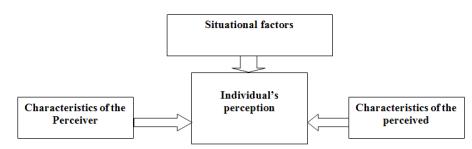
A number of factors operate to shape and sometimes to distort perception. These factors emanate from three sources – the perceiver, the perceived and the situation.
The Perceiver
When a person looks at a target, his interpretation of it is influenced by his personal characteristics like his needs, past experience, habits, personality, values, and attitudes. A person with a strong need for ego satisfaction may select out from a situation and emphasize signals that tend to satisfy the desire for self esteem. Similarly, negative attitudes toward unions may cause a manager to look for antagonisms in even routine visits by local union officials to the organization. These and other personal factors will determine what a person gives attention to in a situation and how these cues are interpreted as a basis for decision-making and action responses.
167
The Perceived
Characteristics in the target / object that are being observed may influence what is perceived. The physical attributes, appearance, and behaviour of other persons in the situation also influence how the object is perceived. Physical attributes of a person are related to age, sex, height, and weight. A young person exercising authority in a situation is viewed differently from an older person doing the same thing. Personal attire and appearance are also relevant factors in the formation of perceptions.
The Situation
The context in which we see the objects or events is important. The physical, social and organizational elements of the situation or event may also influence perceptions. A subordinate calling his boss by the first name may be perceived quite differently when observed in a typical Indian office as opposed to in a social reception. Though the perceiver and the perceived are the same, it is the situation that makes a difference. Such background characteristics of the situation or context are additional factors that can affect how the situation is perceived by the different persons. The following Diagram shows the summary of the factors influencing perception.
Figure 14.2: Factors Influencing Perception
Managing the Perception Process
Successful managers understand the importance of perceptions as influences on behaviour, and handle them accordingly. They are aware of perceptual distortions and accept that perceptual differences are likely to exist in any situation. With this knowledge, they make appropriate decisions that are acceptable to all persons concerned. The perceptual skills of a manager will help him in the following ways.
168
High level of self awareness
Asalreadymadeclear,individualneeds,experience,andexpectations will all affect perceptions. The successful manager understands this and is able to identify when he is inappropriately distorting a situation because of such perceptual tendencies.
Seek information from various sources for decisions
The successful manager minimizes the bias of personal perceptions by seeking out the viewpoints of others. These insights are used to gain additional perspective on situations and the problems or opportunities they represent.
Empathy
As is understood, different people look at the same situation differently. The successful manager rises above the personal impressions and tries to understand problems as felt by other people.
Influence of perceptions on other people
People act according to their own perceptions. If felt necessary, the successful manager influences the perceptions of others in such a way that the work events are interpreted as accurately as possible and to the advantage of all concerned.
Avoid common perceptual distortions
Perceptual distortions include the use of stereotypes and halo effects, as well as selective perception and projection. Successful managers are self disciplined and sufficiently aware that the adverse impact of these distortions is minimized.
Avoid inappropriate attributions
A person has a tendency to explain why events happened the way they did or why people behaved as they did. The successful manager is wise enough to establish the real reasons for the things that happen and avoid
169