Материал: Development of the system of sports betting
Figure 5.3 shows how does the expected payout of the
bookmaker change over time.payout function is the following:
 ,
,
What in this concrete case equals to:
 ,
where
,
where 
is shown that the higher the probability of a goal at
each minute (according to the bookmaker’s beliefs), the faster the expected
payout function decreases. Intuitively it means that the more disctinct the
beliefs of the bookmaker and of the bettor are, the more expensive it is for a
bookmaker to offer the cash out soon, what means that he doesn’t want to
interrupt the bet and wants to wait as long as possible. Hence, the cash out
amount that will be available for the customer will be so low, that a bettor
will not accept it, and the bet will hold until the end of the event.
Appendix 6
that bettor’s and bookmaker’s subjective probabilities
of a goal at each minute are such that
 ,
,
 or
or

’s take some numbers to demonstrate this case
properly.that initially a bettor has  ,
he makes a stake
,
he makes a stake  with
odds
with
odds  .means
that if the outcome will be the one he placed bet on, the wealth of the bettor
will be:
.means
that if the outcome will be the one he placed bet on, the wealth of the bettor
will be:

 .
.
, the outcome will be the one that was not desired by
the bettor, his wealth will be:

 .
.
the case, when a bettor subjectively believes that
there is a probability of a goal at each minute of the game which equals to  ,
i.e. there is a 0,56% chance that a goal will take place at each minute of the
game.to the constraint given in this situation, believes of the bookmaker have
to be the following:
,
i.e. there is a 0,56% chance that a goal will take place at each minute of the
game.to the constraint given in this situation, believes of the bookmaker have
to be the following:


Bookmaker believes that there is a probability of a
goal at each minute which equals  .
.
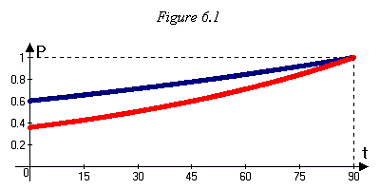
Figure 6.1 shows how the subjective probabilities
could be located in this situation. The blue line represents bettor’s
subjective probability of a “0:0” score as the score at the end of the game at
each minute during the game if no goal took place before that minute. The red
line shows the same probability for a bookmaker.Figure 6.2 shows how does the
certainty equivalent change with time. Remember,

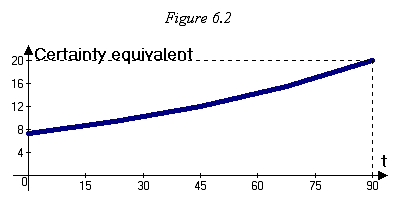
What in this specific case equals to:
 .
.
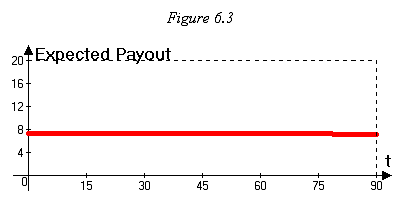
The Figure 6.3 shows how does the expected payout of
the bookmaker change over time.payout function is the following:
,
in this concrete case equals to:  is shown that the expected payout is constant over
time. It means that bookmaker is indifferent whether to offer cash out and
interrupt the betting or to wait until the end. Hence, he will offer the
acceptable for the bettor amount of money from the very beginning of the event.
As bettor is risk-averse he desires to avoid uncertainty when it is possible.
Thus, if the acceptable amount will be offered in the very beginning of the
game, a bettor will accept it (actually, it will be the price of the bet) in
order to avoid uncertainty.is clear that in this case the “cash out” option
will be senseless as the commitment between the bettor and the bookmaker will
take place at the 0th minute.
is shown that the expected payout is constant over
time. It means that bookmaker is indifferent whether to offer cash out and
interrupt the betting or to wait until the end. Hence, he will offer the
acceptable for the bettor amount of money from the very beginning of the event.
As bettor is risk-averse he desires to avoid uncertainty when it is possible.
Thus, if the acceptable amount will be offered in the very beginning of the
game, a bettor will accept it (actually, it will be the price of the bet) in
order to avoid uncertainty.is clear that in this case the “cash out” option
will be senseless as the commitment between the bettor and the bookmaker will
take place at the 0th minute.
Appendix 7
 ,
,

The derivative of the expected payout function is the
following:
 .
.
 ,
,
 =0
as
=0
as  is
a constant.
is
a constant.
 .
.
Thus,  equals
to:
equals
to:
is the same as
 .
.
Appendix 8

The sign of the expression above has to be analyzed.
 ,
which corresponds to
,
which corresponds to

dividing both sides by  :
:
 vs
vs
 ,
,
this is the same as
vs

Appendix 9

The derivative of the  has
to be found.’s take some number to simplify calculations.that initial wealth is
has
to be found.’s take some number to simplify calculations.that initial wealth is
 ,
the stake is ,
and the odds .
A bettor subjectively believes that the probability of a goal at each minute of
game equals
,
the stake is ,
and the odds .
A bettor subjectively believes that the probability of a goal at each minute of
game equals  .certainty
equivalent is now the following:
.certainty
equivalent is now the following:

, simply:

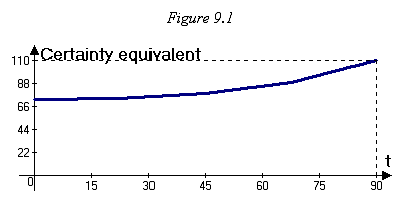
Figure 9.1 shows the certainty equivalent of a bettor in this concrete case.bookmaker has to pay
 ,
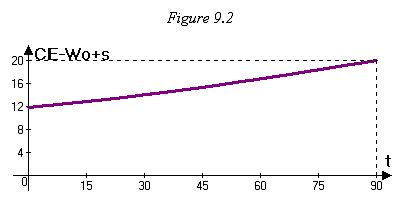
this amount is shown in the Figure 9.2:
,
this amount is shown in the Figure 9.2:
derivative of the CE function is the following:

Figure 9.2 shows that the derivative of the certainty
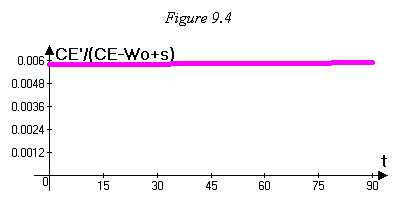
equivalent function is also increasing.has to be analyzed is the ratio:

9.4 demonstrates that this ratio is almost constant
and is approximately equal to 0.006:
Appendix 10
the situation observed in Appendix 9.that initial
wealth is ,
the stake is ,
and the odds .
A bettor subjectively believes that the probability of a goal at each minute of
game equals .was
found that in such case the ratio 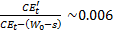 .the
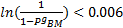
derivative of the bookmakers’ expected payout function to be positive, the
following inequality must hold:
.the
derivative of the bookmakers’ expected payout function to be positive, the
following inequality must hold:
 ,
,
 ,
,


Thus, when a bookmaker believes that with probability
more than 0.6% there will be a goal each minute, then the expected payout
amount of “cash out” will be increasing in time and he will decide to end the
bet at the very beginning, i.e. at 0th minute. ,
the opposite situation occurs, the expected payout amount of “cash out” decreases
in time, the minimum amount will be achieved at the very end of the event, i.e.
at 90th minute.
,
the opposite situation occurs, the expected payout amount of “cash out” decreases
in time, the minimum amount will be achieved at the very end of the event, i.e.
at 90th minute. ,
a bookmaker is indifferent as the expected payout is constant over time.means
that bookmaker is indifferent whether to offer cash out and interrupt the
betting or to wait until the end. Hence, he will offer the acceptable for the
bettor amount of money from the very beginning of the event. As bettor is
risk-averse he desires to avoid uncertainty when it is possible. Thus, if the
acceptable amount will be offered in the very beginning of the game, a bettor
will accept it (actually, it will be the price of the bet) in order to avoid
uncertainty.is clear that in this case the “cash out” option will be senseless
as the commitment between the bettor and the bookmaker will take place at the
0th minute.
,
a bookmaker is indifferent as the expected payout is constant over time.means
that bookmaker is indifferent whether to offer cash out and interrupt the
betting or to wait until the end. Hence, he will offer the acceptable for the
bettor amount of money from the very beginning of the event. As bettor is
risk-averse he desires to avoid uncertainty when it is possible. Thus, if the
acceptable amount will be offered in the very beginning of the game, a bettor
will accept it (actually, it will be the price of the bet) in order to avoid
uncertainty.is clear that in this case the “cash out” option will be senseless
as the commitment between the bettor and the bookmaker will take place at the
0th minute.