Материал: Development of the system of sports betting
Which means that
this case the derivative of the bookmaker’s expected payout function is strictly positive what means that the expected payout function is strictly increasing in time. It means that the minimum payout that a bookmaker has to give to a bettor occurs at the very beginning of the game. Hence, this means that in such case the bet will not occur at all., this means that the beliefs of a bookmaker and a bettor are so close to each other, that a bookmaker considers a bet senseless because he believes in a certain output approximately in the same way as a bettor does.case shows that when probabilities are such that is found above, the “cash out” will not be used because the bookmaker would like to offer cash out as soon as possible, and a bet will possibly not occur at all.
II. Suppose now that bettor’s and bookmaker’s subjective
probabilities of a goal at each minute are such that
 ,
,
means that
 or
or

this situation the derivative of the expected payout amount that a bookmaker has to pay as a “cash out” is strictly negative what implies that the expected payout amount is strictly decreasing in time. This means that the expected payout that a bookmaker has to pay as “cash out” is at its minimum in the very end of the game, at the 90th minute. The bookmaker’s subjective expectations of the outcome are such that it is less expensive for him to wait until the end of the game hoping that someone scores than to interrupt the game and make a bettor cash out. Hence, “cash out” option will not be utilized again as a bookmaker will not desire to offer a certainty equivalent (or more) until the end of the event and the bettor will not accept any amount less of that.case shows that the bet will occur but the “cash out” will not be used again.
III. The last case that has to be considered is the case when
bettor’s and bookmaker’s subjective probabilities of a goal at each minute are
such that:
 ,
,
is the same as
 or
or

this case the derivative of the expected payout amount that a bookmaker has to pay as a “cash out” equals to zero what implies that the expected payout amount is constant over time. Such result means that a bookmaker is indifferent whether to offer a CE as a “cash out” amount at the very beginning of the game, sometime during the game or to wait until the end. As a bettor wants to avoid the uncertainty, he will accept the cash out offer in the very beginning of the game at the price that a bookmaker will offer, and the amount proposed by a bookmaker will be fair. Again, this is the case when a “cash out” option is senseless.
As the analysis above has shown, when a bettor is very confident in his beliefs, the “cash out” option remains unused even though the risk-aversion of a bettor exists.
3.3 Generalizing the problem
Let’s now consider the cases when a bettor is not as
confident as was assumed above, thus, he stakes some part of his wealth,  .the
expression which represents the certainty equivalent:
.the
expression which represents the certainty equivalent:

A bookmaker now faces the following expected payout
(say,  )
function:
)
function:
 ,
,
Or,

Costs minimization problem will be the following:
 ,
,
derivative of the expected payout function is:

 is
always positive, what affects the sign of the derivative is the expression in
the latter brackets:
is
always positive, what affects the sign of the derivative is the expression in
the latter brackets:
 .
.
have to be compared are two following expressions:
 and
and


is a positive constant. Both  and
and
 are
continuous functions but if the time period of 90 minutes is considered, the
quotient of those functions is almost a constant., depending on the value of
are
continuous functions but if the time period of 90 minutes is considered, the
quotient of those functions is almost a constant., depending on the value of  the
bookmaker’s expected payout function can be increasing, decreasing or constant.
The discussion of each case will have the same conclusion as each case of
paragraph 3.2 has. Hence, the expected payout function again will not have any
minimum point except either the 0th or the 90th minute. This means that a “cash
out” option will not be used.
the
bookmaker’s expected payout function can be increasing, decreasing or constant.
The discussion of each case will have the same conclusion as each case of
paragraph 3.2 has. Hence, the expected payout function again will not have any
minimum point except either the 0th or the 90th minute. This means that a “cash
out” option will not be used.
Chapter 4. Conclusion
of innovations have been made in the sports betting
industry which were not analyzed by researchers. The “Cash out” option is one
of those advances that is becoming popular in betting. Bettors use this option
in the betting process on order to secure their profits. The question that
arises is what makes the bettors use the “Cash out”? According to the
rationality implications, if one accepts the bet he will not cash out until the
final whistle of the referee unless any certain factors affect this decision.
What was examined in this paper is whether the risk-aversion is the factor that
affects the decision of bettors in risky situations to quit the game before its
official end and take the money proposed by a bookmaker. It was assumed that
there are not any other factor affecting the decision. The analysis above has
shown that if the risk-aversion is the only factor that a bookmaker rely on
while making a decision, a “cash out” option will not be utilized. There will
not be any point in time during the game (except the 0th and the last minute)
when a bookmaker and a bettor could coincide in decision to quit the game
before the official end. Thus, there might be other factors that are important
in such decision-making. It might be something else that happens during the
game (like a strong player removal/arrival) and affects beliefs of a bettor and
a bookmaker so much that they decide to quit the game and not to wait until the
end. The research has to be developed by analyzing other factors that may be
the reason of “cash outing”. What else could be made is providing an
investigation of the more realistic cases when there are different bettors in
the market and an imperfect information, which means that a bookmaker doesn’t
know the type of a bettor he is “playing” with. To examine the empirical
evidence the real bet could be placed and the real amounts of “cash out”
proposed could be analyzed.
List of references
1. ACOSS (1997). Young People, Gambling and the Internet, ACOSS paper no.88, ACOSS, Sydney.
2. Altman,
J. (1985). ‘Gambling as a mode of redistributing and accumulating cash among
Aborigines: a case study from Arnhem Land’, in G. Caldwell, et al. (eds)
Gambling in Australia, Croom Helm, Sydney, p.50-67
. Arrow, K. J. 1965. The theory of risk aversion. Lecture 2 in Aspects of the Theory of Risk-Bearing, Yrjo Jahnsson Lectures. Yrjo Jahnssonin Saatio, Helsinki, Finland.
4. Cain, J. (1994). ‘Grim face of gambling’, The Age, 13 March, p.14.
. Epstein, L. 1999. A definition of uncertainty aversion. Rev. Econom. Stud. 66 579-608.
. Epstein, L. , J. Zhang. 2001. Subjective probabilities on subjectively unambiguous events. Econometrica 69 265-306
. Faber, M. H. (2012). Basic Probability Theory. In Statistics and Probability Theory (pp. 9-20). Springer Netherlands
. Forrest, D. (2012). Betting and the Integrity of Sport. In Sports Betting: Law and Policy (pp. 14-26). TMC Asser Press.
9. Gutierrez
D. (2012a), “Building Irresistible Social and Mobile Casino Games”, Kontagent
Konnect 2012 User Conference, May 2012. <#"887659.files/image045.gif">
Appendix 2
 .
.
 ,
,

 ,
,


 ,
,


Appendix 3

Taking the first derivative of the given function with
respect to t:

Taking the common multiples  and
and
 out
of the brakets:
out
of the brakets:
 .
.
Appendix 4
that bettor’s and bookmaker’s subjective probabilities
of a goal at each minute are such that
 ,
,
 or
or

’s take some numbers to demonstrate this case
properly.that initially a bettor has  ,
he makes a stake
,
he makes a stake  with
odds
with
odds  .means
that if the outcome will be the one he placed bet on, the wealth of the bettor
will be:
.means
that if the outcome will be the one he placed bet on, the wealth of the bettor
will be:

 .
.
, the outcome will be the one that was not desired by
the bettor, his wealth will be:

 .
.
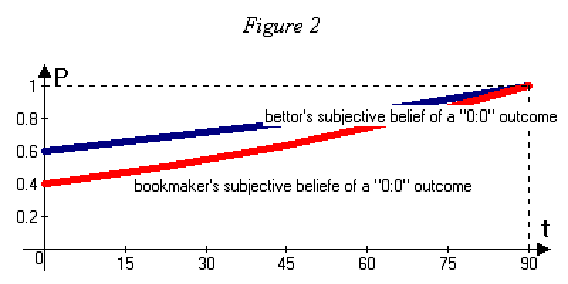
the case, when a bettor subjectively believes that
there is a probability of a goal at each minute of the game which equals to  ,
i.e. there is a 0,56% chance that a goal will take place at each minute of the game.to
the constraint given in this situation, believes of the bookmaker have to be
the following:
,
i.e. there is a 0,56% chance that a goal will take place at each minute of the game.to
the constraint given in this situation, believes of the bookmaker have to be
the following:


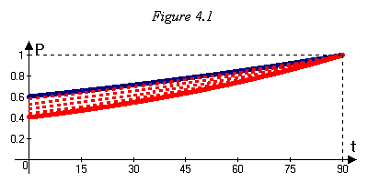
Figure 4.1 shows how the subjective probabilities
could be located in this situation. The blue line represents bettor’s
subjective probability of a “0:0” score at the end of the game at each minute
during the game, if no goal took place before that minute. The red lines show
the same probability for a bookmaker, the smaller the probability of a goal at
each minute according to his beliefs ( ),
the higher is the red line.is clear from the picture that the lower ,
the closer the beliefs of the bookmaker and the bettor are. If their opinions
almost coincide, placing a bet doesn’t make sense. A bettor believes in “0:0”
outcome as well as a bookmaker does, even if a bet occur, a bookmaker will
offer an amount to cash out at the very beginning, that amount will be
acceptable for a bettor and will be equal to the price of the bet.understand it
clearly see the following figures:
),
the higher is the red line.is clear from the picture that the lower ,
the closer the beliefs of the bookmaker and the bettor are. If their opinions
almost coincide, placing a bet doesn’t make sense. A bettor believes in “0:0”
outcome as well as a bookmaker does, even if a bet occur, a bookmaker will
offer an amount to cash out at the very beginning, that amount will be
acceptable for a bettor and will be equal to the price of the bet.understand it
clearly see the following figures:
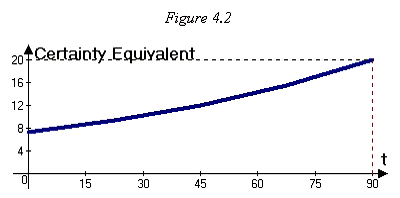
Figure 4.2 shows how does the certainty equivalent change with time. Remember,
 ,in
this specific case equals to:
,in
this specific case equals to:
 .
.
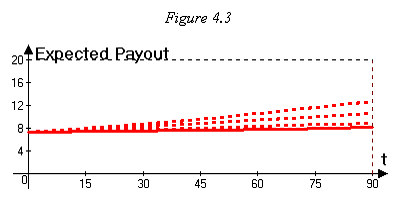
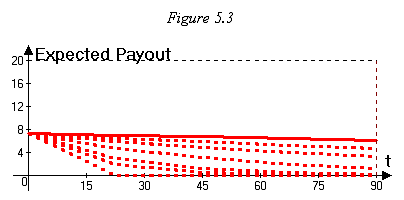
Figure 4.3 shows how does the expected payout of the
bookmaker change over time.payout function is the following:

 ,
,
in this concrete case equals to:

 ,
where
,
where 
is shown that the lower the probability of a goal at each minute (according to the bookmaker’s beliefs), the faster the expected payout function increases. Intuitively it means that the closer the beliefs of a bookmaker are to those of a bettor, the more expensive it is for a bookmaker to wait to offer the cash out, what means that he wants to interrupt the bet as soon as possible.
Appendix 5
that bettor’s and bookmaker’s subjective probabilities
of a goal at each minute are such that
 ,
,
 or
or

’s take some numbers to demonstrate this case
properly.that initially a bettor has ,
he makes a stake with
odds .means
that if the outcome will be the one he placed bet on, the wealth of the bettor
will be:
 .
.
, the outcome will be the one that was not desired by
the bettor, his wealth will be:
 .
.
the case, when a bettor subjectively believes that
there is a probability of a goal at each minute of the game which equals to ,
i.e. there is a 0,56% chance that a goal will take place at each minute of the
game.to the constraint given in this situation, believes of the bookmaker have
to be the following:


Bookmaker believes that there is a probability of a
goal at each minute which is higher than  .
.
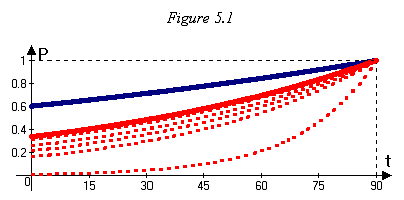
Figure 5.1 shows how the subjective probabilities
could be located in this situation. The blue line represents bettor’s
subjective probability of a “0:0” score as the score at the end of the game at
each minute during the game if no goal took place before that minute. The red
lines show the same probabilities for a bookmaker, the higher the probability
of a goal at each minute according to his beliefs (),
the lower is the red line.is clear from the picture that the higher ,
the more distant the beliefs of the bookmaker and the bettor are. If their
opinions are so different, so a bookmaker is very confident in his beliefs that
the score will not be “0:0” in the end and he will not desire to offer a cash
out and to end the bet before the final whistle of a referee.understand it
clearly see the following figures:
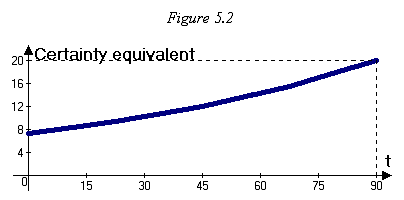
Figure 5.2 shows how does the certainty equivalent
change with time. Remember,
in this specific case equals to:
.