Материал: Current_Neolithic_Research_in_Armenia
Editorial
Introduction
Clare and Gebel
Introduction: Conflict and Warfare
Keynote
Bar-Yosef
Warfare in Levantine Early Neolithic. A Hypothesis
Comments and Contributions
Bernbeck
A Scholastic Fallacy
Clare
Pastoral Clashes: Conflict Risk and Mitigation
Gebel
Conflict and Conflict Mitigation
Grosman
Prehistoric Warfare – Cause and Visibility
Guilaine
Neolithic Warfare: Comments
LeBlanc
Broader Implications
Müller-Neuhof
Comment
Özdoğan
Warfare Due to Social Stress or State of Security Through Social Welfare
Otterbein
Early Warfare
Roksandic
Commentary
Rollefson
Violence in Eden: Comments
Roscoe
War, Community, and Environment
Warburton
Methodological Considerations
Reply
Bar-Yosef
Warfare in Levantine Early Neolithic. Response Ofer Bar-Yosef
Other Contributions
Köksal-Schmidt and Schmidt
Göbekli Tepe „Totem Pole“
Arimura, Badalyan, Gasparan, and Chataigner
Current Neolithic Research in Armenia
Neeley
TBAS 102: A Late Natufian Site in West-Central Jordan
Bartl
Shir, West Syria
New Theses
NEO-LITHICS 1/10
The Newsletter of Southwest Asian Neolithic Research
Special Topic on ConflictandWarfareintheNearEasternNeolithic

Content
Editorial |
3 |
Introduction |
|
Lee Clare and Hans Georg K. Gebel |
|
Introduction: Conflict and Warfare in the Near Eastern Neolithic |
3 |
Keynote |
|
Ofer Bar-Yosef |
|
Warfare in Levantine Early Neolithic. A Hypothesis to be Considered |
6 |
Comments and Contributions |
|
Reinhard Bernbeck |
|
Prehistoric Wars, A Scholastic Fallacy |
11 |
Lee Clare |
|
Pastoral Clashes: Conflict Risk and Mitigation at the Pottery Neolithic Transition |
|
in the Southern Levant |
13 |
Hans Georg K. Gebel |
|
Conflict and Conflict Mitigation in Early Near Eastern Sedentism |
32 |
Leore Grosman |
|
Prehistoric Warfare – Cause and Visibility |
36 |
Jean Guilaine |
|
Neolithic Warfare: Comments |
38 |
Steven A. LeBlanc |
|
Early Neolithic Warfare in the Near East and its Broader Implications |
40 |
Bernd Müller-Neuhof |
|
Comment to Ofer Bar Yosef‘s Keynote: Warfare in Levantine Early Neolithic. |
|
A Hypothesis to be Considered |
50 |
Mehmet Özdoğan |
|
The Neolithic Medium: Warfare Due to Social Stress or State of Security |
|
Through Social Welfare |
54 |
Keith F. Otterbein |
|
Early Warfare in the Near East |
56 |
Mirjana Roksandic |
|
Commentary on “Warfare in Levantine Early Neolithic. A Hypothesis to be Considered” |
59 |
Gary O. Rollefson |
|
Violence in Eden: Comments on Bar-Yosef’s Neolithic Warfare Hypothesis |
62 |
Paul Roscoe |
|
War, Community, and Environment in the Levantine Neolithic |
66 |
David A. Warburton |
|
Warfare in the Neolithic? Methodological Considerations |
68 |
Reply |
|
Ofer Bar-Yosef |
|
Warfare in Levantine Early Neolithic. Response Ofer Bar-Yosef |
71 |
Other Contributions |
|
Çiğdem Köksal-Schmidt and Klaus Schmidt |
|
The Göbekli Tepe “Totem Pole“. A First Discussion of an Autumn 2010 Discovery |
|
(PPN, Southeastern Turkey) |
74 |
Makoto Arimura, Ruben Badalyan, Boris Gasparyan, and Christine Chataigner |
|
Current Neolithic Research in Armenia |
77 |
Michael P. Neeley |
|
TBAS 102: A Late Natufian Site in West-Central Jordan |
86 |
Karin Bartl |
|
Shir, West Syria |
92 |
Theses |
94 |
New Publications |
97 |
Masthead |
99 |
2
Neo-Lithics 1/10
Other Contributions
Current Neolithic Research in Armenia
Makoto Arimura |
National Research Institute for Cultural Properties, Tokyo |
arimura@tobunken.go.jp |
Ruben Badalyan |
Institute ofArchaeology and Ethnography,Yerevan |
rubbadal@yahoo.com |
Boris Gasparyan |
Institute ofArchaeology and Ethnography,Yerevan |
borisg@virtualarmenia.am |
Christine Chataigner |
Maison de l‘Orient et de la Méditerranée, Lyon |
christine.chataigner@mom.fr |
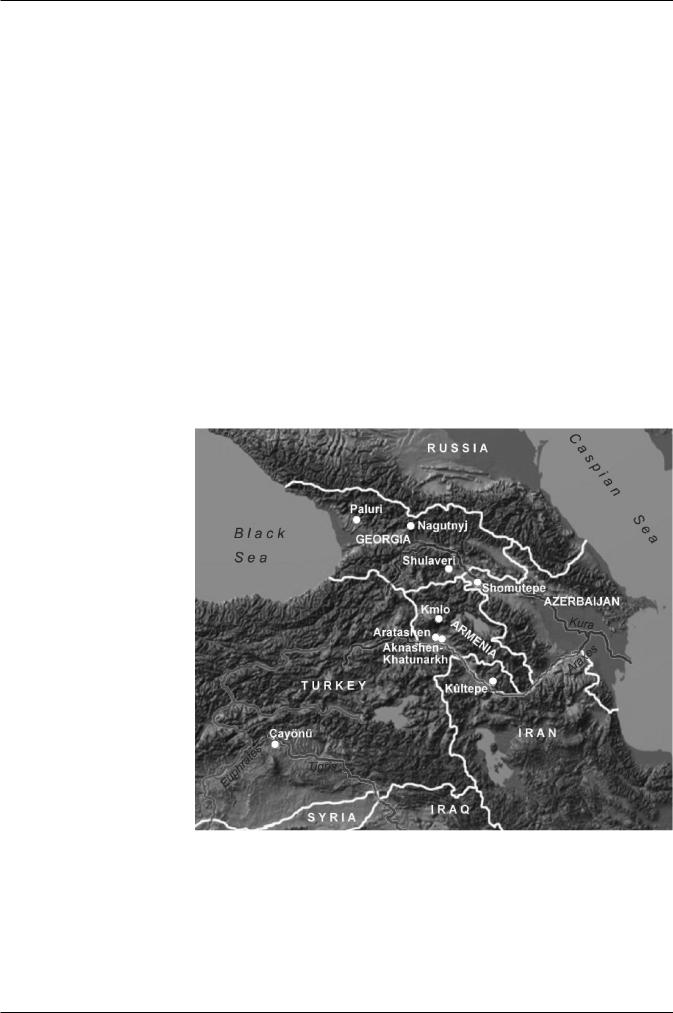
If the cultures that developed in the centre of the Southern Caucasus, of which Armenia is part, are compared to those of the northern Near East or the neighbouring regions bordering the Black Sea and the Caspian Sea, it is clear that there is a large gap in our knowledge of the beginnings of Neolithisation. Indeed, in the basin of the Kura, in Georgia and Azerbaijan, it is only at the beginning of the 6th millennium calBC that a culture appeared (the Shulaveri-Shomutepe culture) that possessed an advanced mastery of the domestication of plants and animals (Kush-
nareva 1997; Kiguradze and Menadbe 2004), whereas in the basin of the Arax the culture of Kültepe of Nakhichevan developed from the 2nd half of the 6th millennium cal. BC (Munchaev 1982; Narimanov 1987) (Fig. 1).
In Armenia, where ten years ago the Neolithic period remained very poorly known, the collaboration between the Institute of Archaeology of Yerevan and the French “Caucasus” mission enabled the discovery of two different cultures: a Mesolithic/ Early Neolithic culture on the eastern flank of the Aragats mountains (Kmlo-2 rock shelter) and a local variant of the Shulaveri-Shomutepe culture in the Ararat plain (Aratashen and Aknashen-Khatunarkh)1.
the wild or domestic status of the highly fragmented bones is difficult to determine. Only wild plant remains were found in this layer. The dating of Kmlo-2 is a difficult issue (Arimura et al. 2010), but excavations in 2009 and additional 14C dating indicate that the site was occupied in three different phases, 11th-10th millennia, 9th-8th millennia and 6th-5th millennia calBC.
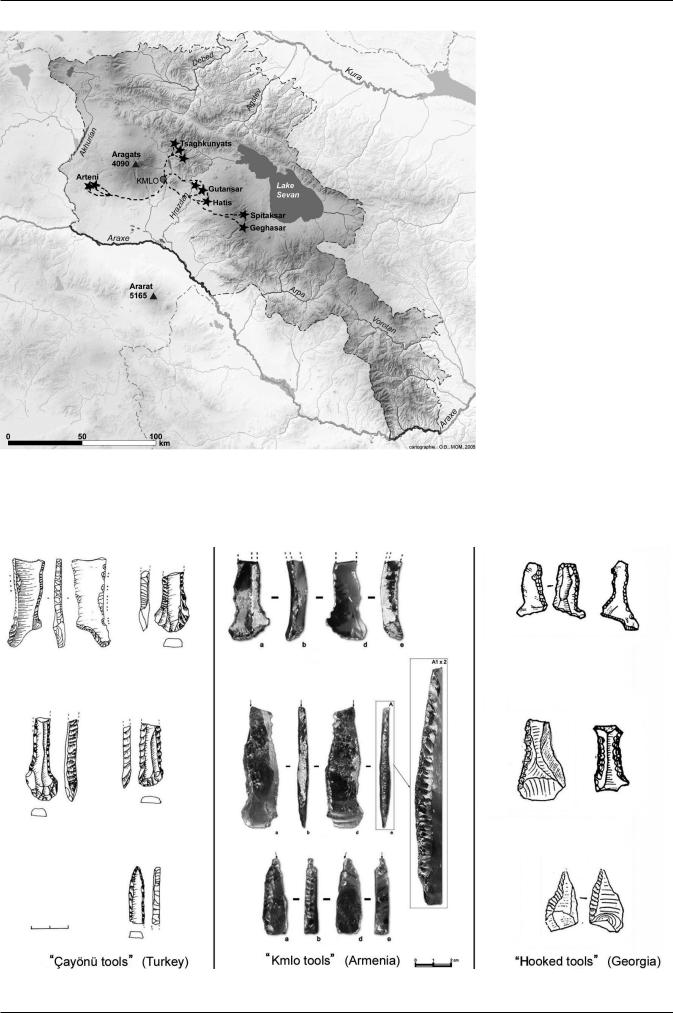
The inhabitants of Kmlo-2 produced their tools from obsidian pebbles washed down by the Kasakh River from outcrops situated near its source (Tsagh-
The Mesolithic / Early Neo- |
Fig. 1 Main Neolitic sites mentioned in the text. |
||
lithic of Kmlo-2 |
|
kunyats range), as well as from larger blocks which |
|
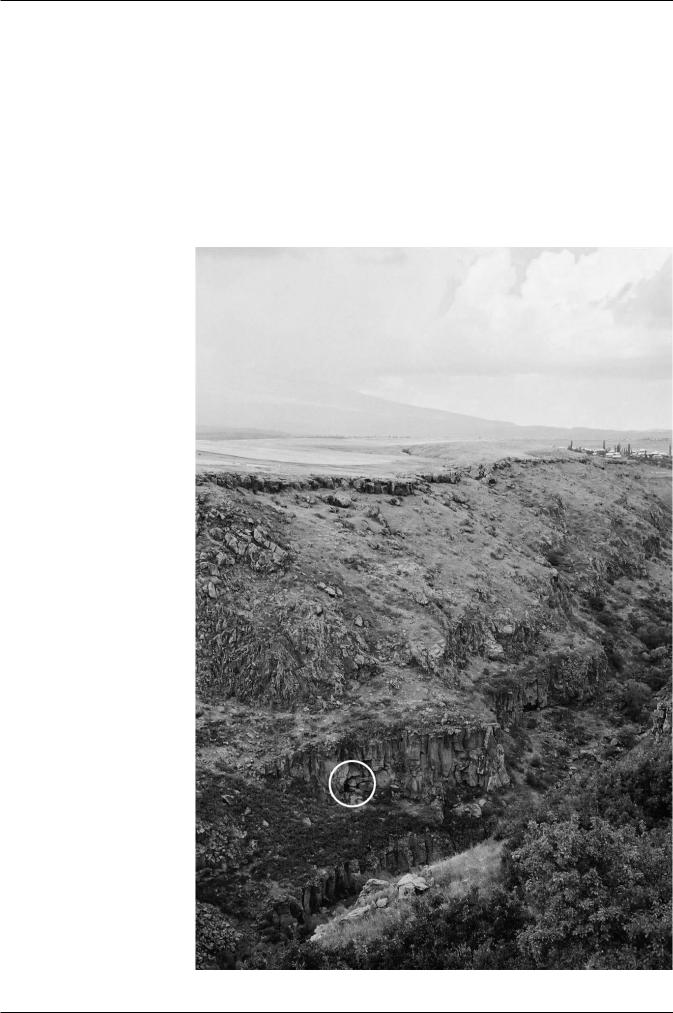
The Kmlo-2 rock shelter (Arimura et al. 2010), cut into |
|||
they brought from deposits that were one to three days |
|||
the basaltic flows of the Aragats mountain carved by |
distant by foot (Gutansar, Hatis, Arteni, Geghasar) |
||
the Kasakh River (Fig. 2), was occupied during the pre- |
(Fig. 3). The numerous debitage products, which repre- |
||
historic period by small human groups that hunted ibex, |
sent 90% of the lithics, provide evidence for making |
||
mouflons and deer. Remains of Caprinae have been |
tools on the spot. There is a large number of microliths |
||
found in the upper horizons of the prehistoric layer, but |
(30%), including geometric pieces such as lunates and |
||
77
Neo-Lithics 1/10
Other Contributions
trapeze-rectangles that probably served as barbs for arrows.
The most interesting objects for the study of relations with the neighbouring regions are obsidian tools with continuous and parallel retouch on one or both lateral edges, clearly executed by pressure flaking technique. These artefacts, original for Armenia and called “Kmlo tools”, are similar to obsidian tools found on sites of the 8th-7th millennia calBC in southeastern Anatolia and northern Mesopotamia (Çayönü, Cafer Höyük, Shimshara, etc) and called “Çayönü tools” or “Çayönü rods” or “Beaked blades” (Redman 1982; Fuji 1988; Caneva et al. 1994;
Mortensen 1970) (Fig. 4).
A use-wear analysis, carried out by L. Astruc (Arimura et al. 2006) on “Çayönü tools” and “Kmlo tools”, shows some differences between the two groups of artefacts. Although the retouch seems to be similar, the blanks on which they are made, the retouching technique, the wear traces, and the methods of rejuvenation are different. According to the use-wear analysis, no direct relationship can be established between “Kmlo tools” and “Çayönü tools”. Moreover, the geochemical analysis of 20 “Kmlo tools” has confirmed that all were made locally on obsidian from Armenian deposits (Tsaghkunyats, Arteni, Gutansar, Hatis, Geghasar) and that there was no import of artefacts or raw material from the northern Near East.
In Georgia, similar tools, called “hooked tools”, characterise a culture attributed to the early Neolithic, the Palu- ri-Nagutnyj culture, that developed on the southwestern slopes of the Greater Caucasus (Grigolija 1977). Similar tools are also found on the high plateaus of southern Georgia (“Paravani group”), where the large obsidian deposit of Chikiani was exploited (Kiguradze and Menadbe 2004: 353-357). Most of these Georgian Early Neolithic sites are found at altitude, several are rock shelters, and all have produced only one level of occupation; unfortunately, none
has yet been dated by 14C.
The chronological attribution of the “Kmlo culture”, characterized by the presence of “Kmlo tools”, has been recently clarified by 14C dating. The horizon in which the “Kmlo tools” appear has been dated to the first half of the 9th millennium calBC; these artefacts are numerous in the overlying horizons dated to the end of the 9th and to the 8th millennium calBC. They seem to have continued in the upper strata of the 6th-5th millennia calBC. This late date for the use of “Kmlo tools” is confirmed by the discovery of similar artefacts on other sites of the region, including the hunter’s camp at
78
Neo-Lithics 1/10
Other Contributions
Fig. 3 Obsidian procurement of the Kmlo-2 inhabitants
Fig. 4 Tools with an abrupt, regular, sub-parallel retouch.
79
Neo-Lithics 1/10