Материал: 2479

I’m looking forward to sending my child to the country.
He was good at gathering mushrooms.
P A S S I V E
Present (Simple)
одновременно
I’m looking forward to being sent to London.
Raymond didn’t like being called Ray.
I’m surprised at your having missed so many lectures this term.
Godfrey felt guilty at having gossiped to Oliver about Letty.
G E R U N D
Perfect
раньше
The boy didn’t like having been left alone.
I won’t go there. I didn’t remember having been invited.
PARTICIPLE I
He is speaking now.
While translating the article, the student consulted the dictionary. Take the letter showing the prices for our products.
A C T I V E |
P A R T I C I P L E |
I |
Present (Simple) |
Perfect |
|
одновременно |
раньше |
|
She is a loving mother. |
Having lost the key, the boy |
|
|
couldn’t get into the house. |
|
She saw the director working at his Having eaten ice-cream, |
they |
|
office. |
went home. |
|
P A S S I V E |
P A R T I C I P L E |
I |
Present (Simple) |
Perfect |
|
одновременно |
раньше |
|
18

Being left alone, he went on with his work.
I heard my poem being recited and felt happy.
This book is out-of-date, having been written in 1940.
The contract having been signed, our managers went home.
PARTICIPLE II
Tables are made of wood.
I want to have my car repaired. Jill had the roof repaired yesterday. The constructed road was 15 miles long.
The road constructed here is 15 miles long. When constructed, the road was carefully tested. Metal bars become longer if heated.
26.Read this transcript of a radio talk show about voting rights for people under age eighteen. What do you think about it?
Smith: Welcome to Voice of the People. I'm Ed Smith, and tonight our topic is youth voting rights. Kyle, you're only sixteen. For someone your age, is getting the vote really important enough to fight for?
Kyle: Sure. Without it, teenagers are too powerless for politicians to listen to. Smith: I don't get it. In the 1960s when military service was required, eighteen- year-olds had an argument -"if we're old enough to fight for our country, we're old enough to vote." What's your argument?
Tina: Well, there are a lot of laws that discriminate against us.
Micah: For example, my parents are divorced. I see my father every week. I don't want to, but the law says I'm too young to decide.
Kyle: My city has curfew laws. I'm responsible enough to work and pay taxes, but too immature to stay out until 10:00. That's fair?
Tina: Women, racial minorities, and people with disabilities have already won their civil rights. Now it's our turn.
Micah: That's right. Things are changing, but not quickly enough for us to get anything out of it.
27.People have different opinions about public issues. Read each statement of opinion. Then choose the sentence (a. or b) that summarizes that opinion.
1.Teenagers are responsible enough to stay out past 10:00 p.m.
a.Teenagers should have permission to stay out past 10:00 p.m.
b.Teenagers shouldn't have permission to stay out past 10:00 p.m.
2.Teenagers are too immature to vote. a. Teenagers should be able to vote.
19
b.Teenagers shouldn't be able to vote.
3.Women are strong enough to be good soldiers.
a.Women can be good soldiers.
b.Women can't be good soldiers.
4.Children are mature enough to choose which parent to live with.
a.Children can choose which parent to live with.
b.Children can't choose which parent to live with.
5.Teenagers are responsible enough to use the Internet without censorship.
a.Teenagers can use the Internet without censorship.
b.Teenagers can't use the Internet without censorship.
6.Adults are too afraid of change to listen to children's ideas.
a.Adults can listen to children's ideas.
b.Adults can't listen to children's ideas.
7.People with disabilities have worked too hard to give up the fight for equal rights.
a.People with disabilities can give up the fight for equal rights.
b.People with disabilities can't give up the fight for equal rights.
8.At age seventy, people are not too old to work.
a.At age seventy, people can work.
b.At age seventy, people can't work.
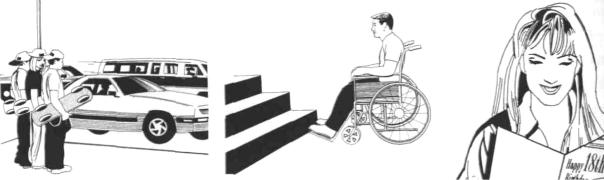
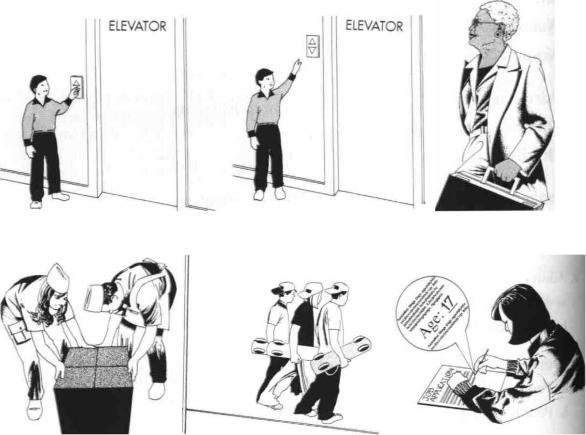
28.Match the pictures (pic. 3) with the sentences below.
a.The buttons are too high for him to reach.
b.The buttons are low enough.
c.The steps are too steep for him to get up.
d.The box is too heavy.
e.The street is too busy for them to cross.
f.The traffic is slow enough for them to cross.
g.She's too old to join the army.
h.She is too young to vote.
i.She is old enough to vote.
1 ________ |
2 ________ |
3 ________ |
20
4 ________ |
5 ________ |
6 ________ |
7 ________ |
8 ________ |
9 ________ |
Pic. 3
4.Discuss one of these questions. Then vote on your opinions.
•At what age should people start to vote?
•Should towns have curfews for people younger than age eighteen?
Example:
A:I think fifteen-year-olds are mature enough to vote. They can read newspapers and understand issues.
B:I disagree. I don't think fifteen-year-olds are concerned enough about politics to vote.
29. What do you think these expressions mean? When would you use them? Discuss your ideas in small groups.
She's old enough to know better.
Life is too short to worry about every little thing.
You're never too old to try.
It looks good enough to eat.
It’s too hot to handle.
21
30.Complete the following sentences. In small groups, compare your opinions.
1.Elderly people are too . . .
Example:
A: People over age seventy are too old to drive.
B: Oh, I don't agree. Some elderly people drive better than young people.
2.The leaders of this country are powerful enough . . .
3.Teenagers are too crazy . . .
4.Guns are too dangerous. . .
5.Taxes aren't high enough . . .
6.Women are strong enough . . .
7.Radio and TV broadcasters speak (or don't speak) clearly enough . . .
8.Time goes by too quickly . . .
31.What are your strategies for remembering names? Read this excerpt from a magazine article.
STOP FORGETTING
Marta wanted to go to the party. She's friendly and enjoys meeting people. But as Marta looked at the invitation, part of her kept saying, "I won't know anyone there! How will I remember all those new names?" Marta's problem is not unusual. Remembering names is a problem for many people. For international travelers like Marta (she's a Mexican student studying in the United States), it is even harder to recall unfamiliar foreign names. What can Marta and others like her do?
Here are some tips from memory experts:
Decide to remember. Making an effort can really help.
Listen carefully when you hear someone's name for the first time. It's important to pay attention.
Keep repeating the name. Calling the person by name more than once will help fix the name in your mind.
Write the name down. Putting things in writing is the most common
memory aid.
Don't hesitate to ask the person to repeat the name. Most people don't mind doing this.
And last, but not least,
Stop worrying. Anxiety only makes the problem worse.
32.Read the first sentence. Then decide if the second sentence is True (T) or
False (F).
1.Marta remembered meeting Mr. Jackson.
__ Marta has already met Mr. Jackson.
22