Материал: 2425

that after a few weeks you’ll be asking them to speak in their native tongue.
This may be hard for you to believe. You might be wondering how you’ll express yourself; how you’ll communicate with store clerks, teachers, classmates and your host family. Even if you’ve studied a foreign language in school, you won’t feel ready to live in that language. But when you’re surrounded by that language from morning till night, you learn the fastest way possible. It’s like a month of classes in a single day!
39. Is it true or false?
1.Universities, corporations and professionals, look unfavourably on students who have spent a school year abroad.
2.If you become an exchange student abroad, you will learn, learn and learn.
3.Tourists have much more opportunities than exchange students.
4.Teenagers all over the world are the same.
5.Host families want to learn about your culture and introduce you to theirs.
6.The fastest way to learn a foreign language is to live abroad.
40.Be ready to tell about advantages of being an exchange student. You may use the plan for your answer. All the other students have to prepare at least one question concerning this problem. Try to answer them.
41.Would you like your child to be an exchange student? Why?
42.Read the following article about GermanRussian relations and write out the events happened in the years pointed out:
1992
2003
October 2005
April 2005
2004/2005
108
The cultural cooperation agreement between the governments of the Federal Republic of Germany and the Russian Federation, which was signed on 16 December 1992, forms a contractual basis for cultural relations between the two countries.
With their extensive two-year programme, the 2003/2004 GermanRussian cultural exchanges under the patronage of the two countries’ presidents made an important and innovative contribution to deepening the relations between German and Russian society and has resulted in many ongoing contacts.
In foreign language teaching, German, though losing ground, occupies second place behind English. An intergovernmental agreement on learning the partner country’s language was concluded in 2003. There are currently some 12,000 young Russians studying at German universities. The agreement on cooperation in youth policy, which entered into force in October 2005 and is implemented through national coordination offices in Hamburg and Moscow, puts bilateral school and youth exchange on a broader footing.
In April 2005, the then Federal Chancellor Schröder and President Putin signed a Joint Declaration on a Strategic Partnership in Education, Research and Innovation aimed at stepping up bilateral cooperation in the education sector, particularly in training specialist and executive personnel. The Goethe Institute is active in many parts of Russia, above all in Moscow and St. Petersburg, where it has its own offices. Numerous other German cultural organizations are also represented. The restitution of German cultural property taken to Russia during the war is an issue that has yet to be settled.
The academic excellence of German universities and universities of applied sciences (Fachhochschulen) is convincing more and more “highpotentials” from all over the world. Almost 250,000 foreign students are currently registered at German universities – nearly 100,000 students more than 10 years ago. In the 2004/2005 academic year alone, the number of US citizens studying in Germany rose by 10%. A German university place is especially popular with students from China, Bulgaria, Poland and Russia.
www.magazine-deutschland.de
43. Find the answers in the text above:
1. What is the main idea of the article?
109
2.How many Russian students are currently enrolled at German Universities?
3.What are the signed declarations aimed at?
4.Is there the Goethe Institute in your city? Have you or your friends been there?
5.Do you have friends studying in Germany?
44. Work in two teams. One team will represent a German university, the other one will stand for the Russian university. Try to attract foreign students. The words below can help you:
culture language friends equipment experience independence
45.Use these words to complete the text:
a)higher education;
b)qualifications;
c)cutting-edge;
d)2010;
e)competitive;
f)graduate schools;
g)Bologna.
In the course of the “1) … process” institutions of 2) … will be replacing their Magister and Diplom courses with programmes leading to bachelor’s and master’s degrees by 3) … . Almost half of all the study programmes at German institutions of higher education have already been restructured. As a result, students’ 4) … can be more easily compared with those from other countries. The universities themselves are also taking up the 5) … challenge. The Federal Government and the individual Länder are making available 1.9 billion euros for the current Initiative for Excellence. This money will be used to support 6) … for young researchers, excellence clusters for 7) … research and the research profiles of up to ten selected elite universities.
110
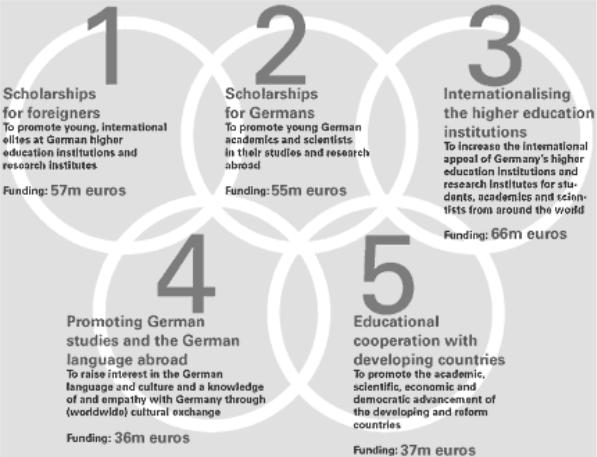
46. What do you know about DAAD?
Look at the chart below and say what DAAD programmes are aimed at.
DAAD
(The German Academic Exchange Service)
The great number and variety of DAAD programmes can be arranged into five strategic goals:
What programmes are best funded?
Which programme would you choose? Why?
111
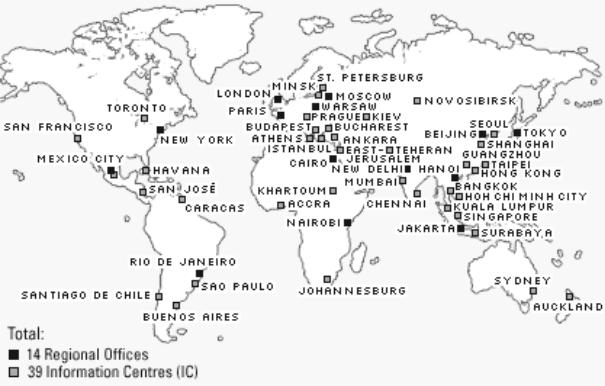
47. Look at the map below (pic.18) and say what countries and cities have regional offices and information centres of DAAD? What cities have you been to?
Pic. 18
48. Read the information about the German Academic Exchange Service then ask and answer questions using the following words:
Pronouns: what, where, how many; Nouns: representation, language; Verbs: perform, choose.
DAAD Head Office in Bonn is the "home" of the executive management and, so, is the hub for all national and international activities of the DAAD. Its representation in Berlin (DAAD’s second home base) performs important cultural, science, education and research policy functions.
The DAAD also has an extensive presence abroad. Its Regional Offices around the world maintain contacts with partners and create efficient communications channels, perform programme management responsibilities and provide support at local level: Beijing, Cairo, Hanoi, Jakarta, London, Mexico City, Moscow, Nairobi, New Delhi, New York, Paris, Rio de Janeiro, Tokyo, and Warsaw.
112