Материал: part10
DICOM PS3.10 2020a - Media Storage and File Format for Media Interchange |
Page 31 |
7 DICOM File Format
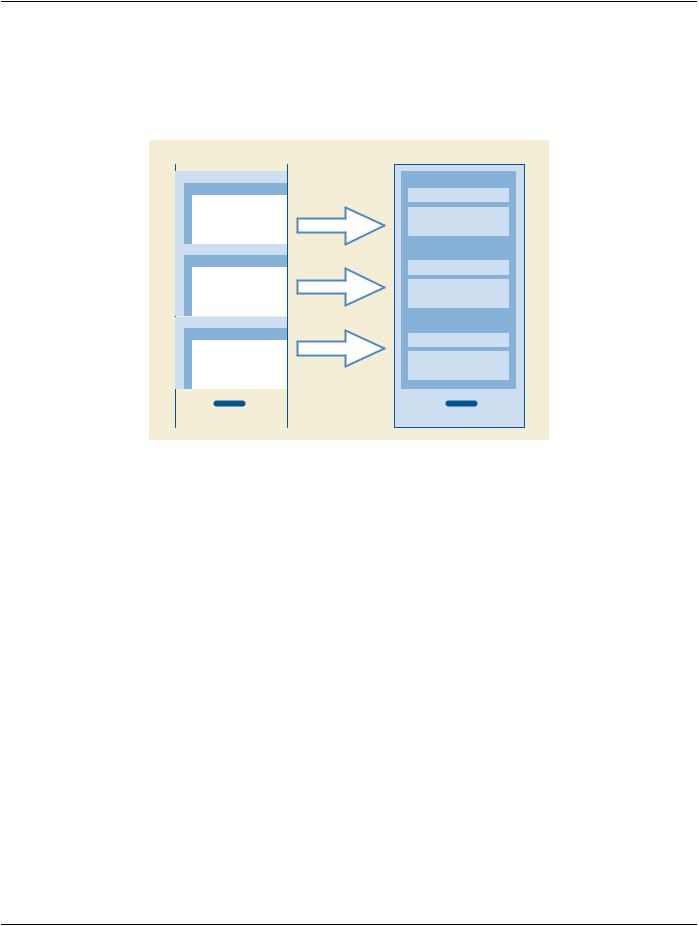
The DICOM File Format provides a means to encapsulate in a file the Data Set representing a SOP Instance related to a DICOM IOD. As shown in Figure 7-1, the byte stream of the Data Set is placed into the file after the DICOM File Meta Information. Each file contains a single SOP Instance.
|
|
|
File-set containing DICOM Formated Files |
||||
|
|
|
|
|
|
|
|
|
DICOM SOP Instance |
|
File containing one SOP Instance |
|
|||
|
|
|
|
|
|
|
|
|
|
|
|
|
DICOM File Meta Information |
|
|
|
|
|
DICOM Part 5 Encoding |
|
DICOM Data Set |
|
|
|
|
|
|||||
|
|
|
|
|
|
|
|
|
|
|
|
|
|
|
|
|
|
|
|
|
|
|
|
|
|
|
|
|
|
|
|
|
DICOM SOP Instance |
|
File containing one SOP Instance |
|
|||
|
|
|
|
|
|
|
|
|
|
|
DICOM Part 5 Encoding |
|
DICOM File Meta Information |
|
|
|
|
|
|
DICOM Data Set |
|
|
|
|
|
|
|
|
|
|
|
|
|
|
|
|
|
|
|
|
|
|
|
|
|
|
|
|
|
|
|
|
|
|
|
|
DICOM SOP Instance |
|
File containing one SOP Instance |
|
|||
|
|
|
DICOM Part 5 Encoding |
|
DICOM File Meta Information |
|
|
|
|
|
|
|
DICOM Data Set |
|
|
|
|
|
|||||
|
|
|
|
|
|
|
|
|
|
|
|
|
|
|
|
|
|
|
|
|
|
|
|
Figure 7-1. File-set and File Format
7.1 DICOM File Meta Information
The File Meta Information includes identifying information on the encapsulated Data Set. This header consists of a 128 byte File Preamble, followed by a 4 byte DICOM prefix, followed by the File Meta Elements shown in Table 7.1-1. This header shall be present in every DICOM file.
TheFilePreambleisavailableforuseasdefinedbyApplicationProfilesorspecificimplementations.ThisPartoftheDICOMStandard does not require any structure for this fixed size Preamble. It is not required to be structured as a DICOM Data Element with a Tag andaLength.ItisintendedtofacilitateaccesstotheimagesandotherdataintheDICOMfilebyprovidingcompatibilitywithanumber of commonly used computer image file formats. Whether or not the File Preamble contains information, the DICOM File content shall conform to the requirements of this Part and the Data Set shall conform to the SOP Class specified in the File Meta Information.
Note
1.If the File Preamble is not used by an Application Profile or a specific implementation, all 128 bytes shall be set to 00H. This is intended to facilitate the recognition that the Preamble is used when all 128 bytes are not set as specified above.
2.The File Preamble may for example contain information enabling a multi-media application to randomly access images storedinaDICOMDataSet.Thesamefilecanbeaccessedintwoways:byamulti-mediaapplicationusingthepreamble and by a DICOM Application that ignores the preamble.
ThefourbyteDICOMPrefixshallcontainthecharacterstring"DICM"encodedasuppercasecharactersoftheISO8859G0Character Repertoire. This four byte prefix is not structured as a DICOM Data Element with a Tag and a Length.
The Preamble and Prefix are followed by a set of DICOM Meta Elements with Tags and Lengths as defined in Table 7.1-1.
- Standard -

Page 32 DICOM PS3.10 2020a - Media Storage and File Format for Media Interchange
Table 7.1-1. DICOM File Meta Information
Attribute Name |
|
Tag |
Type |
Attribute Description |
File Preamble |
No Tag or Length |
1 A fixed 128 byte field available for Application Profile or implementation |
||
|
|
Fields |
specifieduse.IfnotusedbyanApplicationProfileoraspecificimplementation |
|
|
|
|
all bytes shall be set to 00H. |
|
|
|
|
File-set Readers or Updaters shall not rely on the content of this Preamble to |
|
|
|
|
determine that this File is or is not a DICOM File. |
|
DICOM Prefix |
No Tag or Length |
1 Four bytes containing the character string "DICM". This Prefix is intended to |
||
|
|
Fields |
be used to recognize that this File is or is not a DICOM File. |
|
File Meta Information |
|
(0002,0000) |
1 Number of bytes following this File Meta Element (end of the Value field) up |
|
Group Length |
|
|
toandincludingthelastFileMetaElementoftheGroup2FileMetaInformation |
|
File Meta Information |
|
(0002,0001) |
1 This is a two byte field where each bit identifies a version of this File Meta |
|
Version |
|
|
Information header. In version 1 the first byte value is 00H and the second |
|
|
|
|
value byte value is 01H. |
|
|
|
|
Implementations reading Files with Meta Information where this attribute has |
|
|
|
|
bit 0 (lsb) of the second byte set to 1 may interpret the File Meta Information |
|
|
|
|
as specified in this version of PS3.10. All other bits shall not be checked. |
|
|
|
|
|
Note |
|
|
|
|
Abitfieldwhereeachbitidentifiesaversion,allowsexplicitindication |
|
|
|
|
of the support of multiple previous versions. Future versions of the |
|
|
|
|
File Meta Information that can be read by version 1 readers will have |
|
|
|
|
bit 0 of the second byte set to 1 |
MediaStorageSOPClass |
(0002,0002) |
1 Uniquely identifies the SOP Class associated with the Data Set. SOP Class |
||
UID |
|
|
UIDs allowed for media storage are specified in PS3.4 - Media Storage |
|
|
|
|
Application Profiles. |
|
Media Storage SOP |
|
(0002,0003) |
1 Uniquely identifies the SOP Instance associated with the Data Set placed in |
|
Instance UID |
|
|
the file and following the File Meta Information. |
|
Transfer Syntax UID |
|
(0002,0010) |
1 Uniquely identifies the Transfer Syntax used to encode the following Data Set. |
|
|
|
|
This Transfer Syntax does not apply to the File Meta Information. |
|
|
|
|
|
Note |
|
|
|
|
It is recommended to use one of the DICOM Transfer Syntaxes |
|
|
|
|
supporting explicit Value Representation encoding to facilitate |
|
|
|
|
interpretation of File Meta Element Values. JPIP Referenced Pixel |
|
|
|
|
Data Transfer Syntaxes are not used (see PS3.5). |
ImplementationClassUID |
(0002,0012) |
1 Uniquely identifies the implementation that wrote this file and its content. It |
||
|
|
|
provides an unambiguous identification of the type of implementation that last |
|
|
|
|
wrote the file in the event of interchange problems. It follows the same policies |
|
|
|
|
as defined by PS3.7 (association negotiation). |
|
Implementation Version |
|
(0002,0013) |
3 Identifies a version for an Implementation Class UID (0002,0012) using up to |
|
Name |
|
|
16 characters of the repertoire identified in Section 8.5. It follows the same |
|
|
|
|
policies as defined by PS3.7 (association negotiation). |
|
- Standard -

DICOM PS3.10 2020a - Media Storage and File Format for Media Interchange |
Page 33 |
||||
Attribute Name |
Tag |
Type |
Attribute Description |
|
|
Source Application Entity |
(0002,0016) |
3 |
The DICOM Application Entity (AE) Title of the AE that wrote this file's content |
||
Title |
|
|
(or last updated it). If used, it allows the tracing of the source of errors in the |
||
|
|
|
event of media interchange problems. The policies associated with AE Titles |
||
|
|
|
are the same as those defined in PS3.8. |
|
|
|
|
|
|
Note |
|
|
|
|
|
If the Data Set was created de novo by the application writing the file, |
|
|
|
|
|
its AE Title, if it has one, may be used. If the Data Set was received |
|
|
|
|
|
over the network, there is potential ambiguity as to whether the value |
|
|
|
|
|
is the same as Sending Application Entity Title (0002,0017) or |
|
|
|
|
|
Receiving Application Entity Title (0002,0018) or some other value. |
|
SendingApplicationEntity |
(0002,0017) |
3 |
The DICOM Application Entity (AE) Title of the AE that sent this file's content |
||
Title |
|
|
over a network. |
|
|
|
|
|
|
Note |
|
|
|
|
|
This is the AE that was the sender (source) of the content (the Data |
|
|
|
|
|
Set), in the case of a Data Set sent over the network (i.e., the Calling |
|
|
|
|
|
AET of the SCU for a C-STORE operation). If the Data Set was |
|
|
|
|
|
instead created de novo by the application writing the file, it should |
|
|
|
|
|
not be present. |
|
Receiving Application |
(0002,0018) |
3 |
The DICOM Application Entity (AE) Title of the AE that received this file's |
||
Entity Title |
|
|
content over a network. |
|
|
|
|
|
|
Note |
|
|
|
|
|
This is the AE that was the recipient (destination) of the content (the |
|
|
|
|
|
Data Set), in the case of a Data Set received over the network (i.e., |
|
|
|
|
|
the Called AET of the SCP for a C-STORE operation). If the Data Set |
|
|
|
|
|
was instead created de novo by the application writing the file, it |
|
|
|
|
|
should not be present. |
|
Source Presentation |
(0002,0026) |
3 |
The DICOM Presentation Address corresponding to the Source Application |
||
Address |
|
|
Entity Title (0002,0016). |
|
|
|
|
|
See Section 7.1.1.1. |
|
|
Sending Presentation |
(0002,0027) |
3 |
The DICOM Presentation Address corresponding to the Sending Application |
||
Address |
|
|
Entity Title (0002,0017). |
|
|
|
|
|
See Section 7.1.1.1. |
|
|
Receiving Presentation |
(0002,0028) |
3 |
TheDICOMPresentationAddresscorrespondingtotheReceivingApplication |
||
Address |
|
|
Entity Title (0002,0018). |
|
|
|
|
|
See Section 7.1.1.1. |
|
|
Private Information |
(0002,0100) |
3 |
The UID of the creator of the private information (0002,0102). |
|
|
Creator UID |
|
|
|
|
|
Private Information |
(0002,0102) |
1C Contains Private Information placed in the File Meta Information. The creator |
|||
|
|
|
shall be identified in (0002,0100). Required if Private Information Creator UID |
||
|
|
|
(0002,0100) is present. |
|
|
Except for the 128 byte preamble and the 4 byte prefix, the File Meta Information shall be encoded using the Explicit VR Little Endian Transfer Syntax (UID=1.2.840.10008.1.2.1) as defined in DICOM PS3.5. Values of each File Meta Element shall be padded when necessary to achieve an even length, as specified in PS3.5 by their corresponding Value Representation. The Unknown (UN) Value Representation shall not be used in the File Meta Information. For compatibility with future versions of this Standard, any Tag (0002,xxxx) not defined in Table 7.1-1 shall be ignored.
- Standard -

Page 34 |
DICOM PS3.10 2020a - Media Storage and File Format for Media Interchange |
Values of all Tags (0002,xxxx) are reserved for use by this Standard and later versions of DICOM. Data Elements with a group of 0002 shall not be used in Data Sets other than within the File Meta Information.
Note
PS3.5 specifies that Elements with Tags (0001,xxxx), (0003,xxxx), (0005,xxxx), and (0007,xxxx) shall not be used.
7.1.1 DICOM File Meta Information Attributes
7.1.1.1 Presentation Address Attributes
The encoding of the presentation address depends on the network transport protocol.
For objects exchanged using the PS3.8 DICOM Upper Layer Protocol for TCP/IP, the presentation address shall be encoded as a URI consisting of the scheme "dicom" followed by a colon, then either the fully qualified host name or IP address, followed by a colon and then the port number. E.g., "dicom:127.0.0.1:104", "dicom:myhost.mydomain.com:104".
ForobjectsexchangedusingthePS3.18WebServices,thepresentationaddressshallbeencodedastheabsoluteURLoftheendpoint of the base of the resource or service, sufficient to identify the system. E.g., "http://myhost.mydomain.com:80/wado-rs/". The presentation address is not expected to be the complete address of the resource. The scheme shall be "http", regardless of whether secure transport was actually used or not.
Note
For security reasons, care should be taken to assure that no access credentials such as usernames, passwords or authen- tication token parameters are encoded in the presentation address.
7.2 Data Set Encapsulation
Each File shall contain a single Data Set representing a single SOP Instance related to a single SOP Class (and corresponding IOD).
Note
A file may contain more than a single 2D image frame as specific IODs may be defined to include multiple frames.
The Transfer Syntax used to encode the Data Set shall be the one identified by the Transfer Syntax UID of the DICOM File Meta In- formation.
Note
1.The Transfer Syntax used to encode the Data Set cannot be changed within the Data Set; i.e., the Transfer Syntax UID Data Element may not occur anywhere within the Data Set, e.g., nested within a Sequence Item.
2.A DICOM Data Set does not include its total length. The end of the file indication provided by the DICOM File Service (see Section 8.4) is the only indication of the end of the Data Set.
The last Data Element of a Data Set may be Data Element (FFFC,FFFC) if padding of a Data Set is desired when a file is written. The Value of this Data Set Trailing Padding Data Element (FFFC,FFFC) has no significance and shall be ignored by all DICOM im- plementationsreadingthisDataSet.File-setReadersorUpdatersshallbeabletoprocessthisDataSetTrailingPadding(FFFC,FFFC) either in the Data Set following the Meta Information or in Data Sets nested in a Sequence (see PS3.5).
7.3 Support of File Management Information
The DICOM File Format does not include file management information in order to avoid duplication with functions related to the Media Format Layer. If necessary for a given DICOM Application Profile, the following information should be offered by the Media Format Layer:
a.File content owner identification;
b.File access statistics (e.g., date and time of creation);
- Standard -

DICOM PS3.10 2020a - Media Storage and File Format for Media Interchange |
Page 35 |
c.Application file access control;
d.Physical media access control (e.g., write protect).
7.4 Secure DICOM File Format
ASecureDICOMFileshallcontainasingleDICOMFileencapsulatedwiththeCryptographicMessageSyntaxasdefinedinRFC3369. Depending on the cryptographic algorithms used for encapsulation, a Secure DICOM File can provide one or more the following se- curity properties:
•Data Confidentiality (by means of encryption)
•Data Origin Authentication (by means of certificates and digital signatures)
•Data Integrity (by means of digital signatures)
In addition, a Secure DICOM File offers the possibility to communicate encryption keys and certificates to the intended recipients by means of key transport, key agreement or symmetric key-encryption key schemes.
7.5 Security Considerations for DICOM File Format
TheDICOMFileFormathasapotentialsecurityvulnerabilitywhenthe128-byteFilePreamblecontainsmaliciousexecutablecontent. Such malicious executable content may also refer to other malicious content in the file hidden within Data Elements of the File Meta Information or the Data Set.
Depending upon the use and purpose of a particular application it may be appropriate to:
•Sanitize the preamble, such as by:
•Verifying that the preamble is:
•all zeroes, or
•begins with a valid magic number for recognized dual format content (e.g., TIFF or BigTIFF), or
•contains other known safe content.
•Clearing the preamble regardless of its content
Note
This will prevent use by applications that depend on the non-DICOM format, if the dual format capability has been used.
•Testing explicitly for executable preamble contents.
Note
The proper response to the presence of executable content depends upon the purpose of the application, but generally, legitimate executable content will not be found in a DICOM File. A hypothetical example of an exception would be if the file contained its own executable viewer; this is sufficiently unlikely as to be not worth considering.
•Test explicitly for executable content anywhere within the DICOM File.
•Validate that the DICOM values, structures and content comply with the standard encoding rules and the IOD of the specified SOP Class, including Private Data Elements.
Note
Validation that Data Element Values comply with their Value Representation may partially mitigate the risk of hidden ma- licious content, but it may be necessary to remove or analyze the contents of opaque binary data in OB or other binary numeric value Data Elements, whether they be Standard or Private Data Elements. The VR of Private Data Elements may not be known. Without an executable preamble, such hidden content may not be directly executable, but may still serve as a repository of malicious code to be activated by some other accompanying exploit.
- Standard -