Материал: part03

Внимание! Если размещение файла нарушает Ваши авторские права, то обязательно сообщите нам

Page 1466​

DICOM PS3.3 2020a - Information Object Definitions​

•​Local Codes​

Reason for Requested Procedure Code Sequence (0040,100A):​

•​SNOMED codes​

•​ICD-9-CM​

•​ICD-10-CM​

•​Local Codes​

C.23.1.1.2 Image Sets Sequence​

The Image Sets Sequence (0072,0020) within a Hanging Protocol Instance serves to identify the type of image or other object sets​ to which the Hanging Protocol is intended to apply. Multiple types of image sets may be identified for a Hanging Protocol, to combine,​ for example, multiple imaging Studies for a specific anatomy, or multiple imaging Studies performed over a period of time, to monitor​ the progress of a condition. All image sets shall be for the same patient.​

The images to be included in an Image Set may be specified directly by matching Attribute values within the images, or indirectly​ through Key Object Selection Documents or Presentation States by matching their Attribute values.​

Key Object Selection Documents shall be matched by their SOP Class UID. The available Key Object Selection Documents may be​ further matched on the values of their other Attributes (e.g., Concept Name Code Sequence, Coding Scheme Designator = "DCM"​ and Code Value = "113003", which has a code meaning of "For Surgery"). When the Hanging Protocol Instance is applied, the image​ object instances referenced by the matching Key Object Selection Document instances comprise the image set.​

Presentation States shall be matched by their SOP Class UID. The available Presentation States may be further matched on the​ values of their other Attributes (e.g., Content Label). When the Hanging Protocol Instance is applied, the image object instances ref-​ erenced by the matching Presentation State instances comprise the image set.​

Note​

Image Sets Sequence (0072,0020) allows other objects such as waveforms and SR documents to be identified. However,​ Hanging Protocol Display Module operations such as filtering, reformatting, and sorting are defined only for image objects.​ The only expectation for non-image objects is to associate the objects with a position on a screen.​

Each Item in the Image Sets Sequence (0072,0020) shall follow these rules:​

•​Each Item in the Time Based Image Sets Sequence (0072,0030) shall identify one image set, based on time criteria.​

•​The Items of the Image Set Selector Sequence (0072,0022) shall collectively identify one type of image set.​

•​One instance of time based criteria combined with the Items of the Image Set Selector Sequence (0072,0022) shall identify one​ image set.​

•​The number of image sets identified by an Item of the Image Sets Sequence (0072,0020) shall equal the number of Items in the​ Time Based Image Sets Sequence (0072,0030).​

•​The value of Image Set Number (0072,0032) in each Time Based Image Sets Sequence (0072,0030) Item shall be unique across​ all Items of the Image Sets Sequence (0072,0020).​

Note​

1.​TheidentificationofacurrentimagesetisestablishedbytheapplicationpriortoselectionofaHangingProtocolInstance.​ The current image set is not necessarily from a single Study.​

2.​In mammography screening, for example, the Hanging Protocol defines the current image set plus the screening image​ set for the patient from the year prior. There would be one Item in the Image Sets Sequence (0072,0020). Within this​ Item, the Items of the Image Set Selector Sequence (0072,0022) would identify a mammography screening image set​ type. The Time Based Image Sets Sequence (0072,0030) would have two Items, one to identify the current, and one​ to identify the prior.​

- Standard -​

DICOM PS3.3 2020a - Information Object Definitions​

Page 1467​

C.23.1.1.3 Image Set Selector Sequence Attributes​

The Image Set Selector Sequence (0072,0022) contains Items that specify the DICOM Attribute Data Element Tags and values that​ shall be used to identify the image or other object set.​

The Image Set Selector Usage Flag (0072,0024) indicates whether the Attribute identified by Selector Attribute (0072,0026) causes​ matching to succeed or fail if the Attribute is not available in an image object.​

Within an Item, Selector Attribute (0072,0026) identifies a DICOM Attribute Data Element Tag that is likely to be present in image or​ other object instances that are desired for the Image Set. If it is a multi-valued Attribute, the Selector Value Number (0072,0028) in-​ dicates which value is intended to be used for matching. The Selector Attribute VR (0072,0050) identifies the Value Representation​ of Selector Attribute (0072,0026). The value of Selector Attribute VR (0072,0050) determines which Attribute of the Hanging Protocol​ Selector Attribute Value Macro is required to specify one or more desired values for the DICOM Attribute. If more than one value is​ specified for the Attribute, or more than one Item is specified in the Selector Code Sequence Value (0072,0080), then image object​ instances with a corresponding Attribute that matches any one of the values shall be included in the Image Set.​

Note​

The values used for Selector Attribute (0072,0026) are intended to identify a type of image set via the general categories of​ modality, anatomy, procedure intent and/or reason. Therefore the values of the Attributes represented by Selector Attribute​ (0072,0026) are likely to be coded terms, Enumerated Values, Defined Terms or free text. The use of free text Attributes is​ less desirable, because their values are less predictable for matching.​

In an image object, some Attributes occur at the top level, or nested within a Sequence or Functional Group Sequence, or both. In​ addition, a Private Attribute may be identified as a Selector Attribute (0072,0026). The Attributes of the Hanging Protocol Selector​ AttributeContextMacroidentifyaSequence,FunctionalGroupSequence,orPrivateGroupcontextforSelectorAttribute(0072,0026).​

The creator of a Hanging Protocol Instance uses this collection of Attributes to identify one type of image set to which the Hanging​ Protocol is intended to apply. The user of a Hanging Protocol Instance (e.g., softcopy review workstation or pre-fetching application)​ uses this collection of Attributes to match a specific image set to a Hanging Protocol, and/or to determine which image sets need to​ be retrieved in order to use a Hanging Protocol Instance. The Key Attributes to match against to obtain image sets are specified in​ Selector Attribute (0072,0026) and its context in each Sequence Item.​

If the value of the Attribute represented by Selector Attribute (0072,0026) contains a free text description (i.e., Selector Attribute VR​ =LO,SH,ST,LT,UT),whetherexactorpartialmatchingisusedtoidentifyaspecificimageinstancewhenapplyingaHangingProtocol​ Instance is implementation dependent.​

C.23.2 Hanging Protocol Environment Module​

Table C.23.2-1 specifies the Attributes that describe and identify the best suited display environment for a Hanging Protocol.​

Differentviewingstylesandinteractionsmaybedefineddependingonaworkstation'scapabilities.Forexample,thehangingpreferences​ for viewing a screening mammogram Study on a 1Kx1K screen with a 10 second repaint time versus a 2Kx2.5K screen may differ.​

Note​

1.​The term Screen is intended to include all types of display devices (e.g., CRT, LCD, etc.).​

2.​This information may be used by an application to select a subset of the available screens on which to apply a Hanging​ Protocol.​

Table C.23.2-1. Hanging Protocol Environment Module Attributes​

Attribute Name​

Tag​

Type​

Attribute Description​

Number of Screens​

(0072,0100)​

2​

Positive integer indicating the number of screens for​


which this Hanging Protocol is intended.​

Nominal Screen Definition​

(0072,0102)​

2​

Sequence that describes the set of screens for which​

Sequence​


this Hanging Protocol is intended.​

ZeroormoreItemsshallbeincludedinthisSequence.​

- Standard -​

Page 1468​

DICOM PS3.3 2020a - Information Object Definitions​

Attribute Name​

Tag​


Type​

Attribute Description​

>Include Table C.23.2-2 “Screen Specifications Macro Attributes”​


Table C.23.2-2. Screen Specifications Macro Attributes​

Attribute Name​

Tag​

Type​


Attribute Description​

Number of Vertical Pixels​

(0072,0104)​

1​

Positive integer indicating the intended number of rows of the​


addressable area of the screen in pixels.​


Note​


The goal is not absolute size matching.​

Number of Horizontal Pixels​

(0072,0106)​

1​

Positive integer indicating the intended number of columns of the​


addressable area of the screen in pixels.​


Note​


The goal is not absolute size matching.​

Display Environment Spatial​

(0072,0108)​

1​

Exactlyfourdimensionlessfloatingpointvaluesindicatingtherectangular​

Position​


coordinate position of the screen within the overall bounding box that​


encompasses all the screens. See Section C.23.2.1.1.​

Screen Minimum Grayscale​

(0072,010A)​

1C​

Positive integer indicating the desired minimum number of grayscale​

Bit Depth​


bits per pixel of the screen.​


RequiredifScreenMinimumColorBitDepth(0072,010C)isnotpresent.​

Screen Minimum Color Bit​

(0072,010C)​

1C​

Positive integer indicating the desired minimum total number of bits per​

Depth​


color channel used to present a pixel.​


Required if Screen Minimum Grayscale Bit Depth (0072,010A) is not​


present.​


Note​


A 24-bit color system with 8 bits per color channel (red, green,​


blue) would have a value of 8.​

ApplicationMaximumRepaint​

(0072,010E)​

3​

Positive integer indicating the desired maximum time in milliseconds​

Time​


requiredbytheapplicationtorepaintthefullscreenonce(i.e.,recalculate​

all pixels and paint them to the screen).​ Note​

This is not the screen refresh time.​

C.23.2.1 Hanging Protocol Environment Attribute Descriptions​

C.23.2.1.1 Display Environment Spatial Position​

For the Display Environment Spatial Position (0072,0108) Attribute, the lower left corner of the overall bounding box has Cartesian​ coordinates of (0.0,0.0). The upper right corner has coordinates of (1.0,1.0). The scale of the box is based on the Number of Vertical​ Pixels (0072,0104) and Number of Horizontal Pixels (0072,0106), not the physical size of the screens that are part of the workstation.​ The coordinates of each individual screen's box are defined in absolute coordinates relative to the (0,0) and (1,1) range of the overall​ box. Position of a box is given by a (x1,y1), (x2,y2) pair that identifies the upper left corner and lower right corner if the box is rectan-​ gular.​

Note​

The goal is not absolute position matching of the image boxes rendered on the screens using Hanging Protocol layout in-​ formation, but that the relative positioning of the image boxes should be consistent between different workstations.​

- Standard -​

DICOM PS3.3 2020a - Information Object Definitions​

Page 1469​

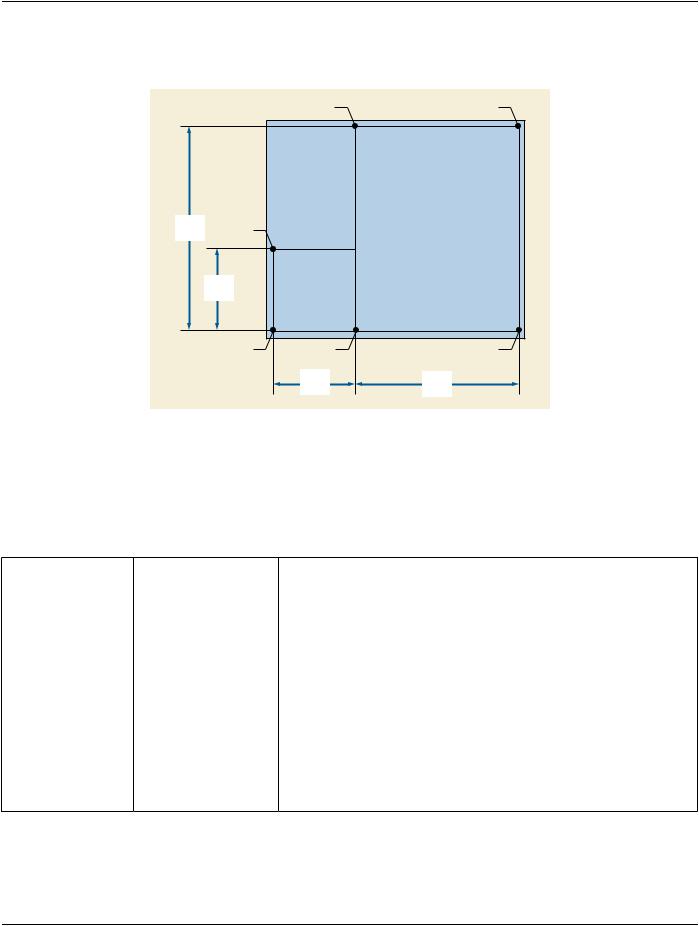
Figure C.23.2-1 depicts a 1K x 1K screen positioned to the left of a 2K x 2.5K screen. The Display Environment Spatial Position​ (0072,0108) of the 1K x 1K screen is (0.0,0.4) (0.33,0.0), and the Display Environment Spatial Position (0072,0108) of the 2K x 2.5K​ screen is (0.33,1.0) (1.0,0.0).​

(0.33, 1.0)

(1.0, 1.0)

2560

pixels (0.0, 0.4)

1024 pixels

(0.0, 0.0)

(0.33, 0.0)

1024

pixels

(1.0, 0.0)

2048

pixels

Figure C.23.2-1. Example Hanging Protocol Screen Environment​

C.23.3 Hanging Protocol Display Module​

Table C.23.3-1 specifies the Attributes that describe operations (filter, reformat, sort, presentation intent), layout and interactions for​ a Hanging Protocol. See Annex V “Hanging Protocols (Informative)” in PS3.17 for further explanation.​

Table C.23.3-1. Hanging Protocol Display Module Attributes​

Attribute Name​

Tag​

Type​

Attribute Description​

Display Sets Sequence​

(0072,0200)​

1​ Sequence that describes one or more display sets used to present the Image​


Sets defined in the Image Sets Sequence (0072,0020).​


One or more Items shall be included in this Sequence.​


See Section C.23.3.1.​

>Display Set Number​

(0072,0202)​

1​ A monotonically increasing integer, starting from 1, incrementing by 1, unique​


within the Hanging Protocol Instance. It shall be used to identify linked display​


sets in the Display Set Scrolling Group (0072,0212).​

>Display Set Label​

(0072,0203)​

3​ Description of the objective of the display set defined by this Sequence Item.​

>Display Set​

(0072,0204)​

1​ Positive integer value that designates this Display Set as part of a specific​

Presentation Group​


presentation group. All Display Sets with the same Display Set Presentation​


Group (0072,0204) value shall be displayed at the same time. The value 1 shall​


indicatethatthisDisplaySetispartoftheinitialpresentationgroup.Subsequent​


values incrementing by 1 shall imply successive temporal ordering of display.​

- Standard -​

Page 1470​

DICOM PS3.3 2020a - Information Object Definitions​

Attribute Name​

Tag​

Type​


Attribute Description​

>Image Set Number​

(0072,0032)​

1​

ImageSetNumber(0072,0032)valuefromaTimeBasedImageSetsSequence​


(0072,0030) Item within the Image Sets Sequence (0072,0020) Item that is​


selected for display by this Display Set.​


Note​


Multiple Image Boxes Sequence (0072,0300) Items within a Display​


Sets Sequence (0072,0200) Item may be used to spread one image​


setovermultipleimageboxeswiththesameDisplaySetcharacteristics.​

>Image Boxes​

(0072,0300)​

1​

Sequence that defines the image boxes for this Display Set.​

Sequence​


Only a single Item shall be included in this Sequence unless Image Box Layout​


Type (0072,0304) is TILED, in which case one or more Items shall be included​


in this Sequence.​

>>Image Box Number​

(0072,0302)​

1​

A monotonically increasing integer that identifies the order of image boxes for​


scrolling, starting from 1, incrementing by 1, unique within a Display Sets​


Sequence (0072,0200) Item.​

>>Display Environment​

(0072,0108)​

1​

Exactly four unitless floating point values indicating the rectangular coordinate​

Spatial Position​


position of the image box within the overall bounding box that encompasses all​


the display space (across all screens). See Section C.23.2.1.1.​

>>Image Box Layout​

(0072,0304)​

1​

Type of layout of the image box.​

Type​


All types except for TILED are single rectangles containing a single frame of​


image pixel data. The types are primarily distinguished by their interaction​


technique.​


Defined Terms:​


TILED​

a scrollable array of rectangles, each containing a single frame​


of image pixel data.​


STACK​

a single rectangle containing a steppable single frame, intended​


for user-controlled stepping through the image set, usually via​


continuous device interaction (e.g., mouse scrolling) or by single​


stepping (mouse or button click).​


CINE​

a single rectangle, intended for video type play back where the​


user controls are play sequence, rate of play, and direction.​


PROCESSED​intended for interactive 3D visualizations that have custom​


interfaces.​


SINGLE​ a single rectangle, intended for images and objects with no​


defined methods of interaction.​


Note​


Thisvaluemayalsobeusedfornon-imageobjects,suchaswaveforms​


and SR documents.​

>>Image Box Tile​

(0072,0306)​

1C​

Positive integer defining the horizontal Image Box tile dimension; the number​

Horizontal Dimension​


of columns.​


Required if the value of Image Box Layout Type (0072,0304) is TILED.​

>>Image Box Tile​

(0072,0308)​

1C​

Positive integer defining the vertical Image Box tile dimension; the number of​

Vertical Dimension​


rows.​


Required if the value of Image Box Layout Type (0072,0304) is TILED.​

- Standard -​