Материал: part03

Внимание! Если размещение файла нарушает Ваши авторские права, то обязательно сообщите нам

Page 586​

DICOM PS3.3 2020a - Information Object Definitions​

3.​An example of an Attribute that might be included in the Unassigned Shared Converted Attributes Macro is Series​ Number (0020,0011), which typically would be the same for all Classic CT images in a set (but is not required to be),​ and will be replaced with a different value in the top-level Data Set, and hence if the original is to be preserved, needs​ to be recorded.​

4.​An example of an Attribute that might be included in the Unassigned Per-Frame Converted Attributes Macro is Instance​ Number (0020,0013), which typically would be different for each Classic CT image in a set, and will be replaced with a​ different value in the top-level Data Set, and hence if the original is to be preserved, needs to be recorded.​

5.​The UIDs of the converted instances are recorded in the Conversion Source Attributes Sequence, and are not included​ in the Unassigned Shared and Per-Frame Converted Attributes Macros.​

For the purpose of comparing values, an Attribute that is not present in a Classic image to be converted is considered the same as​ an Attribute that is present but has no value. Sequence Attributes match when they have the same number of Items and Item contents​ in the same order (irrespective of whether the Sequences or Items are encoded with fixed or variable length).​

The Unassigned Shared Converted Attributes Sequence, and the Unassigned Per-Frame Converted Attributes Sequence may be​ absent, if there are no such Attributes available to be included. E.g., there may be no shared Attributes with the same values, all the​ shared Attributes may be included in the top-level Data Set, there may be no Attributes that vary per-frame or an individual frame​ may have no such Attribute.​

ThenecessaryPrivateCreatorDataElementwithineachSequenceItemaccompaniesPrivateDataElements.Thereisnorequirement​ to preserve the private block of Data Elements used in the Classic images to be converted. Nor is there a requirement that a Private​ Data Element use the same private block in all of the Classic images.​

Matching of Private Attribute Values for the purpose of determining whether they are shared or per-frame may be performed using​ the equivalent meaning if the Value Representation is Explicit and not UN, or known through other means, otherwise, byte matching​ of the UN VR shall be performed.​

C.7.6.16.2.25.1 Unassigned Shared Converted Attributes Macro​

Table C.7.6.16.2.25.1-1 specifies the Attributes of the Unassigned Shared Converted Attributes Functional Group Macro.​

Table C.7.6.16.2.25.1-1. Unassigned Shared Converted Attributes Macro Attributes​

Attribute Name​

Tag​

Type​

Attribute Description​

Unassigned Shared Converted​(0020,9170)​

1C​

Contains all of the Standard and Private Attributes that are present in​

Attributes Sequence​


all of the converted Classic images, that have the same number of​

values,thathavethesamevalues,andthatarenotinthetop-levelData​ Set.​

Only a single Item shall be included in this Sequence.​

Required if any unassigned shared Attributes are present.​

C.7.6.16.2.25.2 Unassigned Per-Frame Converted Attributes Macro​

Table C.7.6.16.2.25.2-1 specifies the Attributes of the Unassigned Per-Frame Converted Attributes Functional Group Macro.​

Table C.7.6.16.2.25.2-1. Unassigned Per-Frame Converted Attributes Macro Attributes​

Attribute Name​

Tag​

Type​

Attribute Description​

Unassigned Per-Frame​

(0020,9171)​

1C​

Contains all of the Standard and Private Attributes that are present in​

Converted Attributes Sequence​


only some of the converted Classic images, or that have a different​


number of values, or that have different values.​


Only a single Item shall be included in this Sequence.​


Required if any unassigned per-frame Attributes are present for this​


frame.​

- Standard -​

DICOM PS3.3 2020a - Information Object Definitions​

Page 587​

C.7.6.16.2.25.3 Image Frame Conversion Source Macro​

Table C.7.6.16.2.25.2-1 specifies the Attributes of the Image Frame Conversion Source Functional Group Macro.​

Table C.7.6.16.2.25.3-1. Image Frame Conversion Source Macro Attributes​

Attribute Name​

Tag​

Type​

Attribute Description​

Conversion Source Attributes​

(0020,9172)​

1​

TheimageorothercompositeSOPInstancethat​

Sequence​


was converted to this frame.​

Only a single Item shall be included in this​ Sequence.​

>Include Table 10-3 “Image SOP Instance Reference Macro Attributes”​
C.7.6.16.2.26 Stored Value Color Range Macro​

Table C.7.6.16.2.26-1 defines the Attributes of the Stored Value Color Range Functional Group Macro​

Table C.7.6.16.2.26-1. Stored Value Color Range Macro Attributes​

Attribute Name​

Tag​

Type​

Attribute Description​

StoredValueColorRangeSequence​

(0028,1230)​

1​ Specifies the range of stored pixel values of this frame​


mapped using the Palette Color LUT.​


Only a single Item shall be included in this Sequence.​

>Minimum Stored Value Mapped​

(0028,1231)​

1​ Minimum Stored Value to map. See​


Section C.7.6.16.2.26.1.​

>Maximum Stored Value Mapped​

(0028,1232)​

1​ Maximum Stored Value to map. See​


Section C.7.6.16.2.26.1.​

C.7.6.16.2.26.1 Stored Value Color Range Macro Attributes Description​

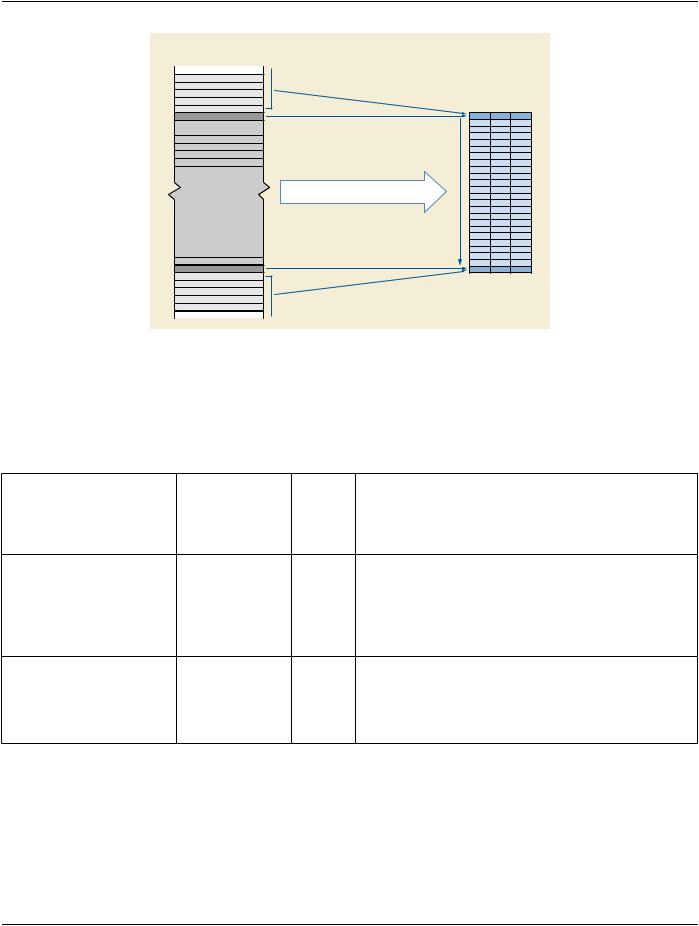
The voxel values of the Parametric Map shall be mapped to RGB values using the following transformation.​

All values smaller than Minimum Stored Value Mapped (0028,1231) shall be treated as equal to this minimum value.​

All values larger than Maximum Stored Value Mapped (0028,1232) shall be treated as equal to this maximum value.​


The values between Minimum Stored Value Mapped (0028,1231) and Maximum Stored Value Mapped (0028,1232) shall be mapped​ to the Palette Color LUT using a linear interpolation function.​

Note​

The Palette Color LUT can be segmented and interpolation needs to accommodate the segmentation.​

In case of floating point mapping the second value of the Palette Color Lookup Table Descriptor is not used in the mapping as the​ Minimum Stored Value Mapped (0028,1231) is used as start value for the LUT values.​

- Standard -​

Page 588​

DICOM PS3.3 2020a - Information Object Definitions​

Stored Values (floats/doubles)

Color LUT

R G B

Minimum Stored Value Mapped (0028,1231)

Palette Color

Number of Entries

. . .

Mapping from Float to LUT via

Linear Interpolation by application


Maximum Stored Value Mapped (0028,1232)

Figure C.7.6.16.2.26.2-1. Stored Value Color Range​

C.7.6.16.2.27 Frame Usefulness Macro​

Table C.7.6.16.2.27-1 specifies the Attributes of the Frame Usefulness Functional Group Macro, related to the clinical usefulness of​ the current frame.​

Table C.7.6.16.2.27-1. Frame Usefulness Functional Group Macro Attributes​

Attribute Name​

Tag​

Type​

Attribute Description​

Frame Usefulness Group​

(0034,0009)​

1​ Sequence that contains the Functional Groups Sequence​

Sequence​


Attributes corresponding to the current frame or audio sample.​


Only a single Item shall be included in this Sequence.​

>Includes Information​

(0034,000C)​

3​ Whether or not the current frame includes useful information, i.e.​


not noise nor void​


Enumerated Values:​


YES​


NO​

>Includes Imaging Subject​

(0034,0008)​

3​ Whether or not the current frame includes the imaging subject.​

Enumerated Values:​

YES​

NO​

C.7.6.16.2.28 Camera Position Macro​

Table C.7.6.16.2.28-1 specifies the Attributes of the Camera Position Functional Group Macro, related to the position of the camera​ or the acquisition device for the current frame, with regards to the patient.​

- Standard -​

DICOM PS3.3 2020a - Information Object Definitions​ Page 589​

Table C.7.6.16.2.28-1. Camera Position Functional Group Macro Attributes​

Attribute Name​

Tag​

Type​

Attribute Description​

Camera Position Group​

(0034,000B)​

1​ Sequence that contains the Functional Groups Sequence Attributes​

Sequence​


corresponding to the current frame or audio sample.​


Only a single Item shall be included in this Sequence.​

>Render Projection​

(0070,1602)​

1​

Projection style.​


Enumerated Values:​


PERSPECTIVE​

>Viewpoint Position​

(0070,1603)​

1​ Position of the viewpoint in volume space.​


Apoint(x,y,z)intheFrameReferenceCoordinateSystemreferenced​


in the Frame of Reference Module.​

>Viewpoint LookAt Point​

(0070,1604)​

1​ Point the viewpoint is looking at.​


Apoint(x,y,z)intheFrameReferenceCoordinateSystemreferenced​


in the Frame of Reference Module.​

>Viewpoint Up Direction​

(0070,1605)​

1​ Vertical orientation of the view.​


A vector (x,y,z) in the Frame Reference Coordinate System​


referenced in the Frame of Reference Module.​

>Render Field of View​

(0070,1606)​

1​ The field of view specified as a 6-tuple of values (X left, X right, Y top,​


Y bottom, Distance near, Distance far) in the Viewpoint Coordinate​


System, in mm.​

See Section C.11.30.1.​

C.7.6.16.2.29 Time of Frame Macro​

Table C.7.6.16.2.29-1 specifies the Attributes of the Time of Frame Functional Group Macro, related to the time of frame.​

Table C.7.6.16.2.29-1. Time of Frame Functional Group Macro Attributes​

Attribute Name​

Tag​

Type​

Attribute Description​

Time of Frame Group Sequence​

(0034,000D)​

1​

Time characteristics of the current frame or audio sample.​


Only a single Item shall be included in this Sequence.​

>Frame Origin Timestamp​

(0034,0007)​

1​

This timestamp contains the capture time of the payload​


content for this frame or audio sample. It is in TAI, not UTC.​

C.7.6.17 Multi-frame Dimension Module​

The Multi-frame Dimension Module contains a Sequence with Items pointing to Attributes defining a set of dimensions that are usually​ known prior to the acquisition commencing. It is up to the generating applications to decide what Attributes are important to describe​ the multi-frame dimensions.​

The application that generates the Concatenation or SOP Instances may use the order of Dimension Index Pointers (0020,9165) in​ the Dimension Index Sequence (0020,9222) to guide the receiving application in determining the order of the presentation of image​ frames. The first index has the highest ranking, the next index has a lower ranking, etc. Frames with higher values for the dimension​ with the highest ranking would only be presented after all frames that have values for Dimension Index Pointers (0020,9165) of the​ lower rankings have been presented.​

If the set of Dimension Index Pointers does not provide an Attribute set whose values are unique for each frame then the order for​ the frames with the same value set will be incompletely specified. The receiving application could use the logical frame number to​

- Standard -​

Page 590​

DICOM PS3.3 2020a - Information Object Definitions​

resolve this ambiguity. If the Attribute set contains more dimensions than are needed to specify a unique ordering, the lower order​ ranking Attribute(s) will have no effect on the ordering.​

Note​

For example if there were the following indices in the following order:​

•​Stack ID (1-3)​

•​In-stack Position Number (1-2 for Stack ID 1, 1-4 for Stack ID 2, 1-3 for Stack ID 3)​

•​Effective Echo Time (1-2), i.e., every slice has been scanned with 2 different effective echo's​

Then the frames could be presented in the following order:​

(Stack ID, In-stack Position, Effective Echo Time)​

(1,1,1), (1,1,2), (1,2,1), (1,2,2),​

(2,1,1), (2,1,2), (2,2,1), (2,2,2), (2,3,1), (2,3,2), (2,4,1), (2,4,2)​

(3,1,1), (3,1,2), (3,2,1), (3,2,2), (3,3,1), (3,3,2)​

The actual order of the frames in the object is up to the generating application.​

If the effective echo time was not included in the Dimension Index Pointers in the above example then the order of sorting​ for the frames with the same indices will be undefined - in this case there would be 2 frames with the index set (Stack ID,​ In-stack Position) = (1,1) and the order of these frames is not specified.​

If there were another Attribute appended to the Dimension Index Pointers, for example TR, then the TR index would not be​ usedindeterminingtheorderoftheframes.SotheIndexFramePointerswouldcontain(StackID,In-stackPosition,Effective​ Echo Time, TR) but the TR index would be irrelevant for frame ordering purposes.​

Table C.7.6.17-1 specifies the Attributes of the Multi-frame Dimension Module.​

Table C.7.6.17-1. Multi-frame Dimension Module Attributes​

Attribute Name​

Tag​

Type​

Attribute Description​

Dimension Organization​

(0020,9221)​

1​ Sequence that lists the Dimension Organization UIDs referenced by the​

Sequence​


containing SOP Instance. See Section C.7.6.17.2 for further explanation.​


One or more Items shall be included in this Sequence.​

>Dimension Organization​

(0020,9164)​

1​ Uniquely identifies a set of dimensions referenced within the containing​

UID​


SOP Instance. See Section C.7.6.17.2 for further explanation.​

Dimension Organization​

(0020,9311)​

3​ Dimension organization of the instance.​

Type​


Defined Terms:​


3D​

Spatial Multi-frame image of equally spaced parallel​


planes (3D volume set)​


3D_TEMPORAL​Temporal loop of equally spaced parallel-plane 3D​


volume sets.​

TILED_FULL​ Tiled image in which each frame represents a single tile​ and the spatial positions of the tiles are implicitly defined​ as per Section C.7.6.17.3.​

TILED_SPARSE​Tiled image in which each frame represents a single tile​ and the spatial positions of tiles are explicitly defined by​ per-frame Functional Group Macro entries.​

- Standard -​