Материал: m912201e
The IEC Operators • 299
Selection Operators
12.5.3MIN
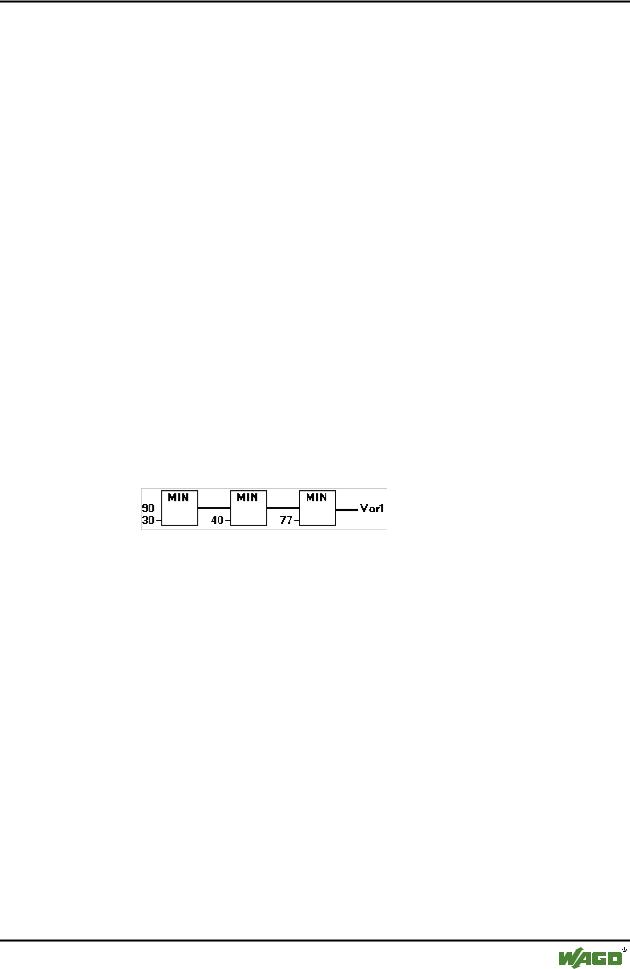
Minimum function. Returns the lesser of the two values.
OUT := MIN(IN0, IN1)
IN0, IN1 and OUT can be any type of variable.
Example in IL:
LD |
90 |
MIN |
30 |
MIN |
40 |
MIN |
77 |
ST |
Var1 (* Result is 30 *) |
Example in ST:
Var1:=MIN(90,30); (* Result is 30 *);
Var1:=MIN(MIN(90,30),40); (* Result is 30 *);
Example in FBD:
12.5.4LIMIT
Limiting
OUT := LIMIT(Min, IN, Max) means:
OUT := MIN (MAX (IN, Min), Max)
Max is the upper and Min the lower limit for the result. Should the value IN exceed the upper limit Max, LIMIT will return Max. Should IN fall below Min, the result will be Min.
IN and OUT can be any type of variable.
Example in IL:
LD 90
LIMIT 30,80
ST |
Var1 (*Result is 80 *) |
WAGO-I/O-SYSTEM 759 WAGO-I/O-PRO 32
300 • The IEC Operators
Comparison Operators
Example in ST:
Var1:=LIMIT(30,90,80); (* Result is 80 *);
12.5.5MUX
Multiplexer
OUT := MUX(K, IN0,...,INn) means:
OUT := INK.
IN0, ...,INn and OUT can be any type of variable. K must be BYTE, WORD, DWORD, SINT, USINT, INT, UINT, DINT or UDINT. MUX selects the Kth value from among a group of values.
Example in IL:
LD 0
MUX 30,40,50,60,70,80
ST |
Var1 (*Result is 30 *) |
Example in ST:
Var1:=MUX(0,30,40,50,60,70,80); (* Result is 30 *);
Note:
Note that an expression occurring ahead of an input other than INK will not be processed to save run time ! Only in simulation mode all expressions will be executed.
12.6 Comparison Operators
12.6.1GT
Greater than
A Boolean operator which returns the value TRUE when the value of the first operand is greater than that of the second. The operands can be BOOL, BYTE, WORD, DWORD, SINT, USINT, INT, UINT, DINT, UDINT, REAL, TIME, DATE, TIME_OF_DAY, DATE_AND_TIME and STRING.
Example in IL:
LD 20
GT 30
ST |
Var1 (* Result is FALSE *) |
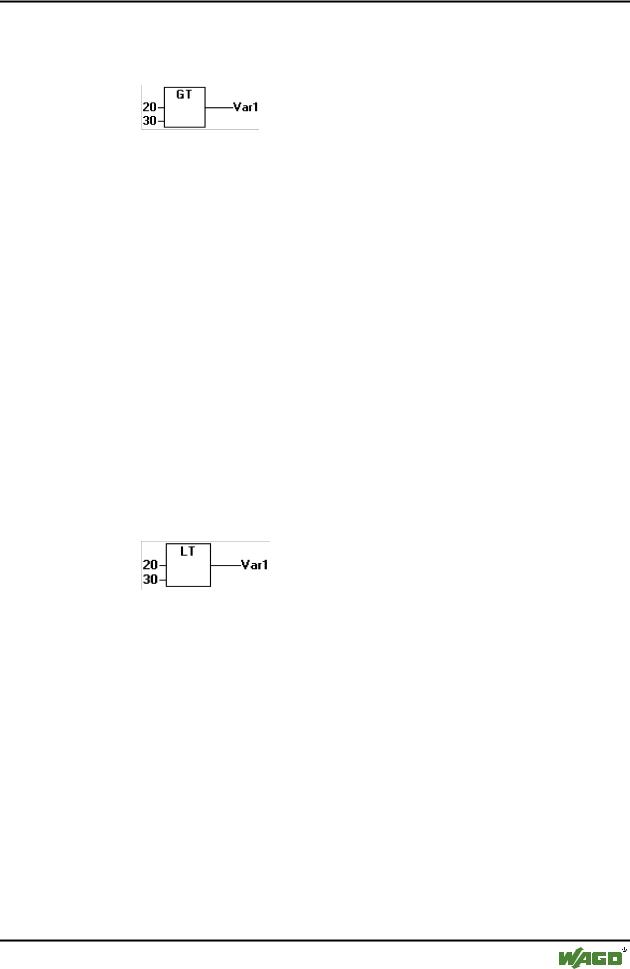
Example in ST:
WAGO-I/O-SYSTEM 759 WAGO-I/O-PRO 32
The IEC Operators • 301
Comparison Operators
VAR1 := 20 > 30 > 40 > 50 > 60 > 70;
Example in FBD:
12.6.2LT
Less than
A Boolean operator that returns the value TRUE when the value of the first operand is less than that of the second. The operands can be BOOL, BYTE, WORD, DWORD, SINT, USINT, INT, UINT, DINT, UDINT, REAL, TIME, DATE, TIME_OF_DAY, DATE_AND_TIME and STRING.
Example in IL:
LD |
20 |
LT |
30 |
ST |
Var1 (* Result is TRUE *) |
Example in ST:
VAR1 := 20 < 30;
Example in FBD:
12.6.3LE
Less than or equal to
A Boolean operator that returns the value TRUE when the value of the first operand is less than or equal to that of the second. The operands can be BOOL, BYTE, WORD, DWORD, SINT, USINT, INT, UINT, DINT, UDINT, REAL, TIME, DATE, TIME_OF_DAY, DATE_AND_TIME and STRING.
Example in IL:
LD 20
LE 30
ST |
Var1 (* Result is TRUE *) |
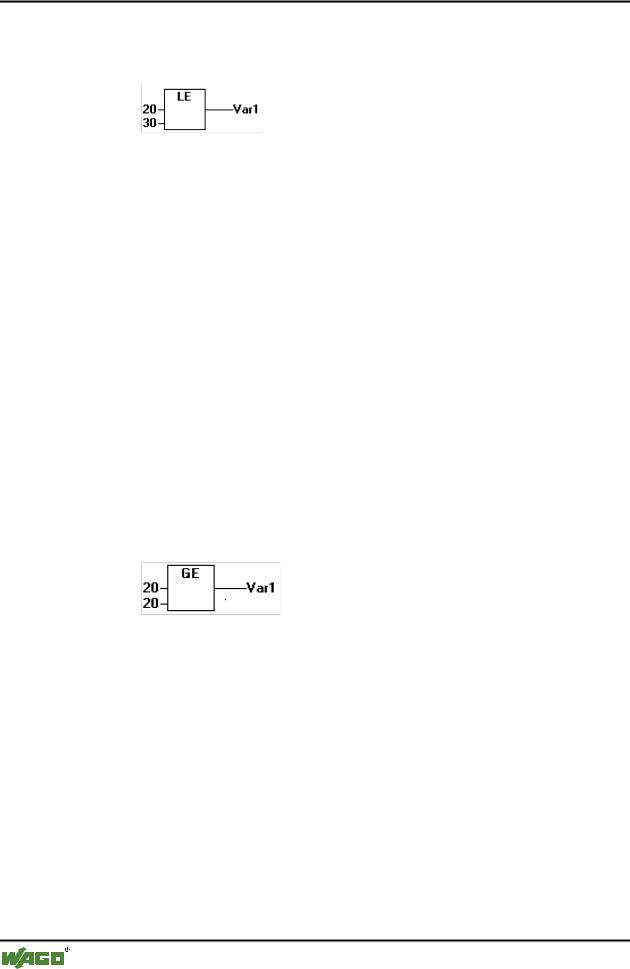
Example in ST:
WAGO-I/O-SYSTEM 759 WAGO-I/O-PRO 32
302 • The IEC Operators
Comparison Operators
VAR1 := 20 <= 30;
Example in FBD
12.6.4GE
Greater than or equal to
A Boolean operator that returns the value TRUE when the value of the first operand is greater than or equal to that of the second. The operands can be BOOL, BYTE, WORD, DWORD, SINT, USINT, INT, UINT, DINT, UDINT, REAL, TIME, DATE, TIME_OF_DAY, DATE_AND_TIME and STRING.
Example in IL:
LD |
60 |
GE |
40 |
ST |
Var1 (* Result is TRUE *) |
Example in ST:
VAR1 := 60 >= 40;
Example in FBD:
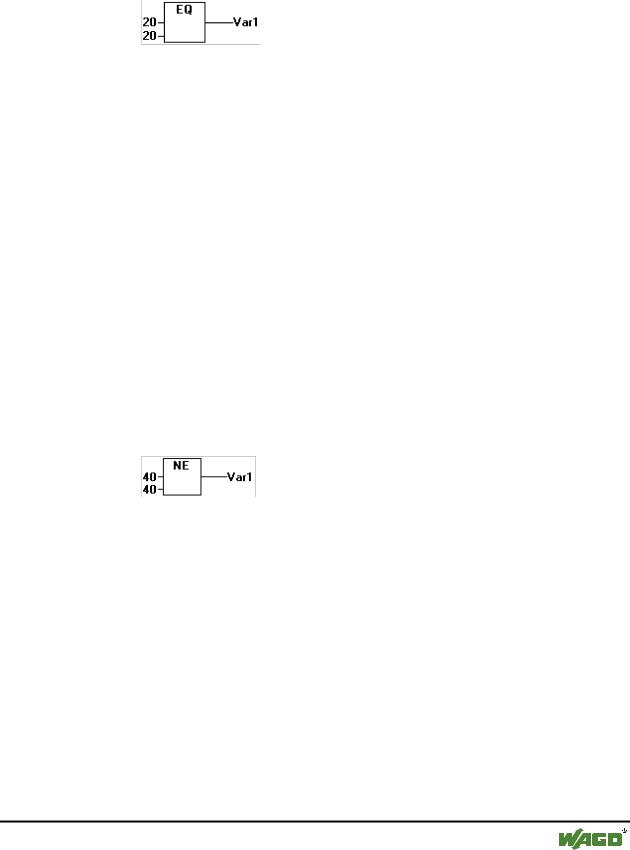
12.6.5EQ
Equal to
A Boolean operator that returns the value TRUE when the operands are equal. The operands can be BOOL, BYTE, WORD, DWORD, SINT, USINT, INT, UINT, DINT, UDINT, REAL, TIME, DATE, TIME_OF_DAY, DATE_AND_TIME and STRING.
Example in IL:
LD 40
EQ 40
ST |
Var1 (* Result is TRUE *) |
WAGO-I/O-SYSTEM 759 WAGO-I/O-PRO 32
The IEC Operators |
• 303 |
Address Operators |
|
|
|
Example in ST:
VAR1 := 40 = 40;
Example in FBD:
12.6.6NE
Not equal to
A Boolean operator that returns that value TRUE when the operands are not equal. The operands can be BOOL, BYTE, WORD, DWORD, SINT, USINT, INT, UINT, DINT, UDINT, REAL, TIME, DATE, TIME_OF_DAY, DATE_AND_TIME and STRING.
Example in IL:
LD |
40 |
NE |
40 |
ST |
Var1 (* Result is FALSE *) |
Example in ST:
VAR1 := 40 <> 40;
Example in FBD:
12.7 Address Operators
12.7.1ADR
Address Function
ADR returns the address of its argument in a DWORD. This address can be sent to manufacturing functions to be treated as a pointer or it can be assigned to a pointer within the project.
Example in IL:
LD Var1
ADR
ST Var2
WAGO-I/O-SYSTEM 759 WAGO-I/O-PRO 32