Материал: m912201e
294 • The IEC Operators
Bit-Shift Operators
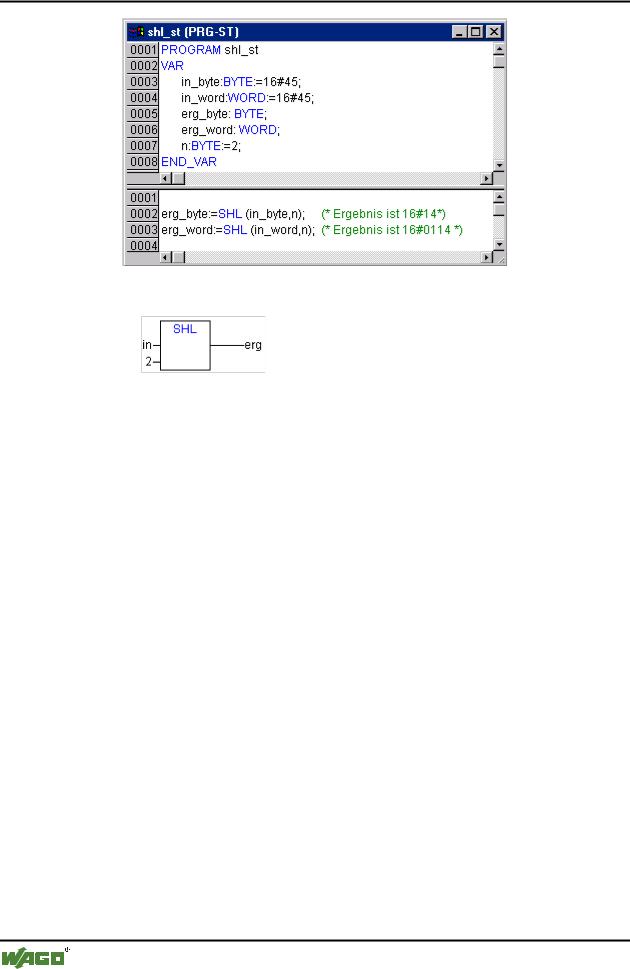
Example in FBD:
Example in IL:
LD 16#45
SHL 2
ST erg_byte
12.4.2SHR
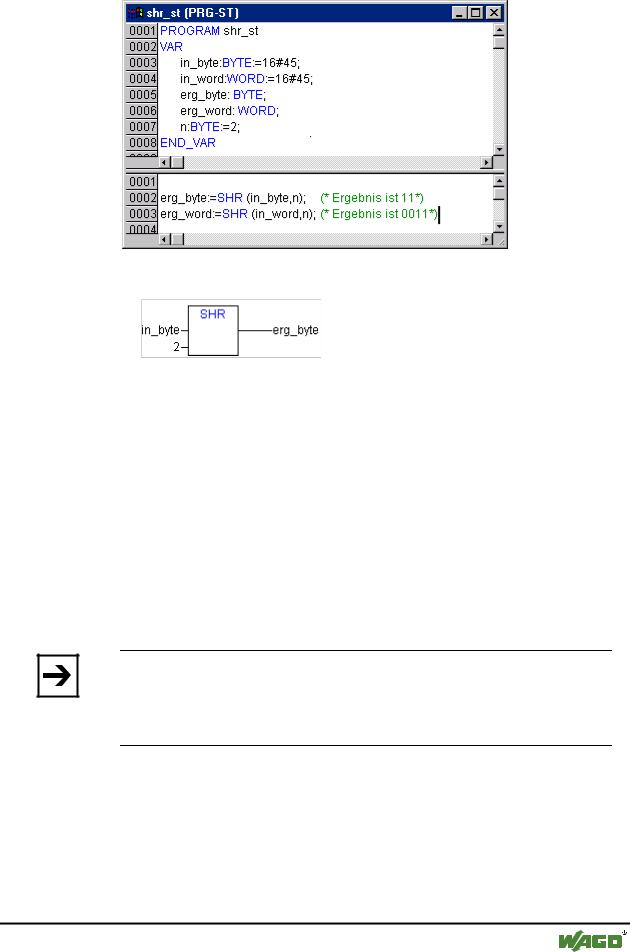
Bitwise right-shift of an operand: erg:= SHR (in, n)
erg, in and n should be of the type BYTE, WORD or DWORD. in will be shifted to the right by n bits and filled with zeros on the left.
See the following example in hexadecimal notation to notice the results of the arithmetic operation depending on the type of the input variable (BYTE or WORD).
Example in ST:
WAGO-I/O-SYSTEM 759 WAGO-I/O-PRO 32
The IEC Operators |
• 295 |
Bit-Shift Operators |
|
|
|
Example in FBD:
Example in IL:
LD 16#45
SHL 2
ST erg_byte
12.4.3ROL
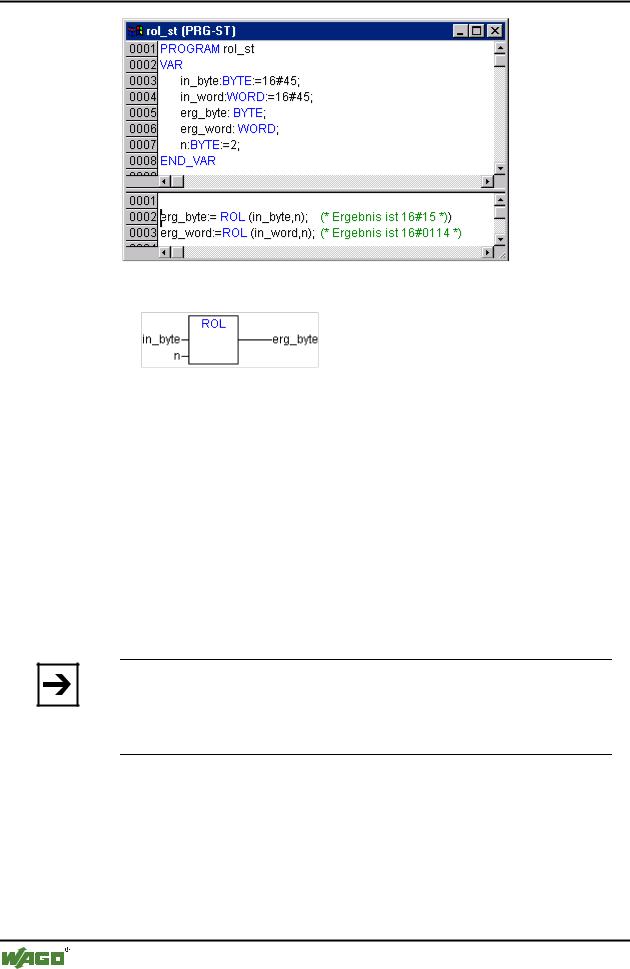
Bitwise rotation of an operand to the left: erg:= ROL (in, n)
erg, in and n should be of the type BYTE, WORD or DWORD. in will be shifted one bit position to the left n times while the bit that is furthest to the left will be reinserted from the right.
Note:
Please note, that the amount of bits, which is regarded for the arithmetic operation, is pretended by the data type of the input variable !. If the input variable is a constant the smallest possible data type is regarded. The data type of the output variable has no effect at all on the arithmetic operation.
See in the following example in hexadecimal notation that you get different results for erg_byte and erg_word depending on the data type of the input variable (BYTE or WORD), although the values of the input variables in_byte and in_word are the same.
Example in ST:
WAGO-I/O-SYSTEM 759 WAGO-I/O-PRO 32
296 • The IEC Operators
Bit-Shift Operators
Example in FBD:
Example in IL:
LD 16#45
SHL 2
ST erg_byte
12.4.4ROR
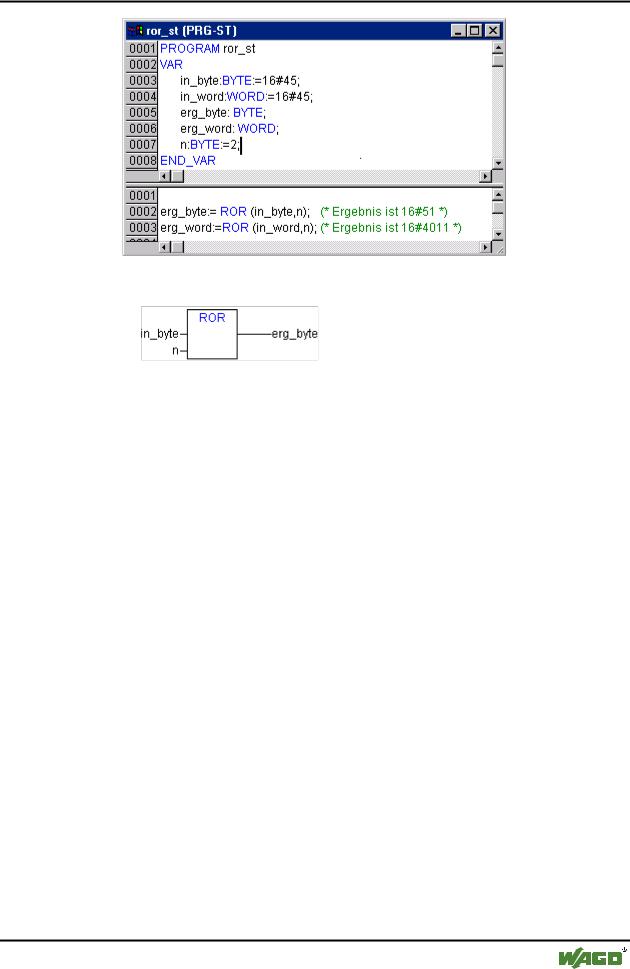
Bitwise rotation of an operand to the right: erg = ROR (in, n)
erg, in and n should be of the type BYTE, WORD or DWORD. in will be shifted one bit position to the right n times while the bit that is furthest to the left will be reinserted from the left.
Note:
Please note, that the amount of bits, which is regarded for the arithmetic operation, is pretended by the data type of the input variable !. If the input variable is a constant the smallest possible data type is regarded. The data type of the output variable has no effect at all on the arithmetic operation.
See in the following example in hexadecimal notation that you get different results for erg_byte and erg_word depending on the data type of the input variable (BYTE or WORD), although the values of the input variables in_byte and in_word are the same.
Example in ST:
WAGO-I/O-SYSTEM 759 WAGO-I/O-PRO 32
The IEC Operators • 297
Selection Operators
Example in FBD:
Example in IL:
LD 16#45
SHL 2
ST erg_byte
12.5 Selection Operators
All selection operations can also be performed with variables. For purposes of clarity we will limit our examples to the following which use constants as operators.
12.5.1SEL
Binary Selection.
OUT := SEL(G, IN0, IN1) means:
OUT := IN0 if G=FALSE;
OUT := IN1 if G=TRUE.
IN0, IN1 and OUT can be any type of variable, G must be BOOL. The result of the selection is IN0 if G is FALSE, IN1 if G is TRUE.
Example in IL:
LD TRUE
SEL 3,4
WAGO-I/O-SYSTEM 759 WAGO-I/O-PRO 32
298 • The IEC Operators
Selection Operators
ST |
Var1 |
(* Result ist |
4 |
*) |
LD |
FALSE |
|
|
|
SEL |
3,4 |
|
|
|
ST |
Var1 |
(* Result ist |
3 |
*) |
Example in ST:
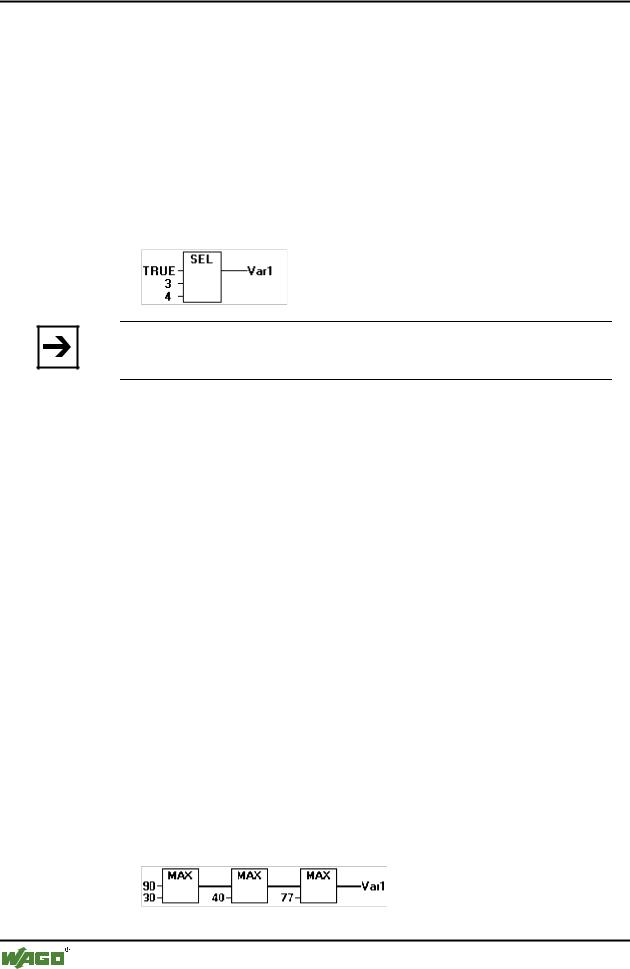
Var1:=SEL(TRUE,3,4); (* Result is 4 *)
Example in FBD:
Note:
Note that an expression occurring ahead of IN1 or IN2 will not be processed if IN0 is TRUE.
12.5.2MAX
Maximum function. Returns the greater of the two values.
OUT := MAX(IN0, IN1)
IN0, IN1 and OUT can be any type of variable.
Example in IL:
LD |
90 |
MAX |
30 |
MAX |
40 |
MAX |
77 |
ST |
Var1 (* Result is 90 *) |
Example in ST:
Var1:=MAX(30,40); (* Result is 40 *)
Var1:=MAX(40,MAX(90,30)); (* Result is 90 *)
Example in FBD:
WAGO-I/O-SYSTEM 759 WAGO-I/O-PRO 32