Материал: m912201e
The IEC Operators • 309
Type Conversion Functions
12.9.5TIME_TO/TIME_OF_DAY Conversions
Converting from the variable type TIME or TIME_OF_DAY to a different type:
The time will be stored internally in a DWORD in milliseconds (beginning with 12:00 A.M. for the TIME_OF_DAY variable). This value will then be converted.
When you perform a type conversion from a larger to a smaller type, you risk losing some information
For the STRING type variable, the result is a time constant.
Examples in IL:
LD T#12ms
TIME_TO_STRING
ST |
str (*Result is 'T#12ms' *) |
LD T#300000ms
TIME_TO_DWORD
ST |
dw |
(*Result is 300000 *) |
LD TOD#00:00:00.012
TOD_TO_SINT
ST si (*Result is 12 *)
Examples in St:
str :=TIME_TO_STRING(T#12ms); |
(* Result is |
T#12ms *) |
|
dw:=TIME_TO_DWORD(T#5m); |
(* Result is |
300000 *) |
|
si:=TOD_TO_SINT(TOD#00:00:00.012); |
(* Result is 12 |
*) |
|
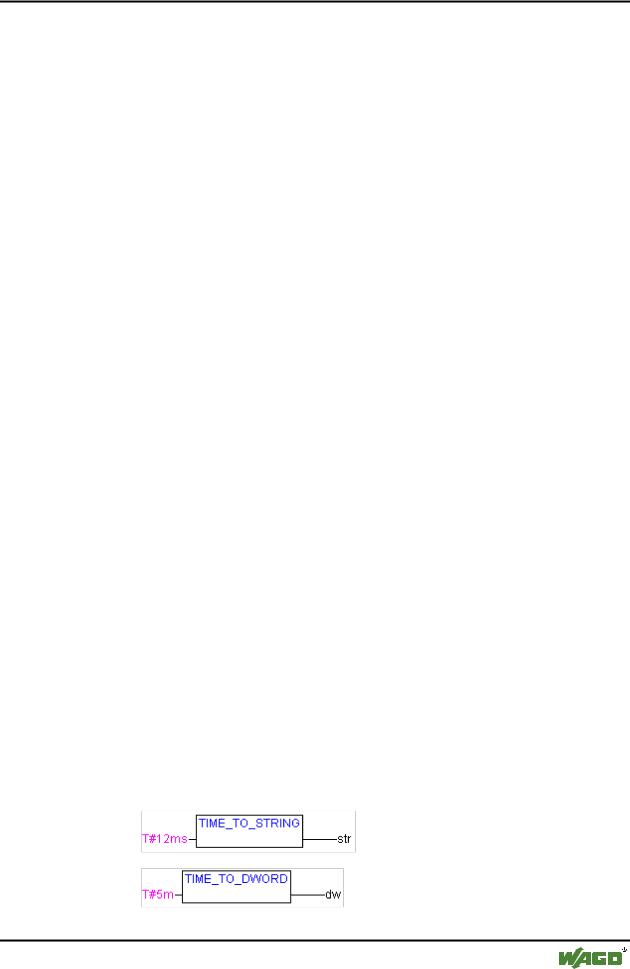
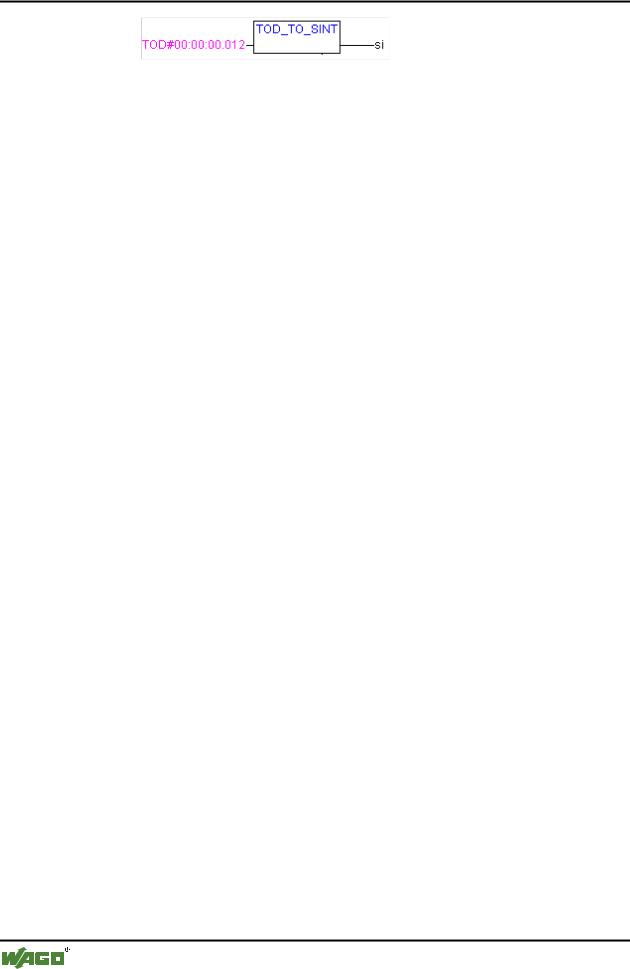
Examples in FBD:
WAGO-I/O-SYSTEM 759 WAGO-I/O-PRO 32
310 • The IEC Operators
Type Conversion Functions
12.9.6 DATE_TO/DT_TO
Conversions
Converting from the variable type DATE or DATE_AND_TIME to a different type:
The date will be stored internally in a DWORD in seconds since Jan. 1, 1970. This value will then be converted.
When you perform a type conversion from a larger to a smaller type, you risk losing some information
For STRING type variables, the result is the date constant.
Examples in St:
b :=DATE_TO_BOOL(D#1970-01-01); |
(* Result is |
FALSE *) |
|
i :=DATE_TO_INT(D#1970-01-15); |
(* Result is |
29952 *) |
|
byt :=DT_TO_BYTE(DT#1970-01-15-05:05:05); |
(* Result is |
129 *) |
|
str:=DT_TO_STRING(DT#1998-02-13-14:20); |
(* Result is |
'DT#1998-02-13-14:20' *) |
|
12.9.7STRING_TO Conversions
Converting from the variable type STRING to a different type:
The operand from the STRING type variable must contain a value that is valid in the target variable type, otherwise the result will be 0.
Examples in St:
b :=STRING_TO_BOOL('TRUE'); |
(* Result is TRUE *) |
w :=STRING_TO_WORD('abc34'); |
(* Result is 0 *) |
t :=STRING_TO_TIME('T#127ms'); |
(* Result is T#127ms |
*) |
|
12.9.8TRUNC
Converting from REAL to INT. The whole number portion of the value will be used.
WAGO-I/O-SYSTEM 759 WAGO-I/O-PRO 32

The IEC Operators |
• 311 |
Numeric Functions |
|
|
|
When you perform a type conversion from a larger to a smaller type, you risk losing some information.
Examples in ST:
i:=TRUNC(1.9); (* Result is 1 *)
i:=TRUNC(-1.4); (* result is -1 *).
Example in IL:
LD 2.7
TRUNC
GE %MW8
12.10Numeric Functions
12.10.1ABS
Returns the absolute value of a number. ABS(-2) equals 2.
The following type combinations for input and output variables are possible:
IN |
|
OUT |
INT |
|
INT, REAL, WORD, DWORD, DINT |
|
|
|
REAL |
|
REAL |
|
|
|
BYTE |
|
INT, REAL, BYTE, WORD, DWORD, DINT |
|
|
|
WORD |
|
INT, REAL, WORD, DWORD, DINT |
|
|
|
DWORD |
|
REAL, DWORD, DINT |
|
|
|
SINT |
|
REAL |
|
|
|
USINT |
|
REAL |
|
|
|
UINT |
|
INT, REAL, WORD, DWORD, DINT, UDINT, UINT |
|
|
|
DINT |
|
REAL, DWORD, DINT |
|
|
|
UDINT |
|
REAL, DWORD, DINT, UDINT |
|
|
|
Example in IL: |
|
|
LD |
2 |
|
ABS |
|
|
WAGO-I/O-SYSTEM 759 WAGO-I/O-PRO 32
312 • The IEC Operators
Numeric Functions
ST |
i |
(*Result is 2 *) |
Example in ST:
i:=ABS(-2);
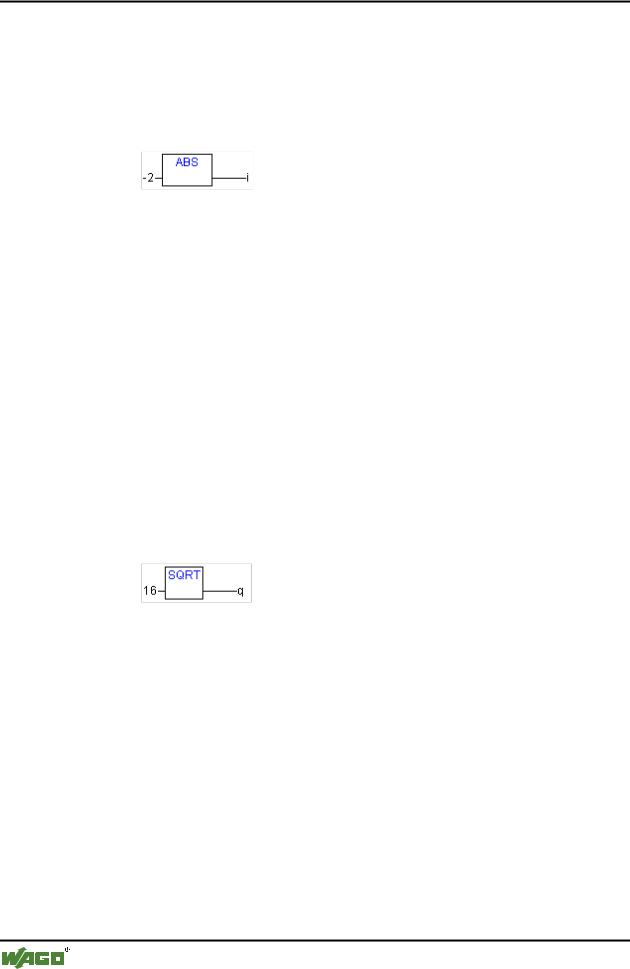
Example in FBD:
12.10.2SQRT
Returns the square root of a number.
IN can be type BYTE, WORD, DWORD, INT, DINT, REAL, SINT, USINT, UINT, UDINT, OUT must be type REAL.
Example in IL:
LD 16
SQRT
ST |
q |
(*Result is 4 *) |
Example in ST:
q:=SQRT(16);
Example in FBD:
12.10.3LN
Returns the natural logarithm of a number.
IN can be type BYTE, WORD, DWORD, INT, DINT, REAL, SINT, USINT, UINT, UDINT, OUT must be type REAL.
Example in IL:
LD 45
LN
ST |
q |
(*Result is 3.80666 *) |
Example in ST:
q:=LN(45);
WAGO-I/O-SYSTEM 759 WAGO-I/O-PRO 32
The IEC Operators |
• 313 |
Numeric Functions |
|
|
|
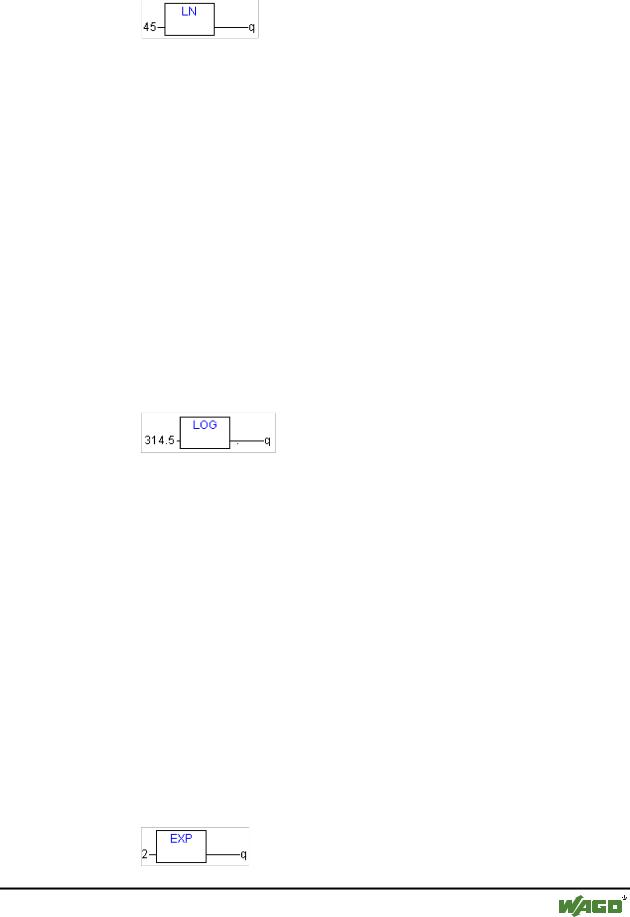
Example in FBD:
12.10.4LOG
Returns the logarithm of a number in base 10.
IN can be type BYTE, WORD, DWORD, INT, DINT, REAL, SINT, USINT, UINT, UDINT, OUT must be type REAL.
Example in IL:
LD 314.5
LOG
ST |
q |
(*Result is 2.49762 *) |
Example in ST:
q:=LOG(314.5);
Example in FBD:
12.10.5EXP
Returns the exponential function.
IN can be type BYTE, WORD, DWORD, INT, DINT, REAL, SINT, USINT, UINT, UDINT, OUT must be type REAL.
Example in IL:
LD 2
EXP
ST |
q |
(* result is 7.389056099 *) |
Example in ST:
q:=EXP(2);
Example in FBD:
WAGO-I/O-SYSTEM 759 WAGO-I/O-PRO 32