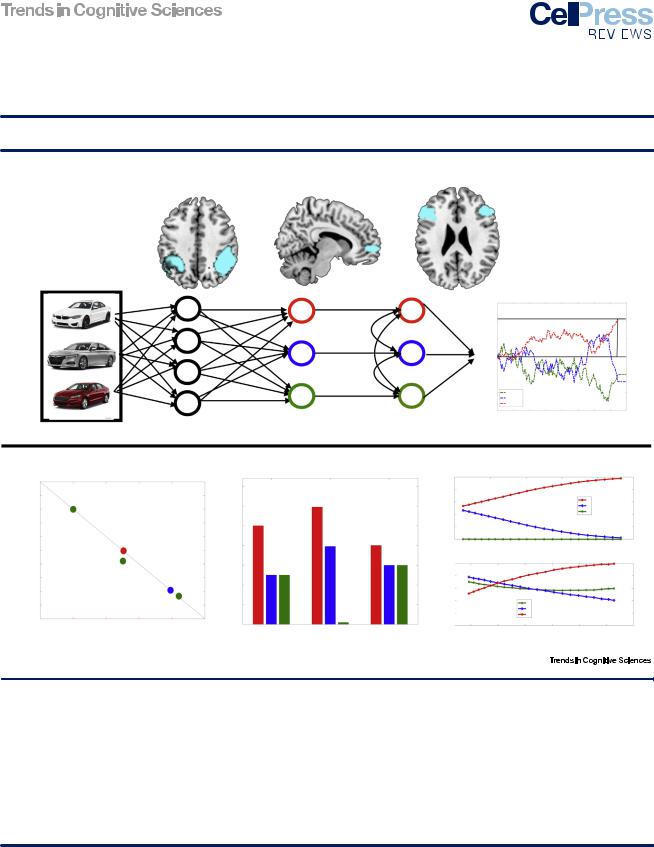
Studies of choice context provide crucial tests of these normative assumptions. When focusing on choice context effects, most theorists are concerned with three major effects, known as similarity, attraction, and compromise effects (lower panel B of Figure 1, Key Figure). Suppose that option A and option B vary on two attributes (e.g., quality and economics). Option B is economical but low-quality, whereas option A is expensive but high-quality, and, because of the even trade-off, suppose that they are chosen equally frequently.
A similarity effect occurs [27] when a third option, S, which is similar but competitive with option B, is added to the choice set (option S in Figure 1). Adding option S now increases the probability of choosing A relative to B, violating IIA. Interestingly, the similarity effect can be reversed when changing the presentation format from an alternativeto an attribute-focused style [28].
An attraction effect occurs [29–34] when a third option, D, is added to the choice set that is similar but much inferior to option A (option D in Figure 1). Adding option D now increases the probability of choosingoptionAabovethat obtained from thebinarychoice,violatingIIAand theregularityprinciple.
A compromise effect occurs [29,35,36] when a third option C is added to the choice set that extends the attribute values beyond option A, such that option A now appears to be between the attribute values of options C and B, thereby making A appear as a compromise (option C in Figure 1). Adding option C now increases the probability of choosing the compromise option A, violating IIA.
Another type of choice context effect, not shown in Figure 1, but also important, is the reference-point effect [37]. In this case, the decision maker initially is in possession of an option, call it R for the reference, but then must give it up for a new option, either A or B. If R is similar to A, then A is chosen more frequently than B; however, if R is similar to B, then B is chosen more frequently than A. In this case, the location of the reference point reverses preferences between A and B.
Violations of IIA rule out popular models such as the ratio of strengths model [25], and violations of regularity ruled out random utility models [26] as well as the elimination by aspects model [27]. Before the arrival of sequential sampling models of preferential choice, no single traditional static theory could account for all of the above context effects, and sequential sampling models provided the first complete account [38].
Further empirical support for sequential sampling models was obtained by investigating how context effects change as a function of deliberation time [39–41]. As predicted by sequential sampling models, longer deliberation times produce larger attraction and compromise effects (Figure 1, bottom panel). Note that only attraction and compromise effects have been examined using deliberation time manipulations with preferential choice (but see [22] for a study of the effects of deliberation time on similarity effects in a perceptual task).
Boxes 1 and 2 describe some additional findings concerning the three major choice context effects. This includes a summary of substantial individual differences in the different types of context effects (Box 1), and extensions of these context effects to inference tasks (Box 2).
Model Comparisons for Value-Based]FID$T861[ Decisions
Comparison of Model Mechanisms
Figure 1A provides a graphical depiction of a general framework used by the competing sequential sampling models, and Box 3 describes the central mechanisms used in various
is that, when comparing the same magnitude change in gains and losses, the change in loss has a greater impact than the change in gain.
Multi-attribute and multialternative tasks: choice tasks that require participants to choose among more than two options that are characterized by two or more attributes. Context effects are often found in these types of choices. Regularity: adding a new option C to the choice set A + B should not increase the probability to choose either A or B.
Ventromedial prefrontal cortex (vmPFC): a section of the prefrontal cortex covering the ventral part of the cerebral midline that has been associated with the computation of subjective value. It has recently been linked to the accumulation process in value-based decisions.