Investigating Bell Inequalities for Multidimensional Relevance Judgments |
185 |
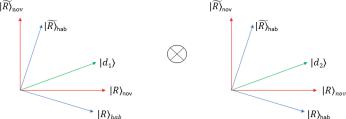
(I) We consider those queries where only two documents are SAT clicked (Satisfied Click - Those documents which are clicked and browsed for at least 30 s). Out of 55617 queries in our dataset, 1702 queries had exactly two SAT clicked documents. We consider a composite system of these two documents and measure (judge the relevance) along di erent basis (relevance dimensions) corresponding to each of the Bell inequalities described in Sects. 3.1, 3.2 and 3.3.
(II) We consider those queries for which we have at least one SAT clicked document. Out of 55617 queries in our dataset, we find 52936 queries with at least one SAT clicked document. We then consider a composite system of this SAT clicked document with all the unclicked documents for the query (one by one) and measure (judge the relevance) along di erent basis (relevance dimensions) corresponding to each of the Bell inequalities described in Sects. 3.1, 3.2, 3.3.
In both cases, we do not find the violation of the Bell inequalities for any query. While case (I) corresponds to correlated documents and case (II) corresponds to anti-correlated documents, it is to be noted that we are taking a composite system by taking a tensor product of two document states. This, in turn is separable back into the two document states. The reason why Quantum Mechanics violates Bell Inequalities is due to the existence of non-separable states like the Bell States. To get something similar to an entangled state, we consider another type of document pairs:
(III) Consider a pair of documents which are listed together for many queries, but are always judged in a correlated manner. That is, if one document of the pair is SAT clicked, the other one is also SAT clicked for that query. And similarly both might be unclicked for another query in which they appear together. Also, we find those documents which are SAT clicked together in half of the queries they occur in, and unclicked in the other half. This corresponds to the following Bell State:
|
|
|
|
|
|
|
|
|
|
|
|
| |
|
1 |
|
| |
|
| |
|
|
|
|
2 |
|
|
|
|
ψ |
= √ |
|
|
( RR |
|
+ RR |
) |
(23) |
We take such pairs of documents to test the Bell inequalities on them. Out of 774 pairs of documents, no pair show the violation of the inequalities discussed above.
The composite state of the two documents described in Eq. (23) appears to be like an entangled state of the documents - knowing that one document is SAT clicked or not can tell us about the other document. However, one fundamental property of the Bell states is their rotational invariance. Representing a Bell State in any basis, one gets the same probabilities of the two possible outcomes. For example,
|
|
|
|
|
|
|
|
|
|
|
|
|
|
|
|
1 |
|
|
|
|
|
|
|
|
|
| |
2 |
| |
|
|
|
+ |
| |
|
|
|
(24) |
ψ |
= √ |
|
|
H H |
|
|
H H |
|
|
|
1 |
|
|
|
|
|
|
|
|
|
2 |
| |
|
|
|
| |
|
|
|
|
|
|
= √ |
|
|
T T |
|
+ T T |
|
|
|
where H, N and T are relevance with respect to the Habit, Topicality and Novelty basis. One can always hypothetically construct document Hilbert spaces in such