Материал: искусственный интеллект

Внимание! Если размещение файла нарушает Ваши авторские права, то обязательно сообщите нам

suai.ru/our-contacts

quantum machine learning

Cybernetics and AI

suai.ru/our-contacts

quantum machine learning

Fuzzy Logic Behavior

of Quantum-Controlled Braitenberg

Vehicle Agents

Rebeca Araripe Furtado Cunha1,2, Naman Sharma1,3, Zeno To ano1,4(B),

and Fran¸cois Dubois5,6

1CentraleSup´elec, Universit´ ParisSaclay, 91190 Gif-sur-Yvette, France zeno.toffano@centralesupelec.fr, zeno.toffano@supelec.fr

2Federal University of Rio de Janeiro, Rio de Janeiro 21941-909, Brazil

3 National University of Singapore, Singapore 119077, Singapore

4 Laboratoire des Signaux et Syst`emes - CNRS (UMR8506), Gif-sur-Yvette, France 5 Conservatoire National des Arts et M´etiers, 75003 Paris, France francois.dubois@u-psud.fr

6 Association Fran¸caise de Science des Syst`emes (AFSCET), Paris, France

Abstract. The behavior of agents represented by Braitenberg vehicles is investigated in the context of the quantum robot paradigm. The agents are processed through quantum circuits with fuzzy inputs, this permits to enlarge the behavioral possibilities and the associated decisions for these simple vehicles. The logical formulation Eigenlogic, using quantum logical observables as propositions and eigenvalues as truth values is applied in this investigation. Fuzzy logic arises naturally in this formulation when considering input states that are not eigenvectors of the logical observables, the fuzzy membership being the quantum mean value of the logical observable on the input state. Computer simulations permits visualization of complex behaviors resulting from the multiple combination of quantum control gates. This allows the detection of new Braitenberg vehicle behavior patterns related to identified emotions and linked to quantum-like e ects.

Keywords: Quantum robots · Fuzzy logic · Quantum gates ·

Braitenberg vehicles · Emotion analysis

1 Introduction

With the recent improvements in quantum information, interest has been growing in the area of quantum robotics. This signifies using concepts from quantum computing to build and conceptualize systems capable of decision making. Simple robots capable of showing complex behavior have been introduced in Valentino Braitenberg’s work on cybernetics proposing vehicle agents that show human-like emotions [1]. Here we aim to implement Braitenberg Vehicles (BV) using quantum-like circuits. Paul Benio who was the first to propose the idea

c Springer Nature Switzerland AG 2019

B. Coecke and A. Lambert-Mogiliansky (Eds.): QI 2018, LNCS 11690, pp. 111–122, 2019. https://doi.org/10.1007/978-3-030-35895-2_8

suai.ru/our-contacts

quantum machine learning

112 R. A. F. Cunha et al.

of a quantum Turing machine in 1980 was also the proponent of the theoretical principle of a quantum robot [2].

A quantum-like implementation of BVs has been undertaken in a previous research work [3], where Raghuvanshi et al. used the reversible quantum logical gate structure in building prototype BVs with Lego blocks. In the work presented here, in order to provide flexibility to the vehicle’s behavior, we design fuzzy logic quantum-like circuits based on the quantum models proposed in [4].

Our goal here is to test the multiple combinations of quantum gates used in the control of BV by analyzing their complex behavior. For this purpose, we have developed a visual simulation tool illustrating BV’s behaviors. This allows us to investigate new emotional behavior patterns not expected by a simple theoretical analysis used for the description of BV in [1].

Mathematical models and simulations of individual and swarm automaton agents in response to environmental stimuli have attracted much interest for the understanding of complex behaviors of a group of animals. In [5], Kangan et al. developed a probabilistic control model (denominated ANIMAT) of mobile agents with biologically-inspired navigation, with the goal to mimic an ant colony. In this research it was made clear that the agent changes its state as a response to environmental stimuli and/or as a result of its own action on the environment, this observation can lead to path planning and intelligent-like emergent behavior of a group of agents. So agent behavioral models should take into account the uncertainty and the dynamics due to their environment.

A theoretical description of the model proposed here for the interaction of BV quantum robots with their environment is given in Sect. 2. This section details the mechanisms of transformation from the sensor input stimuli states to the control signals for the wheels of the BV (see Fig. 2).

In Sect. 3 we provide a brief outline of the logical models used in the design of the BV quantum robots. These models are based on the Eigenlogic approach proposed in [4] and permit to characterize behaviors associated to fuzzy logic control.

We finish by illustrating the simulation results in Sect. 4. In order to test the accuracy of our simulations, we first verify the behaviors predicted by the thought experiments proposed by Valentino Braitenberg [1]. This is done by observing how our simulator reacts to logical operators specifically designed for representing the vehicle’s emotions of Fear, Aggression, Love and Exploration. After testing the BVs with these well established emotions, we test other Eigenlogic control operators such as i.e. the implication operator (see Dubois and To ano in [4]). Finally using di erent operators in a variety of combinations gives us an interesting insight into the global emotional behavior of the vehicles.

2 Modeling of the Vehicle

2.1Introduction to Braitenberg Vehicles

In his book “Vehicles: Experiments in Synthetic Psychology” [1] Valentino Braitenberg describes various thought experiments using simple machines (Braiten-

suai.ru/our-contacts

quantum machine learning

Fuzzy Logic Behavior of Quantum-Controlled Braitenberg Vehicle Agents

113

berg Vehicles BV) that consist of sensors, motors and wheels. Similarly in our approach the quantum robot agents are represented by two controlled wheels at the rear of the BV, with two sensors at the front. The sensors detect light produced by surrounding sources. The sensors can be connected in di erent combinations to the wheels, and may have a positive or negative relation with the strength of the stimuli. These simple changes in configuration can lead to complex and surprising results in the agent behavior. Braitenberg terms this the “law of uphill analysis and downhill invention”. According to this principle it is far easier to create machines that exhibit complex behavior based on simple connective structures than to try to derive their structures from behavioral observations and interpretations.

2.2Quantum Approach for BV Decision Making

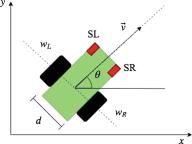
To model the system we consider BVs with two sensors: SL in the upper left corner and SR in the upper right corner (see Fig. 2). The sensors detect light intensity and transform it into an input state vector for the quantum circuit. The system then delivers as an output a fuzzy logical measure that is translated into wheel control by motors.

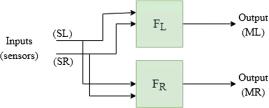
The computational block is composed of matrix operators designed using the quantum-like Eigenlogic method [4] discussed in Sect. 3. We use two operators FL and FR. Each one takes the inputs and delivers signals to the respective motors (left or right). This approach avoids to physically permute the wiring connecting sensors and motors in order to obtain di erent behaviors, it all can be handled by the computing device. The diagram in Fig. 1 resumes the inputoutput process.

Fig. 1. Simplified diagram of the control circuit of a BV connected to the left and right input sensors SL, SR and to the output left and right wheel motors ML, MR.

The equivalent quantum formulation of the system consists in defining the input state vector presented in Eq. (1),

|x = |xL |xR = |xLxR

(1)

where the ket |x corresponds to the combined input state of the bilinear system, formed by the Kronecker product of the individual input states |xL and |xR

suai.ru/our-contacts

quantum machine learning

114 R. A. F. Cunha et al.

corresponding respectively to the left and right sensors. These vectors can be understood as qubits with a given orientation in Hilbert space. The output signal is obtained by the quantum mean value (Born rule) of the logical projection observable on the compound input state |x . It is the control function for the wheels. The quantities μL and μR, for left and right wheel control, are:

μL = x| FL |x

(2)

μR = x| FR |x

(3)

These quantities can also be interpreted as fuzzy membership functions [4]. In the following section we will show that these values are proportional to the angular speed of the wheels.

Fig. 2. Braitenebrg Vehicle orientation at speed v showing at the rear the left and right wheels WL, WR and at the front the light sensors SL, SR spaced at distance d.

2.3Output States and Vehicle’s Motion

Once the vehicle is submitted to the input state |xf , it feeds it into the computation block as presented in the diagram of Fig. 1. The mean values for left and right are obtained as in Eqs. (2) and (3), depending directly in the logical control operators FL and FR. The wheel angular speeds ωL and ωR are calculated by applying the following relations:

ωL = K · μL

(4)

ωR = K · μR

(5)

where K is a constant which allows us to tune the sensitivity of the vehicle to the stimuli. The x and y components of the vehicle speed vector (cf. Fig. 2) are determined by the following di erential equations:

x˙ = vx =

1

R (ωL + ωR) cos(θ)

(6)


2

y˙ = vy =

1

R (ωL + ωR) sin(θ)

(7)

2

˙

1

R (ωR − ωL)


θ =


d

(8)

where R represents the BV wheel radius.