Материал: anglish
"NС units, their advantages and peculiarities, their application.”
Урок 11
Завдання 1. Уважно прочитайте подані нижче слова та їх перекладі запам'ятайте їх значення:
to join - з'єднувати (ся)
to involve - містити у собі
to need - потребувати
to adhere to - додержувати(ся)
idle - бездіяльний, марний;
capacity - потужність, продуктивність, здатність;
to respond - відповідати, реагувати;
to deliver - доставляти, виробляти;
rapid - швидкий;
rugged – міцний;
slave – раб;
to initiate - проявляти ініціативу, почати;
brain – мозок;
directions - вказівка, інструкція;
to crumble – розвалюватися;
lump – купа;
wire - дріт, провід;
cable – кабель;
paint. – фарба;
medium - засіб, спосіб;
but ton – кнопка;
alive - живий, діючий;
Завдання 2. Дайте українські еквіваленти таких словосполучень та прочитайте їх:
to tаkе clear: machine control unit: traditional machining; metal removal рrіnсіples; tooling principles; idle time; a capable operator; utilization rate ; chip making; manually operated machine; to press the button; to initiate the cycle of operations; to come alive; tape-controlled,
Завдання 3. Уважно прочитайте текст 11А, постарайтеся якомога точніше та повніше зрозуміти та запам'ятати його зміст:
TEXT 11 А
То understand what N/C is then, two things should be made clear. First, the actual machine tool with a capable operator can do nothing more than it was capable of doing before a machine control unit (MCU) was joined to it. New metal removing principles are not involved. Cutters cut as they always have. The same drills, milling cutters or other tools are still needed in N/C as they are in traditional machining. Cutting speeds feeds and tooling principles must till be adhered to. What then is the principal advantage? For one thing, the idle time, or time to move into, position for new cuts, is limited only by
the machine's capacity to respond. The utilization rate (chip making) is, therefore, much higher than on a manually operated machine MCU can deliver rand and precise instructions to the machine. When H/C machine-tools are observed, notice how ruggedly they are built. The actual utilization rate being higher, now compresses into l or 2 years the use that a conventional machine receives in possibly 10 years.
The second characteristic of numerical control that should be understood is that the H/C unit is a slave. It can initiate nothing. it cannot think. It is not a mechanical brain. Without directions in one form or another. It will stand until it crumbles, just a beautiful lump of steel, wires, cables, and paint. Once the operator places the program medium (tape) in the MCU, loads the workpiece on the machine, and presses the button to initiate the cycle of operations, then, and only then, does the N/C machine comes alive.
Even then on some machines the operator may have to perform some functions that are not a part of the program. Some N/C machine tools position the work under the cutter, but the operator must feed the tool into the workpiece manually. The most sophisticated units are completely tape-controlled, and leave only the loading and unloading operations to the operator.
Завдання 4. Розшифруйте абревіатури.
NC, MC unit.
Завдання 5. Знайдіть у тексті відповіді на такі запитання:
І. Are there any new cut tine tools and principles of metal removal used connected with NC?
2. What are the advantages of не units?
3. What ructions are performed by the operator of не units?
4. Can an NC unit be considered a mechanical brain?
5. What manual operations are performed by the не unit operator?
Завдання 6. Дайте заголовок до тексту.
Завдання 7. Складіть стислу письмову анотацію тексту (5-6 речень).
Завдання 8. прочитайте текст 11Б, користуючись словником, дайте відповіді на такі запитання:
1. Які питання вирішує робочий, що працює на звичайному верстаті, і які - оператор верстата з чпу?
2. Які професії якості повинен мати оператор верстатів з ЧПУ?
3. Які фактори, обумовлюють необхідність використання верстатів з ЧПУ?
TEXT 11Б
First it is necessary tо understand what the N/C process is. Formely, the machine-tool operator evaded a cutting tool-around a workpleces by the manipulating hand wheels and dials to get a finished or somewhat finished part. In his procedure many judgments of speeds, feeds, mathematics, and sometimes even tool configuration were his responsibility. The number of judgments the machinist had to matte usually depended on the type of shop he worked in and the kind of organization that prevailed. If his ludgement was in error, it resulted in rejects, or at best, part to be reworked or repaired in some fashion.
Decisions concerning the efficient and correct use of the machine tool then depended upon the craftsmanship, knowledge and skill of the machinist himself. It is rare, indeed, when even two expert operators produce identical parts using identical procedures and identical judgements of speeds, feeds and tooling. In fact even one craftsman may not proceed in the same manner second time around.
This matter of skill and craftsmanship is a serious one for the manufacturer. Numerical control will not solve all of the problems, but it does alleviate some troublesome areas. It is definitely one answer. With N/C the correct and most efficient use of the machine no longer rests with the operator. Judgements and procedures are not his province. Process planners and programmers, sometimes far removed from the shop now have the responsibilities for these matters.
What then is the function of the machine operator when N/C. Is installed? One fact is sure. Not all workpleces require machining with N/C. This decision of whether or not to route jobs to an N/C machine or to a man in the shop is determined many times by cost factors and availability of machines. The operator of a numerically controlled machine monitors the operation. In many cases he does not need to be a skilled machinist. Familiarity with programs plus being able to observe intelligently and make suggestions to improve a program are all good steps in the right direction. Intelligence and adaptability are essential.
Завдання 9. Складіть план усного повідомлення за темою:
"NС units, their advantages and peculiarities, their application.”
Завдання 10. Зробіть усне повідомлення на тему, вказану в завданні 9. Користуючись складеним планом.
Unit 5 Technology - Growing Fast! What Is Technology?
Завдання 1. Прочитайте подані нижче слова, пам'ятаючи про правила читання голосних та їх сполучень, а також сполучень приголосних букв:
short, world, tool, like, use, pace, fun, bridge, help, need, good, bad, such, as, but, math, make, life.
Завдання 2. Прочитайте подані нижче багатоскладові слова. Не забувайте про правила читання голосних у наголошеному та ненаголошеному складах:
robot, saw, hammer, solve, invent, device, easy, agree, people, affect, effect, change, about, learn.
Завдання 3. Прочитайте подані нижче слова. У разі утруднень перевірте правильність читання за словником та запишіть їх у транскрипції:
high, involve, fast, exciting, knowledge, science, while, through, answer, society, advancement, acid, find, literate, tech, both.
Завдання 4. Уважно прочитайте та запам'ятайте подані нижче слова та їх переклад:
|
to challenge |
кидати виклик |
бросить вызов |
|
device |
прилад, механізм |
устройство |
|
to involve |
містити, охоплювати |
содержать, охватывать |
|
science |
наука |
наука |
|
tool |
інструмент, знаряддя |
инструмент |
|
to invent |
винаходити |
изобретать |
|
to create |
створювати |
создавать |
|
to advance |
просувати, удосконалювати |
продвигать(ся) |
|
environment |
навколишнє середовище, довкілля |
окружающая среда |
|
acid |
кислота |
кислота |
|
technology |
техніка, технологія |
техника, технология |
|
to cause |
завдавати, спричиняти |
причинять, вызывать |
|
research |
дослідження |
исследование |
Завдання 5. Прочитайте та перекладіть подані нижче слова, ґрунтуючись на їх подібності до слів рідної мови:
robot, combination, subject, design, creative, definition, resources, future, fact, base, satellite, laser, product, problem, idea, essay, computer, person.
Завдання 6. Дайте еквіваленти таких словосполучень рідною мовою:
creative ideas, fast-paced, for a while, a technologically literate person, to make a decision, a decision based on facts, to change through time, tools of technology, to find out more about smth, environmental problems, acid rain.
Завдання 7. Дайте свій варіант перекладу поданих нижче речень. Поясніть особливості перекладу виділеної частини кожного речення:
1. Technology has both good and bad sides.
2. Space exploration was a challenging problem requiring full use of our knowledge, energy, abilities and resources.
3. Though it was a challenging proposition, it promised to be exciting and fun.
4. As you study English you will be reading, listening, speaking and writing in it.
5. I would like your essay to be more creative and more personal.
6. Our last decisions quite agree with the ones made earlier.
7. To obtain the job you need to come up with your own project.
8. My new apartment is not ready yet. I'll stay at the hotel for a while.
9. This research deals with environmental problems caused by the advancement of technology.
10. New advancements in computer technology are unbelievable.
Завдання 8.
а) Згадайте, яким повинен бути порядок слів у питальному реченні. Проаналізуйте подані нижче запитання стосовно порядку слів:
1. What do we call technology?
2. Does technology affect our life?
3. How does technology develop nowadays?
4. Is technology a part of our life?
5. What helps us make our life easier?
6. We cannot stop technological development, can we?
7. In what way does technology affect the environment?
8. What kind of job do you think you would like?
9. Isn't it interesting to study how technology develops?
10. Are you a technologically-minded person or a socially-minded one?
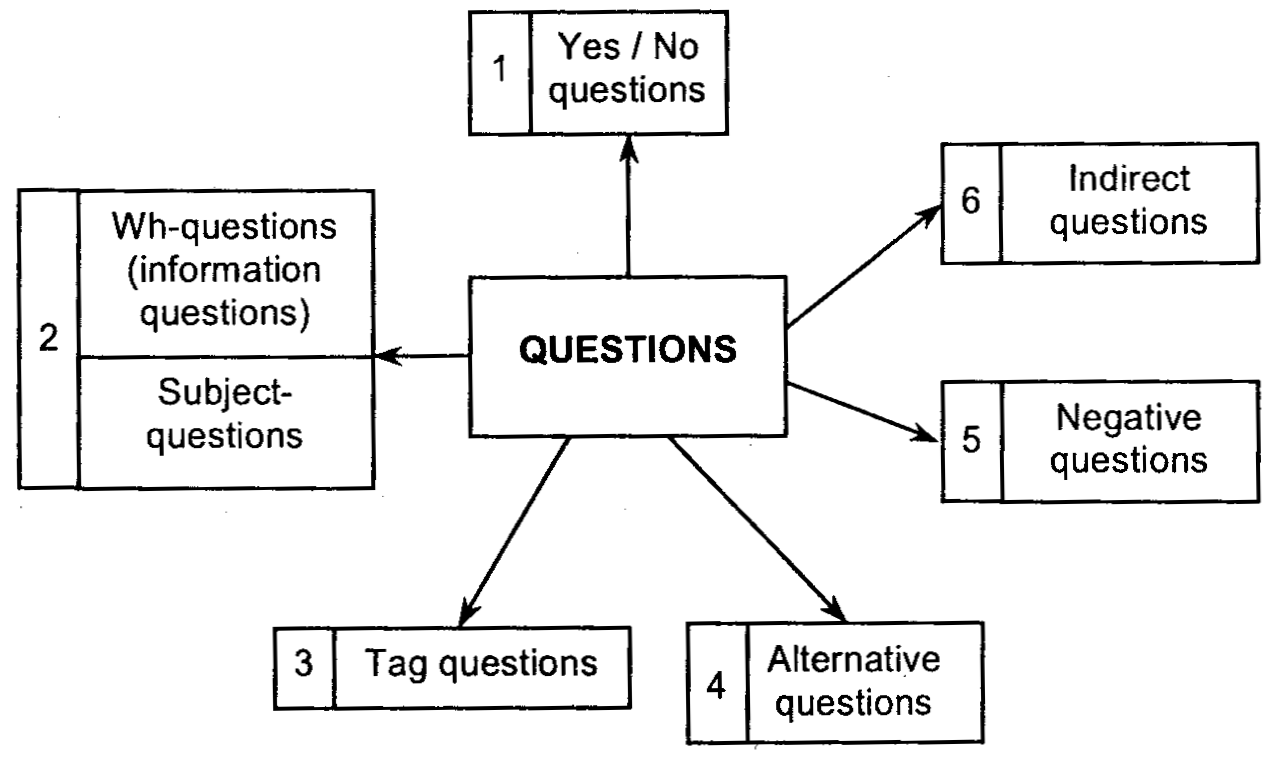
б) Користуючись наведеною схемою, з'ясуйте тип кожного з поданих вище питальних речень:
в) Дайте відповіді на подані запитання.
Завдання 9. Поставте запитання до виділених частин поданих нижче речень:
1. Millions of people all over the world work in technology - related careers.
2. Technology started over 2 million years ago.
3. Technology is changing and growing very quickly.
4. You can have more creative ideas if you open your mind to new things.
5. A technologically literate person can put technology to use to solve problems.
6. A problem - solving strategy can make it easier to solve the problem.
7. Learning about technology is fast - paced, exciting, challenging and fun.
8. There is a good chance that the career you choose will involve technology in some way.
9. Technicians use problem - solving steps in jobs that produce or transport products, communicate messages and research ideas.