Материал: Snote
cosmetics and ornaments
From the most ancient times, cosmetics and ornaments have played a major part in sexual ritual. The application of makeup to the face can become a personal encounter between the self that one is and the self that one wishes to become. A "new face" can generate selfconfidence and at the same time be a stimulating experience for the partner. Many mystical rites make use of this potential and specify makeup that stimulates particular sentiments. The importance of cosmetics in the present day can be gauged by the enormous worldwide sales of these products, even in the poorest areas.
No woman feels complete without her face makeup and personal jewelry, however simple it may be. Even the most natural look is usually cultivated painstakingly. In all cultures, cosmetics helped make the beautiful look exquisite and the ordinary "special."
In China, it was customary for a woman to place a red mark in the middle of her forehead. A similar practice still exists in India and Nepal, where it signifies spiritual or religious commitment. In Tantric rites, both the man and woman can wear this mark, to evoke the memory of the Third Eye of awakened consciousness.
Artful application of cosmetics and ornamentation is a beautiful and significant practice that the couple can share. Obviously, natural cosmetics are preferable to synthetic ones. Many commercial preparations can cause skin problems, so makeup should be carefully chosen or created for oneself. There is no need to buy expensive formulas when Nature provides organic ingredients in a readily usable form. Most women take pleasure in choosing their own special combination and experimenting on themselves. When properly applied, makeup and ornaments can transform a woman.
Tantric rites sometimes specify body makeup. The reasons for this are aesthetic, psychological, symbolic, and, on occasion, physiological. Gentle application of colored cosmetics to various parts of the body stimu-
lates and concentrates energy there. Tantric cosmetic preparations incorporate a number of different substances, such as cinnabar, sandalwood powder and paste, sulphur paste, rice paste, saffron, nutmeg, turmeric, arsenic, soot from various substances, camphor, conch shell, and ashes, some of which undoubtedly have a physical effect on the body. Particularly potent body makeup is made of crushed drugs such as datura (jimsonweed), marijuana, opium, and other intoxicating substances, mixed with fragrant oils and colored with pigments. European witches used similar body makeup in some of their rites.
One common custom of the East involves reddening the soles of the feet and palms of the hands of the woman. This is part of the ritual of honoring the Shakti (the female principle) and natural pigments such as henna are used for this purpose. In more elaborate rites, the feet of the woman can be completely painted with beautiful designs of flowers and
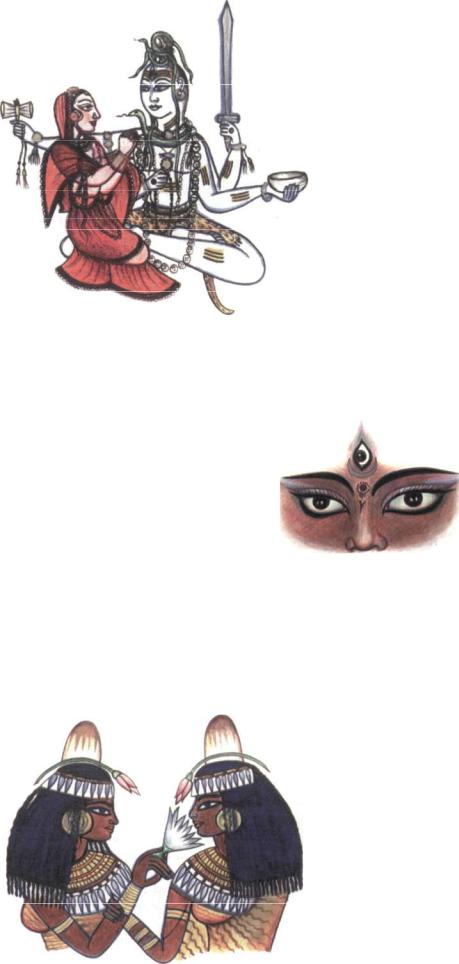
The archetypal Tantric couple, Shiva and Shakti. Shiva is depicted with snakes and a garland of skulls and his body is white as ashes. Shakti is shown as sensuous, with red cosmetics and ornaments dominating. Dramatization of sentiments aids ritual love-making by stirring up the emotions. From a Basohli miniature painting, Punjab Hills, circa 1690.
Tantric makeup, showing the Third Eye of awakened consciousness. From a contemporary sculpture, Crafts Museum, New Delhi.
Egyptian ladies with elaborate cosmetics and ornaments. They wear head-pieces of fragrant perfumes and flowers. From an Egyptian painting.
Vishnu the Preserver 187
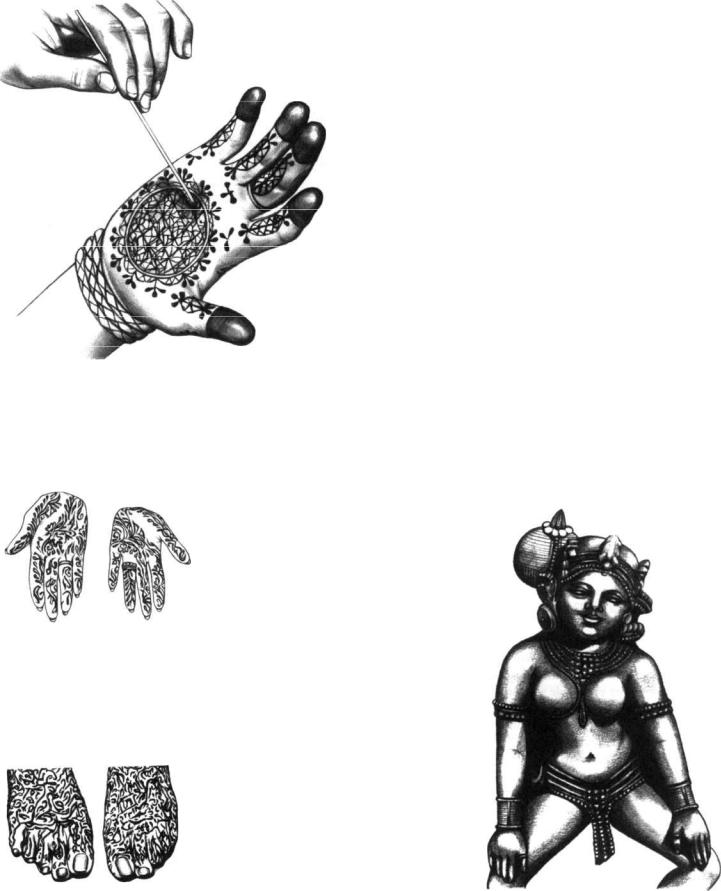
Painting the hands of women with henna or red dye is common to many Oriental cultures. It is particularly associated with marriage rites and ritual love-making. From a contemporary photograph.
Many different designs have evolved from basic floral patterns. From a contemporary photograph of an Indian marriage ceremony.
The feet of women are colored with henna or red dye. Patterns are drawn with great care and are considered an essential part of bridal ceremonies in India. From a contemporary photograph.
symbols. Other parts of the body,
especially the |
areas |
w h e r e |
||
forces are concentrated, like |
||||
the navel, |
heart, |
throat, |
||
forehead, |
and palms of |
|||
the hands, may also be |
||||
o r n a m e n t e d . |
Such |
|||
practices are both aes- |
||||
thetically pleasing |
and |
|||
erotically stimulating, |
||||
helping |
to |
capture |
the |
|
imagination. |
They |
add |
||
magic and intimacy to the |
||||
relationship. |
Furthermore, |
|||
the degree of concentration necessary to successfully apply body makeup will assist in gaining ascendancy over the ever-wandering
mind.
For Tantric rites of high magic, the body is bathed and lightly oiled, and then dusted all over with ashes. Wood ash contains valuable trace minerals in a finely divided state, easily absorbed through the skin. Pure ash from selected hardwoods (for example, oak) has an invigorating and insulating effect on the body, protecting it against psychic disturbances. Once the wood ash is applied, exact marks (usually groups of three parallel lines) are made on the lower legs, thighs, forearms, upper arms, between the sexual region and the navel, across the navel, the middle of the chest, the throat and the forehead—usually with a powder or ointment made from crushed sandalwood, herbs, cereal grains, or intoxicating ingredients. Then the Third Eye, or another symbolic mark, is painted right in the middle of the forehead, rising upward to the middle parting of the hair. The female partner may also have these marks applied, together with the ashes, but the most common custom is for the man to look terrific (with ash and marks) and the woman to look seductive and sensual (face makeup, with parts of the body such as the forehead, throat, nipples, navel, Yoni, hands, and feet colored red). The po - tential inherent in the union of male aggression and female receptivity is activated by the careful and dramatic use of makeup, prior to and during ritual love-making.
The color red is known to effectively stimulate the male sex center. This explains the predominance of red in female facial cosmetics. The Chinese and Japanese, among other evolved cultures, saw in the natural
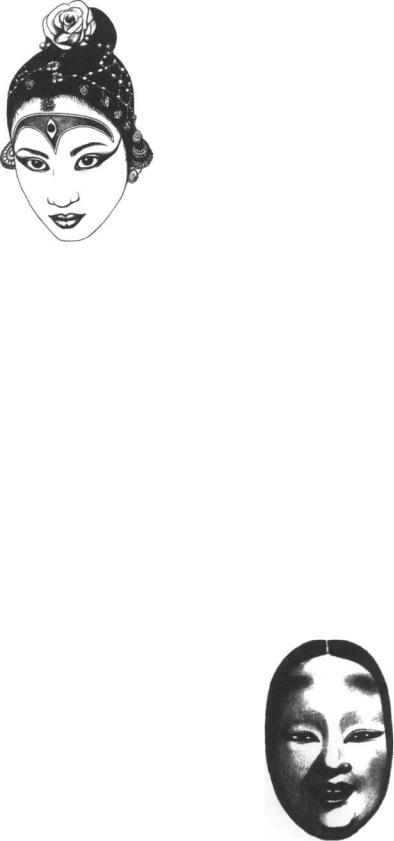
contrast between the skin's pallor (often itself accentuated by white makeup) and the rosy tinge of cheeks and lips, a reminder of the symbolic interplay of red and white ma- teriality-producing forces and accentuated this in their theatrical masks.
Eye shadow also originally had a purpose that has been largely forgotten. Besides accentuating the eyes' natural brightness, shape, and beauty, dark colors absorb reflected light. Kohl, an Eastern product used for this purpose, if properly prepared, has a cooling and therapeutic effect on the eyes. The correct preparation is made from the soot of precious medicinal substances, such as camphor. Recent pharmacological research suggests that camphor stimulates the respiration, heart, and cerebral cortex, and has a powerful effect on activating memory. Furthermore, scientific tests show that special preparations of camphor can increase clairvoyance. Tantric texts include special formulas for preparing extra-potent kohl by burning camphor with other volatile substances, sublimating the smoke on the outside of a metal pot filled with cold water. The Tantric kohl is scraped off the pot and used on the eyes, forehead, and other regions of the body.
Tantric Yogini with body ornaments symbolic of the Five Elements (space, air, fire, water, and earth). From a Pala stone sculpture of the ninth century, Hirapur Yogini Temple, Orissa.
188 Vishnu the Preserver