Материал: 2425
Scores are objective and unbiased. Tests are scored anonymously by ETS-certified experts.
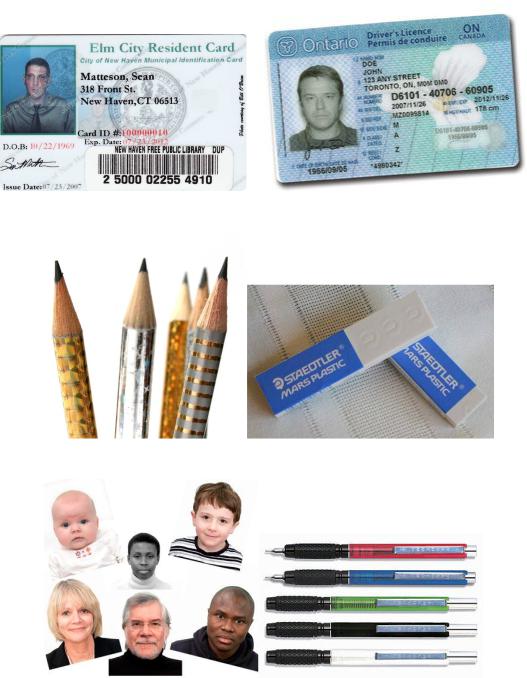
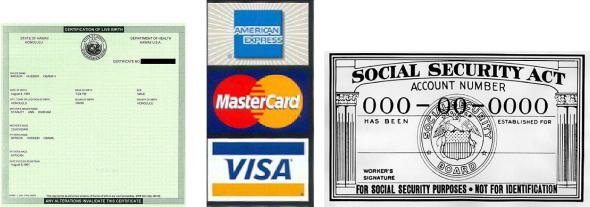
17. Match the words and the pictures (pic. 16, a – i):
a) sharpened pencils; |
b) ID; |
c) credit card; |
d) mechanical pencils; |
e) eraser; |
f) birth certificate; |
g) driver’s license; |
h) photograph; |
i) social security card. |
Pic. 16, a |
Pic. 16, b |
Pic. 16, c |
Pic. 16, d |
Pic. 16, e |
Pic. 16, f |
88
Pic. 16, g |
Pic. 16, h |
Pic. 16, i |
18. What things listed above do you think should be brought on test day? Read the following information and compare it with your answer.
What to Bring on Test Day
You must bring the following documents, information and supplies with you on test day:
1.A valid ID with your name, signature and photograph. The name on the document(s) must be the same name you used when you registered. ID will be checked before you are admitted.
2.Your admission ticket with your registration number and the codes for the institutions you select as score recipients.
3.Your signed photo-file record, with a recent, recognizable photo.
4.3 or 4 sharpened No. 2 or HB pencils and an eraser. Mechanical pencils are not permitted.
Please arrive at least 30 minutes early. If you are late, you may not get in and could lose your test fee.
Do not bring any of the documents listed below.
These documents will NOT BE accepted on test day:
Any expired ID;
Birth certificate;
International driver's license;
Draft classification card;
International student ID;
Credit/debit card of any kind;
Notary-prepared letter or document;
Social Security card;
89
Employee ID card;
Learner's permit or any temporary ID (e.g., driver's license);
Photocopy of ID.
19. Before you start reading explain the words in italics and then match them with the synonyms from the box. Then read the text and try to retell all the main points to your partner. You may use the
words below. |
|
|
|
|
|
|
schedule |
test |
score |
|
statement |
||
scratch paper |
|
assistance |
personal items |
ban |
||
|
|
|
|
|
||
timetable |
examination |
belongings |
affirmation |
|||
prohibition |
draft |
mark |
help |
|
|
|
What to Expect on Test Day
The following information will help you understand test center guidelines, policies and procedures.
Test center administrators cannot make schedule changes.
Friends or relatives are not allowed in the test center during the test.
You should dress comfortably for any room temperature.
You are required to write (not print) and sign a confidentiality statement at the test center. You cannot test without it. Your fees will NOT be refunded.
Your picture will be taken and placed at your assigned station and on your score report.
Scratch paper is provided and must be returned at the end of the session.
If you have a problem with your computer or need assistance, raise your hand.
Testing premises are subject to videotaping.
Personal Items
You will receive instructions on where to put personal items.
If you bring them into the testing room, they will be collected by test center staff.
If you do not follow directions, you cannot take the test.
Any violation of this procedure may result in cancellation of your scores, dismissal by the test center staff, or banning from future testing. Test
90
centers and ETS assume no responsibility for personal items or devices that you bring into the center.
Seating
The test administrator will assign you a seat.
Timing
The TOEFL PBT (paper-based test) takes about 3½ hours.
Each section has a time limit. If you finish a section early, you cannot go to another section.
20. There are two types of TOEFL: the computer-based and paperbased tests. Read the text and find the answers to the questions:
-What is the most popular test format?
-What is checked during the test?
-What types of questions are there in the test?
-What is the total score?
-What rating does an essay receive?
The computer-based test
The length of this test is flexible. It depends how long you take to answer the questions.
The computer-based test was taken by more than 300,000 people in 1998-1999. There are over 300 centres around the world offering the test on computer.
Before you take the test there are seven tutorials on how to use a computer to take the test. These are NOT part of your test.
The test has four sections:
listening, structure, reading, writing.
The listening and structure sections use mostly multiple-choice questions. Full instructions are given on how to answer the questions.
The reading section has comprehension questions on reading passages.
In the writing section you have 30 minutes to write a composition.
The paper-based test
This test lasts less than 3 hours.
91
There are three sections and each section has a minimum of 140 questions.
The three sections are:
listening comprehension, structure and written expression, reading comprehension.
All the questions are multiple-choice.
Scoring
If you take the computer-based test you will be able to see your scores for listening and reading immediately. Your exact scores for the other sections will not be available immediately as your writing will need to be marked.
For the computer-based test you will receive four scaled scores: Listening (0-30), Structure/Writing (0-30), Reading (0-30), and a total score (0-300). The essay will receive a rating between 1 and 6.
If you take the paper-based test you will receive a score with a maximum of 677.
If you had a chance to take TOEFL, what format would you choose? Why?
21. Work in 4 groups. Read the following advice for improving your reading/listening/speaking/writing skills and tell the rest of the group what you should do.
Group 1. Reading skills
1. Read as much and as often as possible in English.
-Read texts on a variety of topics. (Read both academic and non-academic materials. Read about subjects that interest you and that DON’T interest you.)
-Write basic questions to test your understanding of a text. (Write questions and answers about the first paragraph. Then guess what might be discussed in the next paragraph.)
-Use your knowledge of grammar to try to comprehend difficult sections of a passage. (Think carefully about the relationship between independent and dependent clauses. Look at pronouns and find the nouns that they refer to. Look at relative pronouns (who, that, which, whom, whose) used in adjective clauses (for example, The student whose classmates are taking the TOEFL test....) and find the nouns they refer to.)
2. Continually expand your vocabulary knowledge.
-It is important to increase your vocabulary on many subjects because you
92