Материал: npe
Indications:
For the treatment of malaria in the acute period (malarial fever, malarial coma), hematoschizotropic agents are used
For the prevention of distant relapses of the disease (radical cure), patients who have had three or four days of malaria are treated with a histochizotropic agent acting on "dormant" schizonts (hypnozoites) - primaquine, the drug is prescribed according to the scheme.
For individual prophylaxis - chloroquine
For public prevention (especially three-day malaria) pyrimethamine + sulfadoxine (Fansidar).
FROMlaxity of labor; cardiac arrhythmias (in combination with digitalis drugs), whetherfever - derivatives of 4-methanolquinoline.
Malaria (tropical, three-day and four-day forms - for treatment and prevention) infectious polyarthritis, ankylosing spondylitis, glomerulonephritis, renal amyloidosis, paroxysmal atrial fibrillation, intestinal and extraintestinal forms of amoebic dysentery - derivatives of 7-chloroquinoline.
Contraindications:
Retinal diseases, Psoriasis, Porphyria.
Organic heart disease with arrhythmias, diffuse kidney damage, liver dysfunctions, blood diseases, psoriasis, diseases of the retina and cornea of the eye, pregnancy.
Diseases of the middle and inner ear, auditory nerve, optic nerve diseases, cardiac decompensation, blood diseases, pregnancy after 4 months.
Side effects:
With long-term use of drugs are possible:
decreased appetite, abdominal pain, erythema, urticaria, headache, dizziness, sometimes tinnitus, sleep disturbances, nausea, vomiting, baldness, hair graying, blurred vision, corneal edema, irreversible changes in the retina (narrowing of the arteries, edema and yellow atrophy spots, scotoma).
Ticket 37
Basic principles (mechanisms) of action of medicinal substances. Their interaction with receptors.
M- and M, H-cholinomimetic substances. Classification. Mechanism of action. Indications for use. Side effects. Contraindications Comparative evaluation of drugs. Muscarine poisoning, measures of assistance.
Antihypertensive drugs of central neurotropic action. Classification. Mechanism of action. Side effects. Contraindications Comparative evaluation of drugs.
Antibiotics of the penicillin group... Classification. Mechanism of action. Side effects. Contraindications Comparative evaluation of drugs.
1. Basic principles (mechanisms) of action of medicinal substances. Their interaction with receptors.
Pharmacodynamics is a section of general pharmacology that studies the features of the effect of drugs on the body.
The mechanisms of action of drugs are the ways in which substances cause pharmacological effects. The main mechanisms of action of medicinal substances include:
1. Physical.The action of a medicinal substance is associated with its physical properties. For example, activated carbon is specially processed, and therefore has a high surface activity. This allows it to absorb gases, alkaloids, toxins, etc.
2. The mechanism of direct chemical interactionThis is a fairly rare mechanism of drug action, the essence of which is that the drug directly interacts with molecules or ions in the body. Such a mechanism of action is possessed, for example, by the drug unitiol, which belongs to the group of antidotes.
3. Membrane (physical and chemical).It is associated with the effect of drugs on ion currents (Na +, K +, Cl -, etc.), which determine the transmembrane electric potential. By this mechanism, drugs for anesthesia, antiarrhythmic drugs, local anesthetics, etc.
4. Enzymatic (biochemical).This mechanism is determined by the ability of some drugs to have an activating or depressing effect on enzymes. The arsenal of drugs with such a mechanism of action is very wide. For example, anticholinesterase drugs, monoamine oxidase inhibitors, proton pump blockers, etc.
5. Receptor... In the human body, there are highly specific biologically active substances (mediators) that interact with receptors and change the functions of certain organs or tissues of the body. When drugs interact with receptors, biochemical and physiological changes occur in the body, accompanied by one or another clinical effect
The ability of a substance to bind to cell receptors is called affinity1. Affinity is due to the fact that the spatial configuration of the drug can resemble the configuration of the endogenous ligand of this receptor. Intrinsic activity is the ability of a drug to cause receptor activation.
Allocate:
1. Agonists or mimetics are substances that, by binding to receptors, are capable of activating them, which causes the development of a response characteristic of this type of receptor.
2. Antagonists or blockers are medicinal substances that bind to receptors, but do not cause their activation (ie, their intrinsic activity is zero). Antagonists shield cytoreceptors and prevent the development of a response under the action of endogenous agonists.
3. Partial agonists are substances that bind to receptors and cause their activation, however, even if they occupy all receptors, these substances are not able to induce a maximum response for this type of receptor.
2. M- and M, H-cholinomimetic substances. Classification. Mechanism of action. Indications for use. Side effects. Contraindications Comparative evaluation of drugs. Muscarine poisoning, measures of assistance.
I. M-cholinomimetics:
one) Pilocarpine (ocular forms only)
2) Acyclidine (ophthalmic forms, tablets, injections.)
Mechanism of action: stimulates m-cholinergic receptors. They stimulate the central nervous system, narrow the pupil, reduce IOP, accommodation spasm, narrow the bronchi, bradycardia, increase the tone of smooth muscles in the bladder and uterus, increase the secretion of sweat glands, increase the tone of smooth muscles of the gastrointestinal tract, peristalsis.
Indications: glaucoma, intestinal atony, paralytic intestinal obstruction, xerostomia.
Contraindications: bronchial asthma, conduction disturbances in the myocardium, epilepsy, hyperkinesis, pregnancy.
Side effects: hyperexcitability, tremor, bradycardia, bronchospasm, spasm in the gastrointestinal tract and urinary tract, diarrhea, increased uterine tone.
II.M, H-cholinomimetics:
- Acetylcholine (only in experiments, quickly degrades)
- Carbocholine (eye forms only)
Mechanism of action: They act on both M- and H-cholinergic receptors, but the effect on H-cholinergic receptors is weak. The effects are the same as those of M-cholinomimetics.
Indications:
Glaucoma only.
Side effects and contraindications:
Like M-cholinomimetics.
Muscarine poisoning, measures of assistance: Use M-anticholinergics, most often atropine.
3. Antihypertensive drugs of central neurotropic action. Classification. Mechanism of action. Side effects. Contraindications Comparative evaluation of drugs.
Classification:
I GENERATION:
1) Central alpha-2 receptor stimulants:
-CLOFELINE
-GUANFACIN
2) Centrally acting sympatholytics:
-METHYLDOPA
-RESERPINE
Side effects: Drowsiness, lethargy, depression.
II GENERATION:
1) Stimulants of central imidazoline receptors:
-MOXONIDINE
Side effects: To a lesser extent, they depress the central nervous system, less often cause dry mouth, weakness, dizziness.
Mechanism of action: Reduces the activity of the vasomotor center and hypothalamic centers of vascular regulation.
Contraindications: hepatitis, liver cirrhosis, depression, parkinsonism.
Moxonidine - used once a day, there is no sedative effect.
Methyldopa - dilates blood vessels, slows the heart rate, improves cerebral circulation, sodium and water retention.
Reserpine - Slow action, maximum 2-4 weeks.
4. Antibiotics of the penicillin group... Classification. Mechanism of action. Side effects. Contraindications Comparative evaluation of drugs.
Classification: Natural (biosynthetic)
Parenteral: short-acting (3-4 hours) benzylpenicillin sodium salt
long-acting (depot-penicillin): benzylpenicillin novocaine salt, bicillin 1.5
Oral: phenoxymethylpenicillin
Semi-synthetic: a) resistant to penicillase: oxacillin, nafcillin, cloxocillin.
b) Broad spectrum of action: ampicillin, amoxicillin
c) A broad spectrum of action with antipseudomonal activity: carbenicillin
d) Inhibitor-protected: amoxiclav, trifamox, tazocin, tymentin.
e) Combined: ampiox.
Mechanism: inhibit the synthesis of cell wall components, prevent the formation of peptide bonds.
Mode of action: bactericidal, affect only dividing cells.
Spectrum e: gram (+) predominantly staphylococci, streptococci, meningococci, gonococci, spirochetes, clostridia, causative agents of diphtheria, anthrax, listeria.
Indications: upper respiratory tract infections (scarlet fever), erysipelas, rheumatism, pneumonia, meningitis, endocarditis, syphilis, leptosporosis, anaerobic infections.
Side effects: allergies, dysbiosis, glossitis, stomatitis, dyspepsia.
Contraindications: individual intolerance, allergies.
Benzylpenicillins act briefly (3-4 hours), bicillin - long-term (once every 7-14 days, months). Oxacillin is resistant to penicillinase, it is destroyed in an acidic environment. Nafcillin penetrates the BBB. Ampicillin is destroyed by penicillinase, acid-resistant. Carbenicillin is destroyed in an acidic environment and by penicillinase.
Benzylpenicillin is widely used in pediatrics because low toxicity, it can be administered in large doses. Not effective when taken by mouth, even in young children with low gastric acidity. Penicillin is a GABA antagonist and can cause seizures when given in large doses. The younger the child, the greater the risk of developing seizures. Ampicillin, when administered orally, causes diarrhea in a third of children. Oxacillin is capable of impairing liver function.
Ticket 38
Basic principles of first aid for acute drug poisoning
Beta-blockers. Classification. Mechanism of action. Side effects. Contraindications Comparative evaluation of drugs.
Hormonal contraceptive drugs. Classification. Mechanism of action. Side effects. Contraindications Comparative evaluation of drugs.
Antiblastoma Wed-va. Classification. Mechanism of action. Side effects. Contraindications Comparative evaluation of drugs
1. Basic principles of first aid for acute drug poisoning.
Emergency care for acute poisoning consists in the combined carrying out of the following therapeutic measures:
- accelerated elimination of toxic substances from the body;
- specific therapy that favorably alters the transformation of a toxic substance in the body or reduces its toxicity;
- symptomatic therapy aimed at protecting and maintaining the body function that is predominantly affected by this toxic substance.
At the scene, it is necessary to establish the cause of the poisoning, find out the type of toxic substance, its amount and the route of entry into the body. If possible, find out the time of poisoning, the concentration of the toxic substance in the solution or the dosage in medicines.
In case of poisoning with toxic substances taken internally, before the arrival of the doctor, immediately begin gastric lavage to prevent further absorption of toxic substances into the blood. It is necessary to force, if possible, the victim to drink up to 5 liters. water at room temperature in portions of 300-500 ml. Drinking a lot of water causes vomiting.
If vomiting does not occur, then they resort to irritating the root of the tongue and the bottom of the pharynx with something soft. After an attack of vomiting, the patient should rinse his mouth and drink water again. This is repeated 4-5 times. Then it is recommended to put a cleansing enema.
In severe forms of poisoning in unconscious patients (poisoning with sleeping pills, etc.), the victim is placed on his stomach, in extreme cases - on his side with his head turned upside down. If there are vomit in the oral cavity, they are immediately removed (you can use a finger wrapped in a damp handkerchief) and make sure that they do not accumulate. The patient needs to be warmly covered and monitored.
When breathing stops and cardiac activity stops, immediately begin artificial respiration "mouth-to-mouth" or "mouth-to-nose" and closed heart massage. If you need to do both, then it is better to do it together.
2.
Beta-blockers.Classification.
Mechanism of action. Side effects. Contraindications Comparative
evaluation of drugs.
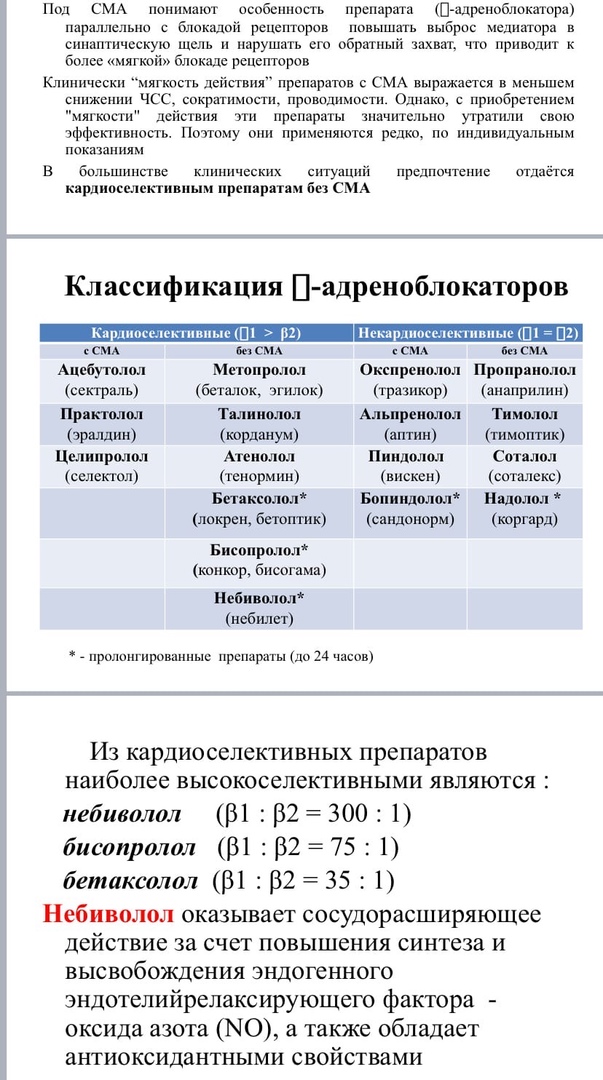
Mechanism of action: blockade of beta-adrenergic receptors of the heart, blood vessels, bronchi. I cause bradycardia, reduce the force of heart contractions, reduce the minute volume of the heart, blood pressure gradually decreases, the effect develops in 2-3 weeks.
Indications: paroxysm, tachycardia, atrial fibrillation, angina pectoris, hypertension.
Side effects: increase the tone of the bronchi (not possible with bronchial asthma), nausea, vomiting, bradycardia, allergies, depression.
Contraindications: bradycardia, heart failure, bronchial asthma, diabetes mellitus, pregnancy.
Anaprilin - reduces heart rate and heart rate, increases bronchial tone, can provoke bronchospasm. Blocks the metabolic effects of catecholamines.
Oxprenolol - less likely to cause bronchospasm.
Metoprolol - affects mainly the beta1-adrenergic receptors of the heart, is used orally for arterial hypertension.
Talinolol - does not affect the bronchi, does not cause orthostatic collapse.
3. Hormonal contraceptive drugs. Classification. Mechanism of action. Side effects. Contraindications Comparative evaluation of drugs.
Classification:
1) combined estrogen-gestagens,
2) drugs with microdoses of gestagens.
Of the estrogens, ethinyl estradiol is used, gestagens are different (norethindrone, norgestrel, levonorgestrel).
Estrogen-gestagens: monophasic drugs - doses of estrogens and gestagens are constant (microginon, minisiston, rigevidon, femoden), 2-phase (anteovin), 3-phase (tricvilar, triziston, triregol).
Mechanism: suppress ovulation as a result of a decrease in FSH and pituitary LH. The condition of the ovaries is similar to that of menopause. In the endometrium - regression in the 2nd phase, which prevents the implantation of the egg. Cervical mucus becomes more viscous, sperm are less active. The contraceptive effect is 100%.
Side effects: increased blood clotting, impaired liver fugation, decreased glucose tolerance, headache, engorgement of the mammary glands, changes in libido, nausea, bleeding, weight gain.
Contraindications: thromboembolism, stroke, tumors of the reproductive system and mammary glands, liver disease, diabetes mellitus, psychosis.
Microdoses of gestagens - continuin, microlut.
Mechanism: change the composition and amount of cervical mucus, reduce sperm activity, reduce the rate of transport of the egg through the fallopian tubes, endometrial regression, suppression of the hypothalamic-pituitary system. The contraceptive effect is lower. Side effects - bleeding, nausea, headache, depression.
Emergency contraception - postinor (increased dose of gestagen), escapel. Apply after intercourse (1-2 days).
Long-acting drugs - gestagen medroxyprogesterone acetate (once every 3 months) - gives bleeding, norplant (under the skin for 5 years).
For men - gossypol (inhibits spermatogenesis), side effects - hypokalemia, irreversible infertility.